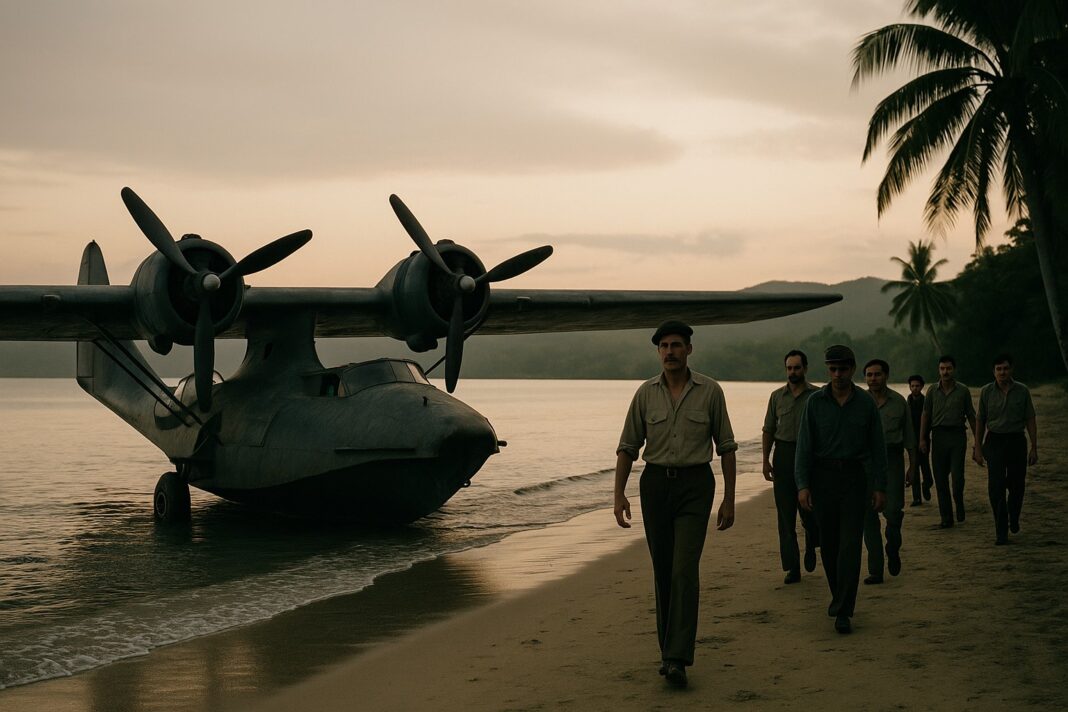
When the sun fell over Luperón Bay on that June 19, 1949, the sky witnessed a scene that seemed taken from the most audacious pages of history, a Catalina seaplane broke the marine horizon and descended with determination over the calm waters of the Dominican north coast.
It carried no tourists or commercial cargo, but rather a group of men determined to give their lives for freedom. They were Dominicans, Central Americans, and North Americans who, in the name of human dignity, came to challenge the most feared regime in the Caribbean, "the dictatorship of Rafael Leónidas Trujillo".
Every June 19th, Dominican history remembers with respect and solemnity the brave men who starred in a heroic expedition in search of freedom. The Luperón Uprising of 1949, although frustrated in military terms, sowed a seed of hope and resistance in the heart of the Dominican people.
That day marked the beginning of a broader struggle against oppression, led by determined men who did not hesitate to risk their lives for the cause of freedom.
The context: a dictatorship that stifled the country
In 1949, the Dominican Republic was under the absolute control of dictator Rafael Leónidas Trujillo, who had ruled since 1930 with an iron fist. The regime was sustained by a structure of systematic repression that eliminated any form of dissent. There was no freedom of expression or real political participation. The right to vote existed only in appearance and all opposition was stifled with imprisonment, torture or assassination.
Total state control, the persecution of social and political leaders, the fear instilled in the citizenry, and absolute censorship were part of daily life. Faced with this panorama, changes from within were impossible. It was then that Dominicans in exile began to organize, with the aim of overthrowing the dictatorship from abroad.
The Expedition: An Act of Valor
On June 19, 1949, a group of patriots tried to break the apparent invulnerability of the dictatorship. The operation, meticulously organized from Guatemala, aimed to introduce armed men by air to Dominican territory. The plan included three planes loaded with combatants and weapons flying from Guatemala to different points in the country.
However, the execution encountered various obstacles.
Only one of the planes, a Catalina model seaplane, managed to partially fulfill its mission and landed in the bay of La Gracia, in the municipality of Luperón, Puerto Plata, around 7 o'clock at night. The other two aircraft were diverted and ended up in Cozumel, Mexico. Despite the reduction in forces, the expeditionaries who managed to touch Dominican soil were not intimidated.
The group was composed of Dominicans, Nicaraguans, a Costa Rican, and U.S. citizens. The Catalina crew included pilot John M. Chewing, co-pilot Habet Joseph Maroot, and engineer George Raymond Scruggs.
Among the Dominican combatants were figures such as Horacio Julio Ornes Coiscou
(leader of the operation and commander of the Liberation Army), José Rolando Martínez Bonilla, Federico Horacio Henríquez Vásquez (Gugú), Hugo Kundhardt, Manuel Calderón Salcedo, Salvador Reyes Valdez, Tulio Hostilio Álvaro Delgado and Miguel Ángel Feliú Arzeno.
The expedition was completed by Alejandro Selva, Alberto Ramírez and José Félix Córdoba Boniche, all Nicaraguans, and the Costa Rican Alfonso Leiton.
Confusion, clashes, and death
After the landing, the expeditionaries began to move on land. But in the midst of darkness and tension, fatal errors arose. In Luperón, the town lights mysteriously went out, plunging the combatants into a chaos that triggered accidental clashes among them.
Costa Rican Alfonso Leiton was mortally wounded by a shot to the neck. In another unfortunate episode, Nicaraguan Alberto Ramírez lost his life after an exchange of fire with Dominican Hugo Kundhart, who was injured but survived momentarily.
The wounded bodies were taken back to the Catalina seaplane, hoping to preserve their lives. However, the forces of the regime had already been alerted. A patrol boat of the Trujillo government attacked the aircraft violently, causing its destruction.
Alberto Ramírez, Salvador Reyes Valdés, and Hugo Kundhart were burned to death in the fire. The dream of liberating the nation vanished in flames.
Heroes Who Survived and Persisted
Among the survivors of that tragic night are names that would later continue the fight for freedom: Horacio Julio Ornes Coiscou, Tulio Hostilio Arvelo Delgado, José Rolando Martínez Bonilla, Miguel Ángel Feliú Arzeno and the Nicaraguan José Félix Córdoba Boniche.
Feliú Arzeno, in fact, would die a decade later in another libertarian attempt: the expedition of June 14, 1959, when again exiled Dominicans tried to overthrow the Trujillo regime.
These survivors became living symbols of resistance. Their determination did not wane, and their experience became a testament to what it meant to face one of the most ruthless dictatorships in the hemisphere.
International Support
The Luperón Uprising did not arise from nothing. It was the result of years of organization and commitment from exile. In Costa Rica, Horacio Julio Ornes founded the "Legion Caribe", a revolutionary alliance of Central American and Caribbean exiles united against the tyrannies that plagued their respective countries. Ornes was also a protagonist in the taking of Puerto Limón in 1948, strengthening his reputation as a strategist determined to liberate the Dominican people.
The plan also had key backing: Don Juan Rodríguez, a Dominican exile, was one of the main financiers of the expedition.
Likewise, the President of Guatemala, Dr. Juan José Arévalo, offered Guatemalan territory, weaponry, and military advice, demonstrating an international solidarity that contrasted with the indifference of other nations towards the dictatorships of the Caribbean.
A Lasting Legacy
Today, on the anniversary of the Luperón Uprising, the country remembers not only a failed military attempt, but a supreme expression of courage. The men who landed that night did not know if they would be received as liberators or exterminated as enemies. However, they accepted the risk with honor, guided by the hope of a future without chains.
Although the dictatorship did not fall on June 19, 1949, the actions of these men revived the spirit of resistance. It was a spark that, years later, would contribute to igniting the definitive fire that would end Trujillo's regime in 1961. 
 Spanish