

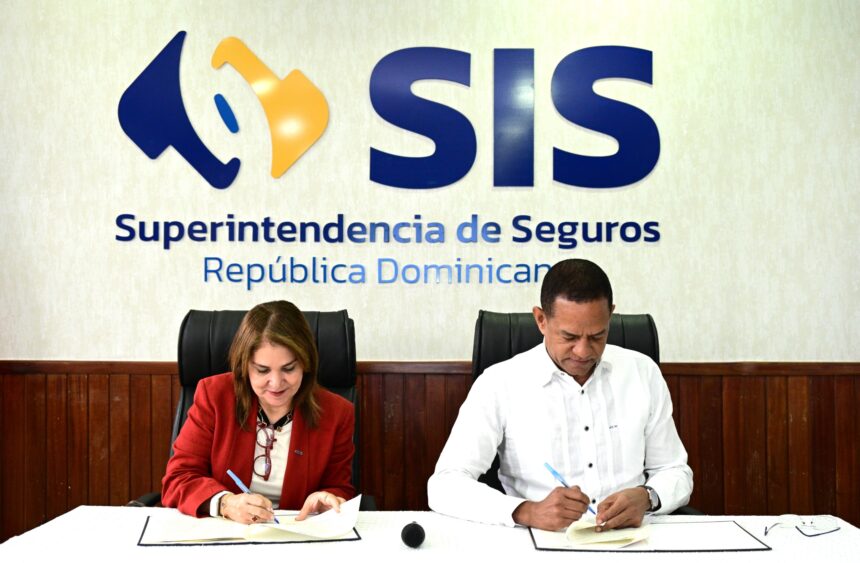
Santo Domingo.- The Superintendency of Insurance (SIS) and the Ibero-American University (UNIBE) signed a collaboration agreement aimed at promoting specialized training, knowledge exchange, and the professional development of personnel linked to the insurance sector.
The agreement was signed by the Superintendent of Insurance, Julio César Valentín Jiminián, and the Administrative Vice-Rector of UNIBE, Grace Cochón, who were accompanied by the Insurance Intendant, Francisco Campos; the Director of Anti-Money Laundering of the SIS, Lillian Báez Ureña, as well as by advisors and directors of the substantive areas of the institution.
Also participating for UNIBE were Loraine Amell, Vice-Rector of Outreach; Maribel Medina, Director of Continuing Education; Marien de Moya, Head of Outreach; and Hayley Olivo, professor and coordinator of the specialized program in Insurance Management.
During her participation, the Administrative Vice-Rector of UNIBE, Grace Cochón, highlighted the importance of the agreement, considering that it responds to the university’s mission to strengthen alliances between the public and private sectors, academia, and society, especially in fundamental areas such as the prevention of money laundering.
“We are very satisfied to contribute to training on this subject, which contributes significantly to financial stability and transparency in the country’s economic sphere. We have been developing these programs for several years, but having the endorsement of the Superintendency of Insurance represents a very important support for us,” he highlighted.
For his part, Superintendent Julio César Valentín Jiminián emphasized the importance of human talent training as a fundamental pillar for the development of the insurance sector and the country, while also valuing UNIBE’s academic contribution to the national insurance ecosystem.
You can also read:
“We hope that this alliance will be fruitful and become part of the legacy of both institutions, contributing to laying the foundations for building a better country, where every sector has people endowed with up-to-date knowledge. And there is no one better than academia to contribute to that purpose. When we speak of academia, we speak of one that is distinguished by its quality and excellence, such as UNIBE,” he expressed.
Specialized training to respond to the needs of the sector
More Read


The purpose of the agreement is to contribute to the strengthening of the compliance culture, solvency, and professionalization of the insurance sector, through greater coordination between academia and the regulatory body, for the benefit of the integrity of the national financial system and the protection of policyholders.
Within this framework, both institutions will promote the exchange of experiences, knowledge, personnel, and best practices in areas of common interest, as well as the development of academic and continuing education activities.
UNIBE will develop specialized programs with an emphasis on the prevention of money laundering, the financing of terrorism, and the financing of the proliferation of weapons of mass destruction, in addition to content related to the actuarial function applied to the insurance sector.
The university will also grant scholarships to the technical and administrative staff of the SIS and will provide physical spaces for the development of the activities planned in the agreement.
For its part, the Superintendency of Insurance will provide teachers and experts to give lectures, modules, courses, workshops, and other academic activities, contributing its experience and technical knowledge in the areas of its competence.
Likewise, it will provide technical and institutional support to the initiatives developed within the framework of the alliance. Both entities may share information and teaching materials, as well as collaborate on other activities of common interest, in accordance with their capabilities and internal regulations.
More Read

With this collaboration, the Superintendency of Insurance and UNIBE seek to contribute to ensuring that the insurance sector has professionals better prepared to respond to its current challenges, raise performance standards, and promote greater protection for policyholders.