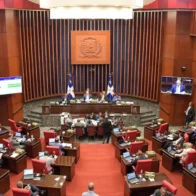


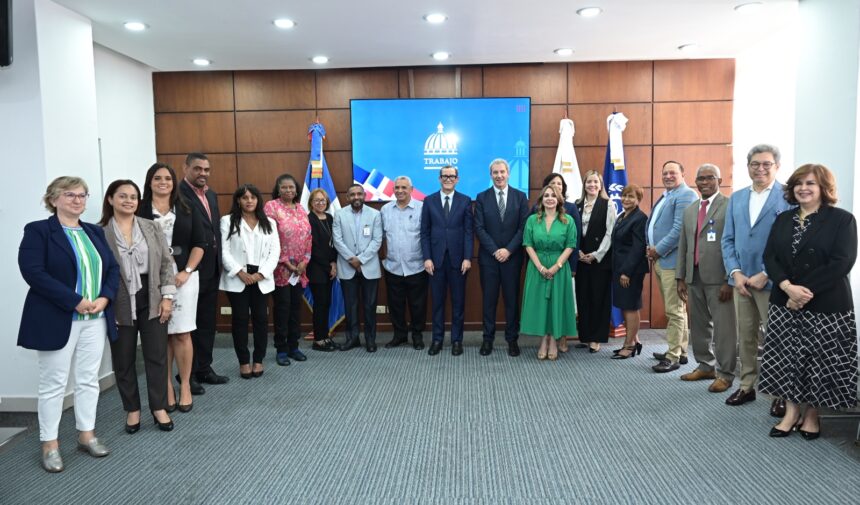
The Ministry of Labor reaffirmed this Tuesday its commitment to the generation of decent employment, the formalization of the labor market, and the strengthening of social dialogue during the celebration of the third tripartite session of the Monitoring Committee for the Decent Work Program of the Dominican Republic 2027-2029.
The initiative promoted together with the International Labour Organization (ILO) to strengthen social justice and promote decent work, brought together representatives from the Government, the employer sector, and workers to evaluate the progress of the program and consolidate actions aimed at promoting more formal employment opportunities, expanding social protection, and ensuring better working conditions for the population.
At the opening of the session, the Minister of Labor, Eddy Olivares, highlighted that decent work constitutes the foundation of the country’s economic and social development, while identifying informality as one of the main challenges to achieving a more competitive and inclusive economy.
“Decent work will always be a cardinal aspect of any development process. Formality is an indispensable requirement to guarantee jobs with dignity, social protection, job security, equal opportunities, and respect for workers’ rights,” stated Olivares.
The minister stressed that the Decent Work Program synthesizes the aspirations of millions of Dominicans throughout their working lives, by promoting productive jobs with access to social security, safe work environments, and spaces where equality and freedom of association and collective bargaining prevail.
More Read

For his part, the ILO director for Central America, Panama, and the Dominican Republic, Eliel Hasson, stated that the session represents much more than an institutional act, as it reflects a firm political and technical will to place decent work at the center of the national development strategy.
Hasson also highlighted the growing leadership of the Dominican Republic in international arenas linked to the labor sector. “It is no coincidence that President Luis Abinader participated in the International Labour Conference held in 2025 in Geneva, nor that the Dominican Republic will chair the Council of Ministers of Labor of Central America next year. All of this evidences the country’s leadership in the construction of labor policies promoted by the ILO,” he noted.

On behalf of the business sector, Laura Peña Izquierdo, president of the Dominican Republic Employers’ Confederation (COPARDOM), noted the business community’s support for the Decent Work Program, considering it the main instrument of cooperation between the ILO, the Government, and social actors to promote a labor agenda that fosters economic growth, the generation of productive jobs, social protection, and the strengthening of social dialogue.

Meanwhile, Santos Sánchez, representative of the labor sector, highlighted that tripartism continues to be the fundamental axis for building consensus, strengthening labor peace, and consolidating a climate of social stability that favors the country’s development.
During the meeting, the objectives and work methodology were presented, the Tripartite Monitoring Committee—a political and technical body that will move forward with drafting the Program document—was reactivated, and the schedule that will guide the process until its launch was validated.
The Decent Work Country Programme identifies the priorities regarding employment, labor rights, social protection, and social dialogue, which have been agreed upon in a tripartite manner by governments, employers’ organizations, and workers’ organizations in the country. At the same time, it constitutes the ILO’s programming instrument at the national level.
This tool aligns with the National Development Strategy, the United Nations Sustainable Development Cooperation Framework, and the strategic plans of the Dominican State. Likewise, it promotes synergies and brings together different sources of funding to achieve joint results of greater scope and impact. Development cooperation is a central piece of these initiatives.
The deputy ministers of Employment, Leonardo Gil, of Labor Regulation, Domingo Santana, and of Mediation, Union and Business Affairs, Maritza Contreras, general directors of the institution, and the ILO technical team, among others, participated in the session.