
 Spanish

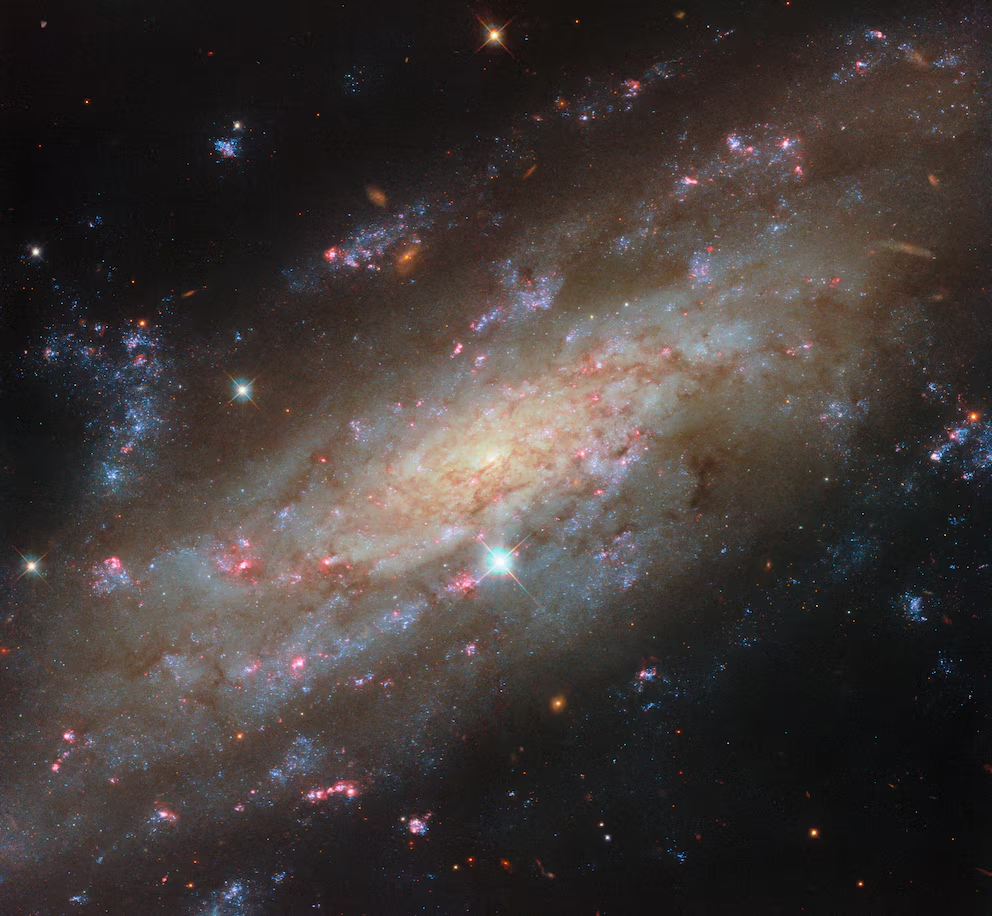

The NASA and ESA's Hubble Space Telescope has revealed with unprecedented precision the structure of NGC 3137, a spiral galaxy located 53 million light-years away. This observation, built from six different color bands, offers a key perspective to understand the development and life cycle of stars.
According to NASA, NGC 3137 is located in the constellation Antlia (The Air Pump).
Researchers have identified the existence of more than 500 candidate dwarf galaxies within this environment, although the definitive catalog of these smaller groupings is still under review, reported the Hubble scientific team.
Scientists catalog more than 500 dwarf galaxies in the vicinity of NGC 3137, providing data on cosmic evolution (Infobae Illustrative Image)
Through the study of this galactic group, scientists can analyze fundamental questions about the dynamics and internal evolution of our own Milky Way, providing an essential comparative mirror for contemporary astronomy.
In one of the most detailed observations, the Hubble camera managed to capture the silhouette and structural details of NGC 3137 thanks to its inclination with respect to Earth. This orientation allowed researchers to appreciate its "diffuse and feathery spiral structure", a quality that distinguishes this galaxy from others observed by the telescope over three decades of operations.
We recommend reading:Hubble Telescope captures a spiral galaxy with an irregular shape
One of the most outstanding aspects of the recent photographic record is the central core of NGC 3137. The Hubble has confirmed the presence of a supermassive black hole whose mass is estimated to be 60 million times that of the Sun, according to the NASA report. In the images, this bright center appears surrounded by an intricate network of fine dust clouds. The relationship between the black hole and the star-forming regions is a matter of study to understand the evolutionary processes of spiral galaxies.
The image also documents other relevant objects in the visual field: some Milky Way stars in the foreground are distinguished, briefly intersecting the same line of sight, as well as background galaxies much more remote. The analysis of star clusters in 55 galaxies will help compare the evolution of spiral systems in the nearby universe (Illustrative Image Infobae) The main interest of the current observation campaign (program no. 17502, under the direction of principal investigator D. Thilker) lies in the analysis of the dense clusters of blue stars and the glowing red gas clouds that dot NGC 3137. These formations indicate the existence of young and hot stars still enveloped in their birth nebulae, as documented by the Hubble scientific team. In the words of NASA, "star clusters in the galaxy grab all the attention" because they constitute direct records of stellar life in different phases: from the formation of new stars to the oldest stellar populations, born in the early years of their host galaxy's life. The study is part of a broader campaign that includes observations of star clusters in 55 nearby galaxies, which will allow for comparison and contrast of stellar evolution in spiral systems with similar characteristics. As the Hubble team pointed out, a spiral galaxy is characterized by a rotating disk and curved arms that emerge from a dense central region. This structural model defines both NGC 3137 and the Milky Way itself, reinforcing the value of these studies for understanding the history and projection of our galaxy. The Hubble redefines the study of spiral galaxies with high-resolution images and findings in Andromeda, NGC 1073, and NGC 1300