 Spanish
We recommend reading: Colombia will have a second round between Abelardo de la Espriella and Iván Cepeda
A Childhood in Exile
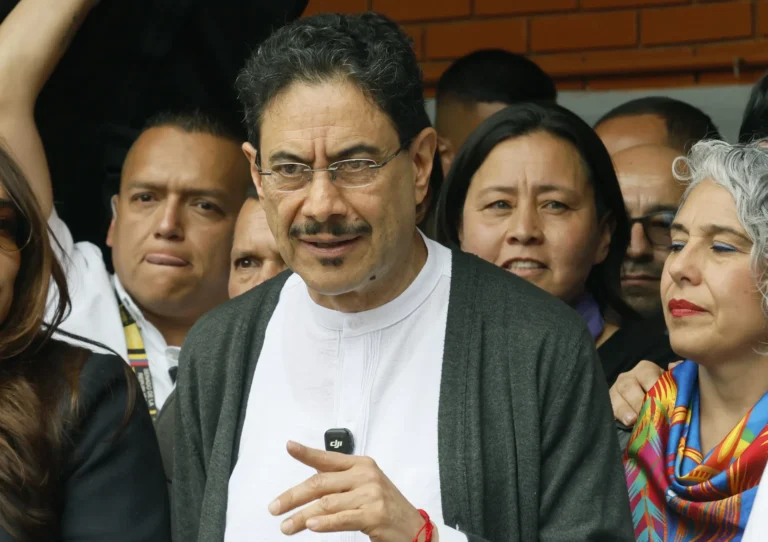
Iván Cepeda was born in Bogotá on October 24, 1962, and grew up in a family marked by left-wing political militancy and the violence that plagued Colombia for decades. During his childhood, he lived in Cuba and in the former Czechoslovakia with his family, and years later he was exiled again in France due to threats for his work in defense of human rights. In Europe, she pursued a master's degree in International Humanitarian Law at the Catholic University of Lyon (France), after graduating in Philosophy from the University of St. Clement of Ohrid of Sofia, in communist Bulgaria during the years of the Iron Curtain. The murder of his father made him one of the most visible voices in denouncing the extermination of the Patriotic Union, a party whose members were victims of assassinations, disappearances, and forced displacement during the 80s and 90s of the last century.The defense of the victims
Before arriving at Congress, Cepeda worked with social and victims' organizations and was one of the founders of the National Movement of Victims of State Crimes (Movice). His political career began in 2010, when he was elected representative to the House for Bogotá by the Alternative Democratic Pole. Four years later he arrived at the Senate, a corporation to which he has been re-elected ever since. Cepeda's national notoriety grew especially due to the debates he promoted in Congress on paramilitarism and alleged links between politicians and businessmen with illegal armed organizations. Those accusations led to a direct confrontation with former President Álvaro Uribe (2002-2010) and one of the most relevant and polarizing judicial processes in recent Colombian politics, which brought the former president to the brink of prison. The process turned Cepeda into the great opponent of Uribism and reinforced a political discourse focused on leaving behind "the politics of fear and war," as he has said during the campaign. Between 2012 and 2016, Cepeda participated as a facilitator in the peace negotiations between the Colombian Government and the former FARC guerrilla that led to the agreement signed during the presidency of Juan Manuel Santos (2010-2018). Likewise, he participated in approaches with the guerrilla of the National Liberation Army (ELN) and in processes of submission to justice of illegal armed groups. The presidential project In this campaign, Cepeda has proposed to deepen Petro's social reforms, accelerate the implementation of the peace agreement, and reinforce the policies of protection for social leaders and communities affected by violence. In its Government program, it proposes to advance towards "three peaceful revolutions: ethical, economic and political", in addition to strengthening the agrarian reform, the energy transition and peace negotiations with armed groups.You can also read:Registrar Hernán Penagos responded to Gustavo Petro and defended the guarantees of the elections: “Absolute tranquility”
Her running mate for the vice presidency is indigenous senator Aída Quilcué, a defender of the rights of indigenous peoples and communities affected by the armed conflict. In this campaign, the political space of the left in Colombia has been consolidated in a scenario still marked by polarization, the persistence of armed conflict in several regions, and tensions surrounding the legacy of the current government.
