
 Spanish

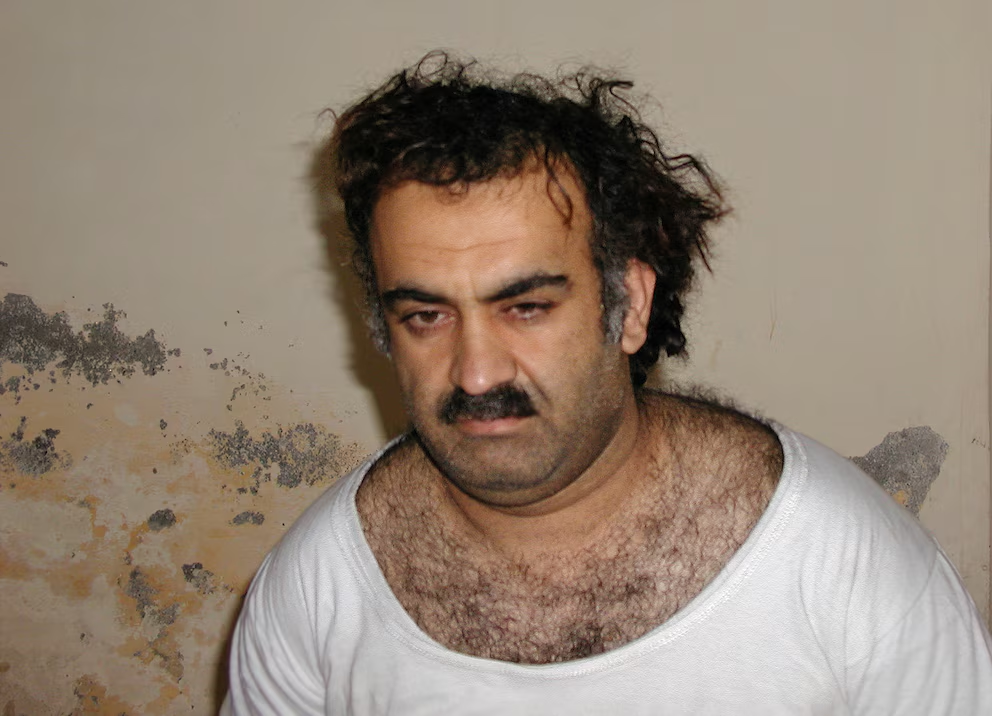

A U.S. federal appeals court on Friday overturned an agreement that allowed Khalid Sheikh Mohammed (KSM), accused of being the mastermind of the September 11, 2001 attacks, to plead guilty in exchange for avoiding the death penalty, according to official media reports.
The ruling, issued by the Federal Court of Appeals for the District of Columbia Circuit, represents a new turn in the prolonged legal process against the main defendants of the Al Qaeda attack that left nearly 3,000 victims in New York and Washington.
The plea agreement, negotiated over two years and approved by both military prosecutors and the highest authority at the Pentagon for Guantanamo Bay, provided for life imprisonment without the possibility of parole for Mohammed, Walid bin Attash, and Mustafa al-Hawsawi, considered relevant accomplices. As part of the deal, the accused were to answer questions from the victims' families, with the aim of clarifying outstanding aspects of the attack.
However, former Defense Secretary Lloyd Austin revoked the agreement in July 2024, arguing that the decision on the maximum penalty in a case of such dimensions should rest solely with the Secretary of Defense. Austin stated that "American families and the public deserve the opportunity to see the military commission trials carried out," according to the court ruling. Defense lawyers argued that the agreement already had legal validity and that Austin's intervention, under the Joe Biden administration, was late. A military judge in Guantanamo and a military appeals panel agreed with the defense and declared the agreement valid in November.
The appeals court panel, composed of judges Patricia Millett and Neomi Rao, finally determined, by a majority of two votes to one, that Austin acted within his powers and criticized the decision of the lower military judge. The vote was supported by Millett, appointed by Barack Obama, and Rao, by Donald Trump. For his part, judge Robert Wilkins, also appointed by Obama, expressed in his dissenting vote that the Government “ has not been remotely close to clearly and indisputably demonstrating that the military judge was wrong”.
The agreement, originally announced in July 2024, generated negative reactions among some family members of the victims of the attacks. Following the cancellation by Austin, the Department of Justice supported the measure and requested the District of Columbia Court of Appeals to prevent the military commissions from proceeding with the procedures related to the pact. After the presidential change, the new Republican administration maintained the appeal and the court decided to suspend the proceedings while evaluating the case.
The annulment of the agreement means that the legal proceedings against Mohammed and his co-defendants will continue without a quick resolution in sight. They face charges since 2012 for terrorism, aircraft hijacking, conspiracy, murder in violation of the law of war, attacks against civilians, and intentional serious bodily injury. An eventual trial could last for at least 18 months, according to the forecasts expressed to EFE by the then coordinator of the defenses at Guantanamo, Brigadier General Jackie Thompson. One of the recurring challenges in the judicial process has been to resolve whether the accused can receive a fair trial after having been subjected to torture while in the custody of the CIA, a question that the plea agreement would have avoided addressing. Mohammed, a former engineer and considered one of Osama bin Laden's most trusted men, was captured in Pakistan in March 2003 and remained for three years in secret CIA prisons before being transferred to Guantanamo in 2006. The Guantánamo detention center was created after the attacks to house terrorism suspects outside of US legal jurisdiction. It held nearly 800 prisoners at its peak; it currently maintains only a fraction of that number, following the progressive repatriation of inmates to various countries. The recent judicial decision hinders the closure of a legal process marked by more than two decades of legal and logistical difficulties, and delays an outcome for one of the most significant trials related to the national security of the United States. SOURCE: INFOBAE