
 Spanish

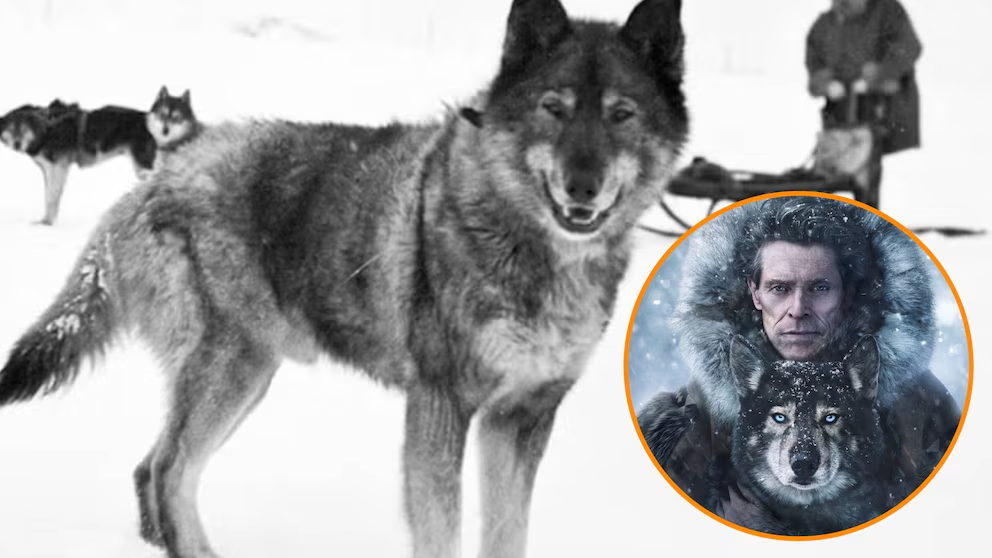

A movie based on real events is among the most viewed on Netflix. It's Togo, a story that recounts the fundamental role of a dog in the serum run to Nome, Alaska, in 1925.
The production, originally released by Disney in 2019 and which has been part of the streaming platform's catalog since December 2025, revives one of the most remembered events in the history of the United States, centered on the figure of an animal that spent years in anonymity.
During the winter of 1925, the remote port of Nome, in Alaska, faced a critical situation due to a diphtheria epidemic. More than 10,000 people inhabited that city, located under extreme conditions of isolation.
With the disease spreading among children and adults, and the scarcity of an effective antitoxin, the authorities were forced to seek a solution kilometers away.
 Togo was initially considered a weak dog, but his actions during the epidemic transformed his destiny and that of his trainer, Seppala (Sigrid Seppala Hanks Collection, Carrie M. McLain Memorial Museum)
Throughout the 20th century, various efforts sought to reclaim Togo's place in the history of the "serum run." In 1983, the dog's dissected body was placed at the headquarters of the Iditarod Trail Sled Dog Race, a competition that covers part of the original 1925 route.
Two decades later, in 2001, he obtained his own statue in Seward Park, New York.
Seppala's figure is also remembered among institutions in the United States. Since 1967, the year of his death, the "Leonhard Seppala Humanitarian Award" has been presented during the Iditarod, a distinction reserved for the musher who best cares for their dogs during the race.
The cast, led by Willem Dafoe as Leonhard Seppala and Julianne Nicholson in the role of Constance Seppala, contributed to the drama of the story. In the film, the protagonist dog is played by Diesel, a direct descendant of Togo. The film accurately reproduces the risks and obstacles overcome by Seppala's team, from the brittle ice to the fierce polar wind (Credits: Disney)
Almost a century later, the true scope of the journey led by Seppala and his inseparable companion continues to attract public interest. "I thought of the ice, the darkness and the irony that when Nome needed life, only the dogs could deliver it," Seppala wrote, as quoted by the American Kennel Club.
Togo was initially considered a weak dog, but his actions during the epidemic transformed his destiny and that of his trainer, Seppala (Sigrid Seppala Hanks Collection, Carrie M. McLain Memorial Museum)
Throughout the 20th century, various efforts sought to reclaim Togo's place in the history of the "serum run." In 1983, the dog's dissected body was placed at the headquarters of the Iditarod Trail Sled Dog Race, a competition that covers part of the original 1925 route.
Two decades later, in 2001, he obtained his own statue in Seward Park, New York.
Seppala's figure is also remembered among institutions in the United States. Since 1967, the year of his death, the "Leonhard Seppala Humanitarian Award" has been presented during the Iditarod, a distinction reserved for the musher who best cares for their dogs during the race.
The cast, led by Willem Dafoe as Leonhard Seppala and Julianne Nicholson in the role of Constance Seppala, contributed to the drama of the story. In the film, the protagonist dog is played by Diesel, a direct descendant of Togo. The film accurately reproduces the risks and obstacles overcome by Seppala's team, from the brittle ice to the fierce polar wind (Credits: Disney)
Almost a century later, the true scope of the journey led by Seppala and his inseparable companion continues to attract public interest. "I thought of the ice, the darkness and the irony that when Nome needed life, only the dogs could deliver it," Seppala wrote, as quoted by the American Kennel Club.
The only accessible remedy was in Nenana, 1,085 kilometers from Nome, which forced an improvised and risky delivery through dog sled teams.
Togo's Central Role and the Most Extensive Route
Among the selected teams, Leonhard Seppala, a renowned musher of Norwegian origin, and his lead dog, Togo, a 12-year-old Siberian Husky, were considered the main hope of the expedition. According to the American Kennel Club (AKC), Seppala and Togo completed the most extensive relay route, totaling about 425 kilometers, while the average distance covered by each team was around 50 kilometers. The Disney+ movie, directed by Ericson Core and starring Willem Dafoe —in the role of Seppala—, recounts the challenges faced during the journey, including the crossing over the treacherous Norton Sound and the extreme cold conditions. "After thinking about the ice and the darkness and the terrible wind... when Nome needed life in small packages of serum, it was the dogs who carried it there," Seppala wrote in his autobiography, as quoted by the AKC. The film narrative portrays the bond between the musher and his dog, as well as the initial conflicts. During his youth, Togo was a sickly dog and was more of a burden than a support dog. For this reason, he was given away to a neighbor due to his apparent weakness. However, Togo demonstrated unexpected tenacity when, after being given away, he escaped by jumping out a window and traveled several kilometers to return to Seppala's house.Togo was overshadowed by Balto
Despite the magnitude of the feat, Togo was not the dog that received immediate recognition. The final stretch of the race, about 85 kilometers (53 miles), was completed by the team led by Balto, another dog born in the same kennel as Seppala and guided by the musher Gunnar Kaasen.
The fame of the feat fell on Balto, who obtained a statue in Central Park and multiple public mentions, with Togo being relegated for decades to the background. The film argues that Balto's notoriety was the result of fortune and circumstance, given the greater distance and dangers overcome by Togo. It is said that the latter was leading the most complex and dangerous part of the expedition, managing to cross ice on the verge of breaking and helping his team after they got stranded on an iceberg. Togo revives these passages with fidelity to historical records, avoiding exaggerations, even in the most dramatic sequences.Togo's Background and Late Recognition
Born in 1913, Togo was a sickly and restless puppy, according to the AKC history. He joined Seppala's team after escaping the house he was given to and has since demonstrated remarkable skills. After winning the All-Alaska Sweepstakes in 1915, 1916, and 1917, he gained local fame for his ability, although public consecration would come many years after the diphtheria outbreak. For many connoisseurs, Togo was the real hero.The journey led by the dog was not only more extensive, but also the most dangerous: “On the return through the Norton Sound, after being stranded on an ice floe, Seppala threw Togo the rescue rope, who was able to drag the entire team and save the supplies”, recalled the AKC.
After the feat, Togo lived to be 16 years old and died in Maine, where he was cared for by musher Elizabeth Ricker, a friend of the Seppalas; a fact that differs from the ending of the Disney biographical film, which suggests that the animal lived with its owner until the end.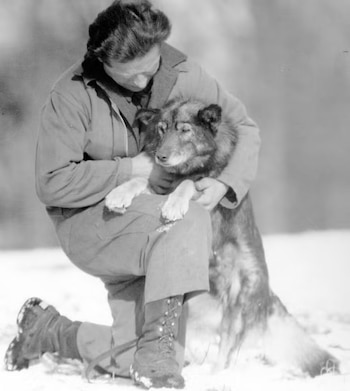 Togo was initially considered a weak dog, but his actions during the epidemic transformed his destiny and that of his trainer, Seppala (Sigrid Seppala Hanks Collection, Carrie M. McLain Memorial Museum)
Throughout the 20th century, various efforts sought to reclaim Togo's place in the history of the "serum run." In 1983, the dog's dissected body was placed at the headquarters of the Iditarod Trail Sled Dog Race, a competition that covers part of the original 1925 route.
Two decades later, in 2001, he obtained his own statue in Seward Park, New York.
Seppala's figure is also remembered among institutions in the United States. Since 1967, the year of his death, the "Leonhard Seppala Humanitarian Award" has been presented during the Iditarod, a distinction reserved for the musher who best cares for their dogs during the race.
The cast, led by Willem Dafoe as Leonhard Seppala and Julianne Nicholson in the role of Constance Seppala, contributed to the drama of the story. In the film, the protagonist dog is played by Diesel, a direct descendant of Togo. The film accurately reproduces the risks and obstacles overcome by Seppala's team, from the brittle ice to the fierce polar wind (Credits: Disney)
Almost a century later, the true scope of the journey led by Seppala and his inseparable companion continues to attract public interest. "I thought of the ice, the darkness and the irony that when Nome needed life, only the dogs could deliver it," Seppala wrote, as quoted by the American Kennel Club.
Togo was initially considered a weak dog, but his actions during the epidemic transformed his destiny and that of his trainer, Seppala (Sigrid Seppala Hanks Collection, Carrie M. McLain Memorial Museum)
Throughout the 20th century, various efforts sought to reclaim Togo's place in the history of the "serum run." In 1983, the dog's dissected body was placed at the headquarters of the Iditarod Trail Sled Dog Race, a competition that covers part of the original 1925 route.
Two decades later, in 2001, he obtained his own statue in Seward Park, New York.
Seppala's figure is also remembered among institutions in the United States. Since 1967, the year of his death, the "Leonhard Seppala Humanitarian Award" has been presented during the Iditarod, a distinction reserved for the musher who best cares for their dogs during the race.
The cast, led by Willem Dafoe as Leonhard Seppala and Julianne Nicholson in the role of Constance Seppala, contributed to the drama of the story. In the film, the protagonist dog is played by Diesel, a direct descendant of Togo. The film accurately reproduces the risks and obstacles overcome by Seppala's team, from the brittle ice to the fierce polar wind (Credits: Disney)
Almost a century later, the true scope of the journey led by Seppala and his inseparable companion continues to attract public interest. "I thought of the ice, the darkness and the irony that when Nome needed life, only the dogs could deliver it," Seppala wrote, as quoted by the American Kennel Club.




