
 Spanish

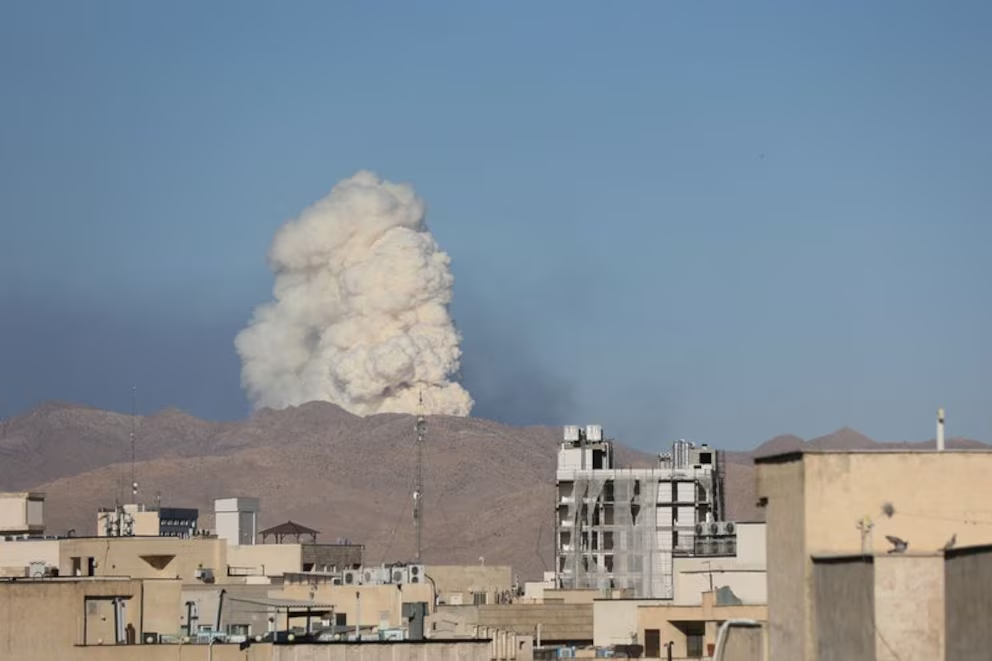

The Israeli Army confirmed this Thursday that it had shot down dozens of Iranian soldiers in an attack launched against a unit that was carrying out repairs to missile launch systems in the west of the country.
In a statement, the military portfolio reported that "Air Force planes have destroyed engineering equipment and eliminated dozens of Iranian Army soldiers operating in the attack zone," in line with the trend seen in recent days by the enemy, to "try to restore these missile storage launch systems" that were damaged in the first days of the clashes.
"The Air Force continues to operate in the Iranian sky to eliminate threats directed at the Israeli rear. The Israel Defense Forces (IDF) will not allow the Iranian regime to re-establish its missile launch infrastructure," the statement promised in that regard.
The episode in western Iran happened shortly after the Defense Forces confirmed that, during the early hours, they had launched another large-scale air offensive, directed against multiple Iranian military targets. Among the targets of the operation was the Arak heavy water nuclear reactor, which plays a central role within the Persian atomic program, especially for its ability to produce plutonium.
According to Israeli military sources, 40 fighter jets participated in the offensive, using more than 100 guided munitions, all directed with information gathered by the Israeli Military Intelligence Directorate, with the aim of preventing the central facility from being restored and used for the development of nuclear weapons.
"The nuclear reactor in the Arak area, in Iran, was attacked, including the structure of the reactor core seal, a key component in the production of plutonium," the Army stated, while Iranian state television announced that the reactor had been evacuated before the bombing and "there is no radiation hazard."
Next to this installation, Benjamin Netanyhau's troops also attacked a site specializing in the development of nuclear weapons in the Natanz region, also with the capacity to accelerate the development of the enemy program.
Finally, other points associated with the production of ballistic missiles, air defense systems, radars, anti-missile batteries and ground-to-ground missile depots were hit in the last few hours.
The operations this Thursday represented the seventh consecutive day of Israeli bombings on critical infrastructure in Iranian territory. These actions were carried out in response to the sustained advancement of the Persian nuclear program and following the military escalation that began last Friday, June 13, the date on which a strong exchange of missiles was reported after the first air attack by the IDF on Tehran and other regions.
In response to these offensives, the Persian regime has also been launching its own offensives against the Jewish State, although in its case it focuses on civilian and residential targets.
In fact, in the last few hours, Iran launched a ballistic missile against the Soroka Medical Center, the largest in southern Israel, causing extensive damage and leaving several injured, according to official sources.
"During a war, I believe one must choose words carefully and execute actions with precision. Our goal is twofold: nuclear and ballistic. We are going to eliminate them. We are in the process of eradicating this threat," Netanyahu said during a visit to the site in which he condemned what happened and promised to defeat the enemy.





