
 Spanish

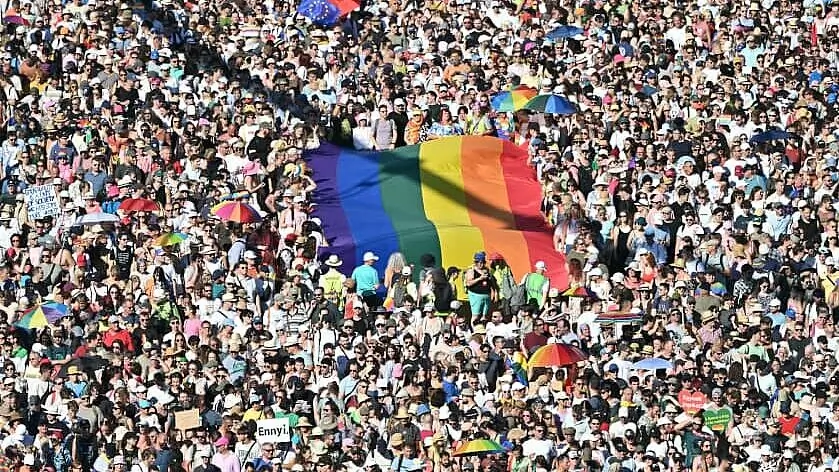

Several European civic organizations are requesting in a letter sent to the European Commission that the application of a law regulating the use of real-time facial recognition systems be suspended at prohibited events such as the Pride March in Pécs, southern Hungary, scheduled for this Saturday.
The signatories assert that the law promoted by the government of Prime Minister, the ultranationalist Viktor Orbán, provides for fines for participants in unauthorized marches and allows the use of real-time facial identification systems, prohibited by community legislation.
Therefore, they request that the European Commission initiate an "urgent" procedure, asking the Court of Justice of the European Union to "take precautionary measures to ensure that the laws cannot continue to be applied until a judgment is issued."
The letter was drafted by organizations such as the Hungarian Union for Fundamental Rights (TASZ), the international association of civil rights organizations European Digital Rights (EDRI), and the European Center for Not-for-Profit Law (ECNL).
Hungarian police have banned the Pécs Pride March, announced for October 4, a measure that was confirmed by the supreme court of the Central European country.
The march organizers assure that the concentration will take place despite the prohibitions.
Legal amendments promoted by Orbán's government and approved last April prohibit the organization of events that represent and "promote" homosexuality, alluding to the development of minors that the conservative executive considers "appropriate".
One of these reforms provides for fines of up to 500 euros against participants in prohibited marches and authorizes the police to use real-time facial identification systems.
The document sent to the President of the European Commission, Ursula von der Leyen, and other members of the Community executive indicates that the use of these devices is specifically prohibited according to European legislation on Artificial Intelligence.
Furthermore -they add-, the amendments represent "a denial of freedom of expression", violate human dignity and constitute "direct discrimination" against the LGTBI community.
On June 28th, Budapest City Council organized the Pride March, in which, despite a ban, at least 200,000 people participated, making the event the largest demonstration against Orbán's government.