
 Spanish

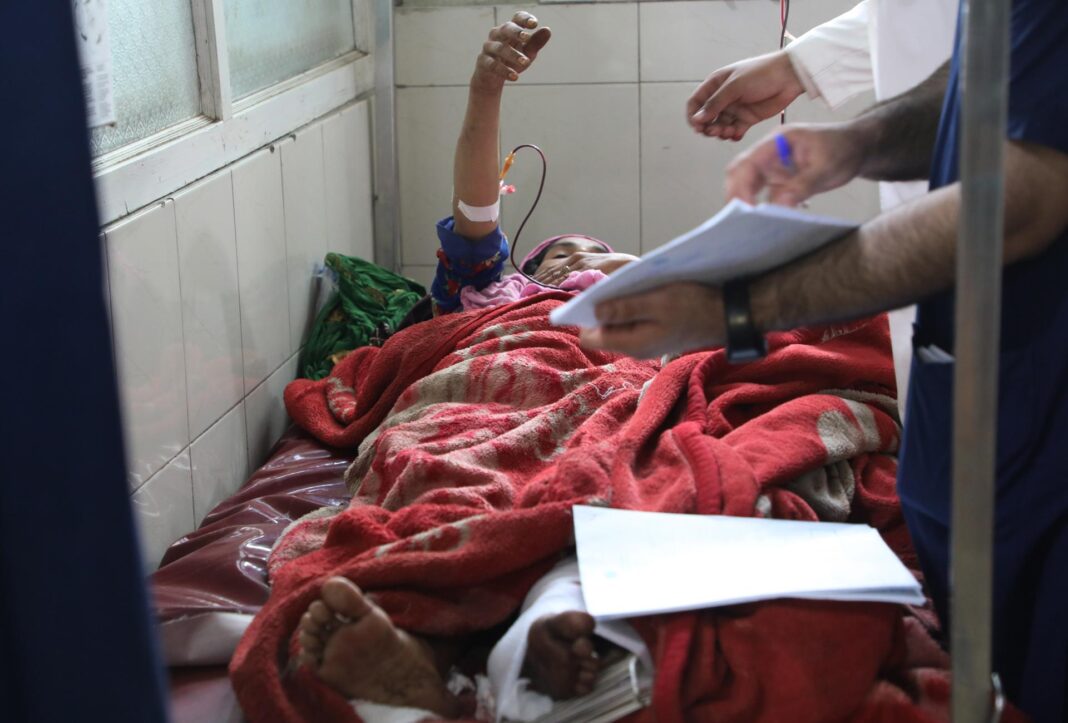
Jalalabad (Afghanistan).- After the 6.0 magnitude earthquake that shook eastern Afghanistan, the death toll rises to at least 800 dead and 2,800 injured, while hospitals remain overwhelmed and victims continue to arrive from villages and mountains where people are still trapped under the rubble.
"Today is the second day since the earthquake, more than 32 hours have passed, and the injured are still arriving," explained to EFE Dr. Sharif Khamosh, from the Regional Hospital of Nangarhar, in Jalalabad, the capital of one of the most affected states.
Nationals
Vendors highlight high flow of buyers at the Inespre Great Agricultural Fair
Santo Domingo.– Vendors participating in the Gran Feria Agropecuaria del Instituto de Estabilización de Precios (Inespre) stated that since its opening, a high flow of people has been registered, which has significantly boosted sales and confirms the population's interest in acquiring food at affordable prices. Merchants consulted pointed out that since the early hours of […]
Prisons Director says those involved in the Senasa case are isolated from other inmates: "If they take them there, they'll be pecked at."
Santo Domingo.– The general director of Penitentiary and Correctional Services (DGSPC), Roberto Santana Sánchez, revealed this Friday that Santiago Hazim and the others involved in the Senasa case are isolated from the rest of the prison population in the Las Parras prison, for security reasons. “They are separated from the common population. The prisoners say […]
Edeeste and Pgase dismantle another illegal connection in a hotel in Higüey
Higüey. – The Eastern Electricity Distribution Company (Edeeste) and the Deputy Attorney General for the Electrical System (Pgase) report that they continue dismantling irregular connections through extensive inspection operations in various commercial establishments, this time in the Villa Francisca sector, Higüey municipality, La Altagracia province. In this operation, which also involved the Superintendency of Electricity […]
Court validates Rafael Calderón's medical leave after receiving a report from Inacif
Santo Domingo.- The Fourth Instruction Court of the National District confirmed this Thursday the validation of the medical license granted to former senator Rafael Calderón after receiving the corresponding report from the National Institute of Forensic Sciences (Inacif). Magistrate Altagracia Ramírez, presiding judge of the court, reported that the medical examiner appointed by the court […]
Two suspects arrested for participating in the kidnapping of a person in Higüey
Santo Domingo.- The Public Ministry arrested, along with the National Police, a married couple considered among the "dangerous" members of a network dedicated to kidnapping and money laundering. Tairi Vásquez Severino and her partner Jhan Carlos Rivera Martínez were arrested by the Specialized Anti-Money Laundering and Terrorism Financing Prosecutor's Office and the Prosecutor's Office of […]
Sports
Rays trade Shane Baz to the Orioles for four prospects and a draft pick
Tampa, Florida.– The Baltimore Orioles acquired right-handed pitcher Shane Baz from the Tampa Bay Rays in exchange for a package of four prospects and a Competitive Balance Round A pick, the club reported this Friday. In the transaction, Tampa Bay receives outfielder "Slater de Brun", catcher "Caden Bodine", right-handed pitcher "Michael Forrest" and also outfielder […]
Athlete Commission concludes its first forum "Vision beyond the goal"
SANTO DOMINGO.- The Athletes Commission of the Dominican Olympic Committee concluded this Tuesday the First Athletes Forum “Vision beyond the goal”, which was held for two days at the Olympic Hostel with the participation of about 200 athletes from different disciplines. You may be interested in:Detroit and RD: tickets available from today; here are the prices […]
May 2025 left indelible marks on American sport
Sports Writing (EFE).— The month of May 2025 was marked as one of the most intense and memorable on the sports calendar in America, with historic comebacks, absolute consecrations and world-class protagonists such as Carlo Ancelotti, Álex Palou, Shohei Ohtani, Saúl ‘Canelo’ Álvarez, as well as the teams Oklahoma City Thunder and Indiana Pacers. You […]
Adolis García agrees to one-year contract with the Phillies
PHILADELPHIA.- The Philadelphia Phillies reached an agreement for one season and $10 million with free agent outfielder Adolis García, as confirmed by a source to MLB.com. The club has not yet made the official announcement of the deal, which was initially reported by journalist Francys Romero. You may be interested inr: Soto returns to wear […]
Johan Rojas responds to boos and avoids controversy over statements about Lidom umpires
Santo Domingo.- The Giants of Cibao outfielder, Johan Rojas, spoke after last night's game and reacted to the boos he received from the Tigres del Licey fans, assuring that he is not affected and that, on the contrary, he takes it as an additional motivation on the field. “Well, I never… I haven't been the […]
Technology
An Ariane 6 rocket launches two new Galileo system satellites from Guiana.
Science Writing- An Ariane 6 rocket from the European Space Agency (ESA) has taken off from the spaceport in French Guiana with two new satellites on board that will join the Galileo constellation and provide greater robustness to the European navigation program, which serves more than half of the world's population. At 5:01 (GMT), as […]
OpenAI denies responsibility for a young man's suicide after interacting with ChatGPT
Technology
EFE -
0
New York .- The technology OpenAI has denied being responsible for the suicide of a 16-year-old who took his own life after interacting with ChatGPT for months, and has attributed his case to an "improper use" of the tool. "The injuries and damages alleged by the plaintiffs were caused or contributed (…) by the misuse, […]
NASA launches three missions to map the heliosphere and study the solar wind
Technology
EFE -
0
Miami (USA).- NASA launched three missions into space this Wednesday that seek to map the heliosphere, the layer that surrounds and protects the solar system, to critically monitor space weather and to study how the Earth's upper atmosphere responds to the solar wind. The three missions took off from Florida on a SpaceX Falcon 9 […]
Nvidia: From Video Games to the World's Summit as a Colossus of Artificial Intelligence
Nvidia is no longer just a graphics card manufacturer. The company founded in 1993 by Jensen Huang, Chris Malachowsky, and Curtis Priem, which was born with the vision of bringing 3D graphics to video games, has become the most valuable company on the planet, surpassing Apple and Microsoft with a capitalization of around $4.3 trillion. […]
Apple equips its AirPods with translation in English, Spanish, Portuguese, French, and German
Technology
EFE -
0
New York.- Apple equips its AirPods with live translation in English, Spanish, Portuguese, French, and German thanks to its new operating system, iOS 26, which launches this Monday on compatible devices. Starting today, the AirPods Pro 2 and AirPods 4 with noise cancellation, paired with iPhones compatible with Apple Intelligence - Apple's artificial intelligence - […]
International
The Pentagon conducted a military operation in Syria following the ISIS attack in which two US soldiers died
U.S. forces launched an operation against the Islamic State in Syria in response to an attack in Palmyra that left three Americans dead, according to Pentagon chief Pete Hegseth on Friday. "U.S. forces initiated Operation Falcon Eye strike in Syria to eliminate ISIS fighters, infrastructure, and weapons depots in direct response to the attack on […]
Maduro creates his own Nobel Peace Prize and proclaims himself the winner
Venezuelan dictator, Nicolás Maduro, has proclaimed himself this Thursday as the winner of his invented award Architect of Peace, in allusion to the Nobel Peace Prize that the opposition leader María Corina Machado won last October. The ceremony took place in Caracas, within the framework of the commemorative activities for the 195th anniversary of the […]
Haiti's CPT acknowledges the end of its term, but seeks to maintain influence in the Executive Branch
Santo Domingo.- Less than two months before the official end date of its mandate, set for February 7, 2026, the Haitian Presidential Transition Council (CPT) acknowledged that its institutional cycle is nearing its end, although its members would not be willing to completely withdraw from control of the Executive Branch. As reported by the Haitian […]
Petro says that Nicolás Maduro should not give orders to the Colombian military
Bogotá.- The president of Colombia, Gustavo Petro, stated this Thursday that Nicolás Maduro should not give orders to the Colombian Army, in response to a call from the Venezuelan ruler for the military of the two countries to protect sovereignty. "No, he doesn't have to give orders to the military", Petro affirmed when asked if […]
Maduro insists on his call to the Colombian military to join Venezuela
Caracas.- The president of Venezuela, Nicolás Maduro, insisted this Thursday on his call to the Colombian military to join the people and the Venezuelan Armed Forces to defend sovereignty "as a single Army", in a context marked by the military deployment of the United States in the Caribbean Sea, rejected by both Caracas and Bogotá. […]
Entertainment
Alofoke Media Group celebrates its traditional Christmas party today
This Saturday, Alofoke Media Group celebrates its traditional Christmas party with its collaborators, a significant meeting in which the successes and achievements reached during the year 2025 are commemorated, and the commitment, dedication and effort of all its team throughout the year are recognized. The event was attended by the directors of Alofoke Media Group, […]
Wisin revives his beginnings by receiving his first car as a birthday gift
Wisin celebrated his 46th birthday this Friday with a very special surprise that awakened nostalgia and emotion in both him and his followers. The Puerto Rican artist, whose real name is Juan Luis Morera, shared the significant moment through his social networks, where he showed the gift that marked his birthday celebration. In the context […]
Chayanne concludes successful tour with more than 100 concerts globally
Puerto Rican artist Chayanne closes one of the most solid and successful moments of his career with the end of his international tour Bailemos Otra Vez, which began in August 2024 and which, since then, toured North America, Central America, South America and Europe, confirming that his connection with the public not only remains intact, […]
Bulletin 47 announces that it will give away a Christmas dinner to a low-income family
Santo Domingo, RD - Urban artist Bulín 47 announced that he will give away a Christmas dinner to a low-income family during his performance at the closing of the annual Medios Telemicro employees' party. The interpreter of "Lo Que Te Killa" stopped his presentation to share with the audience his desire to bring joy to […]
Caroline Aquino and Nahiony Reyes confirm their return to TV in 2026
Santo Domingo, RD - Caroline Aquino and Nahiony Reyes announced their long-awaited return to Dominican television for the year 2026, a piece of news that has generated great enthusiasm among the public. The announcement was made during the introduction of the celebration of the Telemicro media group's employee party, a setting in which both presenters […]
Opinion
When corruption is not protected by the presidential band
In the Dominican Republic, presidents don't fall because of the opposition. They fall because of something more intimate and devastating: their own family. When corruption shares the same last name as the presidential band, it ceases to be a case and becomes a sentence. It's not a contract that is judged: it's the entire credibility […]
We have a permanent constitutional back and forth
In 2015, an internal crisis within the Dominican Liberation Party (PLD) forced the leadership of that organization to promote a constitutional reform to enable President Danilo Medina, who had been elected in 2012 through a constitution that prohibited consecutive re-election. Medina was eligible to try to return in 2020, that is, after a period, a […]
When the slander is coordinated and clumsy
For days, Leonardo Aguilera has been the target of a campaign as evidently coordinated as it is poorly executed. Defamation, slander, and half-truths circulate on networks and certain media with suspicious synchronicity. Who's sending them? Who's biting their nails? The formula is old: fabricate scandals where they don't exist, repeat lies until they seem like […]
The TV changed in DR
In 2025, live news streaming via YouTube on smart TVs leaves traditional television behind and transforms news consumption in the Dominican Republic.By: Pavel De Camps Vargas Who's dominating your home screen today? It's not traditional television. In the Dominican Republic, YouTube has taken over the television in this 2025, redefining the map of news consumption. […]
¿To govern or campaign? Abinader made it difficult
"I am a tolerant and democratic president, but everything has a limit... We will continue to govern for the people and, for that reason, I say to all pre-candidates and their coordinators: proselitizing acts to officials are not allowed. If they want to campaign, they must leave their positions." Thus spoke the head of state, […]
Economy
AES Foundation and Supérate train another 152 "Super Entrepreneur Women"
The AES Foundation concluded a new cycle of the Women Super Entrepreneurs project, through a graduation activity that brought together 152 participants, who completed a training process aimed at strengthening their productive and business capacities. The initiative, developed in partnership with the Supérate Program, is implemented nationwide and has impacted 932 women in more than […]
Poultry farmers claim there is sufficient production to meet demand for Christmas and New Year
Santo Domingo,.- The Dominican Association of Poultry Farming (ADA) reported this Thursday that the national production of broiler chickens for this month reaches 24.7 million units, a volume that allows covering the expected demand and the supply of the market during the season of greatest consumption of the year, such as Christmas and New Year. […]
Dominican Republic to receive $566 million in loans from CAF
Santo Domingo.- The Development Bank of Latin America and the Caribbean (CAF) approved the granting of two loans to the Dominican Republic, totaling 566 million dollars, aimed at enhancing water security in the capital and the province of Santo Domingo, and modernizing the penitentiary system. The initiatives respond to strategic national priorities and will improve […]
The country registers 5,149,829 formal and informal jobs, states the Central Bank
Santo Domingo,.- The Central Bank stated this Monday that there are 5,149,829 people employed in the country, for a year-on-year increase of 2.4%, equivalent to 119,965 net employed compared to the July-September 2024 period. The employment rate, that is, the ratio between the total employed and the working-age population, stood at 63.1% for July-September 2025, […]
Judge considered the Senasa case as treason and a collective holocaust
As a grim, somber, scandalous, extremely serious, cruel to the extreme case, a kind of collective frenzy and collective holocaust, the permanent attention judge Rigoberto Sena Ferreras, qualified the case of the multimillion-dollar fraud in the National Health Insurance (SENASA). "When one goes to the State to drain its institutions, it constitutes an act of […]
Style
Family Integration Center graduates over 3,700 people in 2025
The Family Integration Center (CIF) graduated more than 3,700 people during the year 2025, after completing training processes in 30 training areas. 17 technical courses and 11 workshops of human-social and family training were carried out, developed in coordination with public institutions, through the Center for the Promotion and Promotion of Non-Profit Associations and the Ministry […]
RIU Hotels & Resorts recognizes its main local agencies in DR
Punta Cana. - The hotel chain RIU Hotels & Resorts held a new edition of its traditional Local Agencies Awards, an event that took place on December 14th in the recently renovated Riu Palace Bávaro. The activity brought together more than 60 attendees, including representatives from travel agencies, business partners, and media, and aimed to […]
Ulrick Gaillard is recognized for 28 years of humanitarian work in the Dominican Republic
Santo Domingo.- The town hall of the municipal district of El Puerto, in San Pedro de Macorís, recognized doctor Ulrick Gaillard, founder and president of the North American organization Batey Relief Alliance (BRA), for his almost three decades of tireless humanitarian service in favor of the most vulnerable populations in the country. The distinction was […]
Microbiologist warns that not changing your socks daily could cause respiratory infections
A single pair of used socks can contain between eight and nine million bacteria Microbiologist Primrose Freestone, from the University of Leicester, warned that not changing your socks every day not only increases foot odor, but could also pose a risk to overall health. In that sense, he explained that the prolonged use of socks […]
¡Inevitable! At Christmas, people gain an average of between 1 and 3 pounds, according to studies
Gaining weight during Christmas seems almost an inevitable tradition. Abundant meals, sweets, drinks, and less physical activity fuel the feeling that the holidays leave lasting consequences on the scale. However, scientific evidence shows that the real impact is usually much less than what is believed. Various studies have analyzed how much weight people actually gain […]
Editorial
Development for the border
If anything has been highlighted by the prolonged Haitian crisis, it is the historical debt that the Dominican Republic has with its own border. The provinces that guard that line of more than 390 kilometers not only face the direct consequences of the collapse of the Haitian state, but have also been, for decades, forgotten […]
Tourism continues to grow
Without a doubt, the tourism sector represents one of the greatest successes of the governments of President Luis Abinader, an area that he already knew well before his arrival at the Presidency of the Republic, due to his experience as a local businessman. Since his swearing-in in August 2020, the Tourism Cabinet was implemented, coordinated […]
The Independence of July 4th
This July 4th, the United States commemorates the 249th anniversary of its independence, a date that marks the beginning of a nation forged in the fight for freedom, civil rights, and self-determination. Since then, this feat has been celebrated in multiple cultural expressions that exalt patriotic pride and the sense of national belonging. However, on […]
Four years reporting for you
Today we proudly and gratefully celebrate the fourth anniversary of De Último Minuto, a project that was born with the firm conviction of transforming the way information is reported in the Dominican Republic. In these four years, we have witnessed —and been protagonists— of a revolution in digital journalism, marked by immediacy, technological innovation, and […]
We are connected to the present, focused on the future
On the eve of celebrating the fourth anniversary of De Último Minuto, we reaffirm our commitment to innovation, technology and, above all, to you: our readers. We are driven by the constant desire to evolve, to do things differently and to keep up with the times. Therefore, today we present two new products that will […]
De Último Minuto
The Truth Newspaper - A media outlet of Alofoke Media Group




KEEP IN TOUCH
DOWNLOAD OUR APP!


© 2025 De Último Minuto. All rights reserved.