
 Spanish

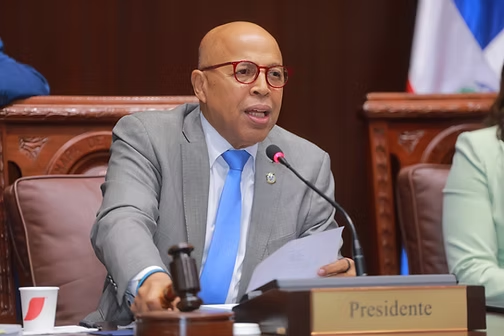

Santo Domingo.- The Chamber of Deputies approved this Tuesday, in first reading, the organic bill that creates the National Intelligence Directorate (DNI), and regulates the National Intelligence System.
The legal text, submitted by the president of the Senate of the Republic, Ricardo de los Santos, and approved in that wing of the National Congress, aims to establish the legal framework of the State intelligence system, as provided for in Article 261 of the Constitution of the Republic, as well as to create the National Intelligence Directorate (DNI) as the governing body of the system.You may be interested in: MESCyT, DNCD, DNI and SESI strengthen academic cooperation
The project was motivated by the president of the Permanent Defense Commission, in charge of its study, Ramón Bueno, who stated that the Commission had the opportunity to review, correct, and build a new regulatory framework that responds to the constitutional mandate, strengthens national security, and at the same time, fully guarantees the fundamental rights of individuals."This new project starts precisely from this premise because it incorporates clear controls, precise limits and guiding principles that oblige the actions of State intelligence, by submitting to the respect of due process, legality, proportionality and judicial supervision," Bueno stated in a note from the Chamber of Deputies.
He considered that one of the most relevant aspects of the legislative initiative is the express inclusion of guarantees for freedom of expression and the press. "The project clearly establishes that journalists, their sources, and the media will not be subject to special procedures for objecting to information in order to reveal journalistic sources, thus recognizing the value of professional secrecy and the essential role of the press in a free society," he emphasized. Also, the deputies approved in second discussion, the bill of economic incentives for specialist doctors who perform functions in the border area, which includes the provinces of Pedernales, Independencia, Elías Piña, Dajabón, Montecristi, Santiago Rodríguez and Bahoruco. The regulations, proposed by the representative in the Chamber of Deputies for Bahoruco, Juan Bolívar Cuevas, establish that the doctors benefiting from these incentives will sign a minimum service contract of three years in the border area. In case of non-compliance, they must reimburse the benefits received, except in cases of force majeure duly proven. Also, a monitoring committee will be established, composed of representatives from the Ministry of Public Health and Social Assistance (MISPAS), the National Health Service (SNS), the Dominican Medical College, and other relevant entities to evaluate the fulfillment of the program's objectives and propose necessary adjustments. The deputies will meet again tomorrow starting at 10 in the morning.




