
 Spanish

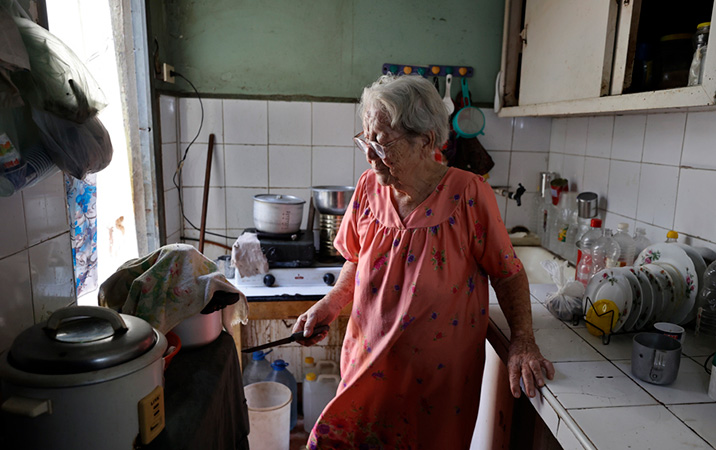

“After so much anguish in life and at the end of the road having to go through this,” he laments upon receiving EFE at his home, a small apartment located in the center of the city of Pinar del Río (west). The deep Cuban crisis is in full metastasis and affects everything from the economy to health and education, including food and energy.
Teté, as she prefers to be called, has been without electricity since the previous day. "If it comes now in the morning, it's two or three hours. And then it doesn't come until night, if they put it on," she says while organizing some plastic buckets in the kitchen that were once white.“This is for when the power comes back: to fill them with water for cooking. The water also goes out because there is no electricity to pump it. It's worth noting that the firefighters (from the station in front of their building) help us carry water,” he assures.
Teté says that she gradually became alone, because a large part of her family died and the rest emigrated. "I have two nieces in Havana who are crazy for me to go with them, but none of that. I have always lived here and I am not leaving," she explains.
This nonagenarian is not afraid of living alone. What she is "terrified" of is power outages and the lack of water, food, and medicine, which affect her threefold, she says, because of her age. She assures that her emigrated family members and neighbors help her; if not, "the story would be different".
“This is the worst”
Cuba has been experiencing a situation that experts describe as a “polycrisis” for four years. The prolonged daily blackouts are compounded by shortages of basic necessities (food, water, medicine, fuel), an inflation that has tripled prices in just five years, increasing dollarization, and an unprecedented wave of migration.“This is incomparable to anything. Not even in the special period,” Teté emphasizes, referring to the crisis of the 90s, after the fall of the Soviet bloc in Europe, then Cuba's main supplier.
Teté was born in the 1930s of the last century, during the government of Gerardo Machado (1925–1933), and lived the time before and after the revolutionary triumph of 1959, led by Fidel Castro (1926-2006).
“I know the bad, the good, and the mediocre of all those governments because I lived through them, and this one has no comparison to anything. It's a constant struggle with everything: the bread that comes one day and not the next; beans, very expensive; there's no milk, meat, or anything,” he states.
Sitting in an old wooden armchair worn by the years, she points to her refrigerator: “That one doesn't frost anymore and the food goes bad on me with how expensive everything is.” “Not even in the special period was there as much misery as now,” she finishes indignantly.
An aging country
More than a quarter of the 9.7 million Cubans are 60 years old or older, according to the National Office of Statistics and Information (Onei), which places the country as one of the most aged in Latin America and the Caribbean. And in the current socioeconomic context, many suffer especially, according to Cuban sociologist Elaine Acosta.
In statements to EFE, this professor from Florida International University (USA) emphasizes that the crisis directly impacts this age group, "with serious effects on their physical and mental health."
He added that this segment of the population "suffers from greater stress, anxiety, and a sense of hopelessness, of impossibility of developing their lives as older people, of living a dignified life." “A good part of this generation also lived through the crisis of the special period, so they suffer from chronic diseases associated with that food deficit they experienced during the 90s,” he highlights.The unprecedented migratory exodus hitting Cuba also impacts the quality of life of older adults who, like Teté herself, "have been left without their closest family networks that can assist them in everything that implies the daily management of food, of daily survival," she stated.
In the case of power outages, the sociologist emphasized that "it implies developing strategies" to keep food without refrigeration, having to cook all at once during the day, managing long lines to get food, and even "often consuming it past its expiration date".
Acosta considered that “there are things that the Cuban State is not doing” which “significantly worsens the quality of life of older people who were already being affected several years ago”.
Many elderly people are then left at the mercy of despair in the midst of the serious situation, as Teté herself laments: “Every day is worse. There is no life here. I am not going to see the end, but this does not have a good ending.”
Laura Bécquer






