
 Spanish

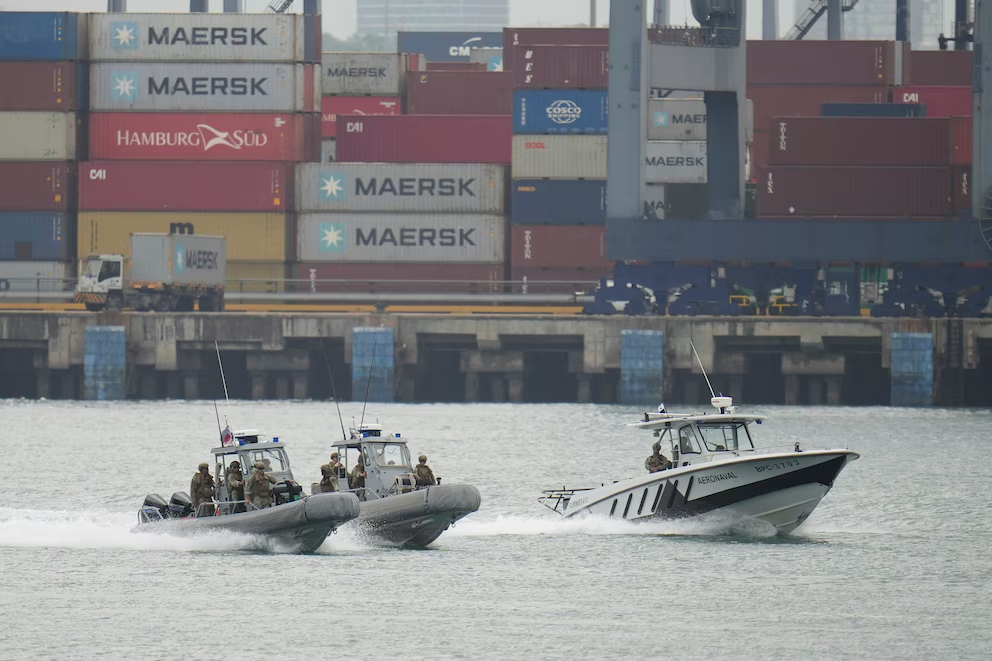
Security forces from Panama and the United States Southern Command (SOUTHCOM) will conduct joint exercises between July 13 and 18 focused on preparing for threats to the security of the Panama Canal and other strategic infrastructure in the country, according to the National Aeronaval Service (Senan).
According to the Senan statement, the exercises, called Panamax Alpha 2025 Phase I, will feature the participation of three helicopters from the Joint Task Force Bravo (JTF B) of the Southern Command: two UH 60 Black Hawk models and a CH 47 Chinook. The practices will include actions such as embarkation and disembarkation operations, fast rope insertion, extraction with a rescue crane, and communication exercises with a maritime platform.
The activities will take place at the Teniente Octavio Rodríguez Garrido Air Base, located in Panama Pacifico; at the Almirante Cristóbal Colón Naval Air Base, in the Caribbean; and at the Mayor Salvador Córdoba Air Base, located in the province of Darién, bordering Colombia.
The Senan highlighted that "these activities, carried out with specialized personnel from the National Aeronaval Service, the National Police and the National Border Service, reinforce preparedness against threats to the security of the Panama Canal and other strategic infrastructures, with full respect for national sovereignty".
Since the formal disappearance of its Army in 1990, after the 1989 US invasion, Panama guarantees its security through specialized police forces. In this context, joint exercises with US forces have become a constant practice.
However, this year a controversy arose related to the signing of a memorandum between the US Department of Defense and the Ministry of Public Security of Panama, which provides for the temporary and rotating US military presence in the Central American country. Various national sectors considered this agreement as a possible violation of Panamanian sovereignty and the Neutrality Treaty that governs the interoceanic canal. This treaty, in force since 1979, guarantees Panama's sovereignty over the waterway and its permanent neutrality to the traffic of ships of any nation.
The controversy was heightened after the President of the United States, Donald Trump, stated he was willing to "take back the Canal for the United States" due to concerns about possible Chinese influence in his administration. The Government of Panama, headed by President José Raúl Mulino, repeatedly rejected those statements and defended the full Panamanian sovereignty over the strategic infrastructure.
The United States built and operated the Panama Canal for more than 80 years, until its transfer to the Panamanian State on December 31, 1999, in accordance with the Torrijos-Carter Treaties of 1977. The 82-kilometer canal connects the Atlantic and Pacific oceans and represents a strategic point for the global economy and security.
The development of these bilateral exercises occurs in a context of political tensions and internal debates about the foreign military presence and the role of bilateral agreements in the national security of the Central American country.




