
 Spanish

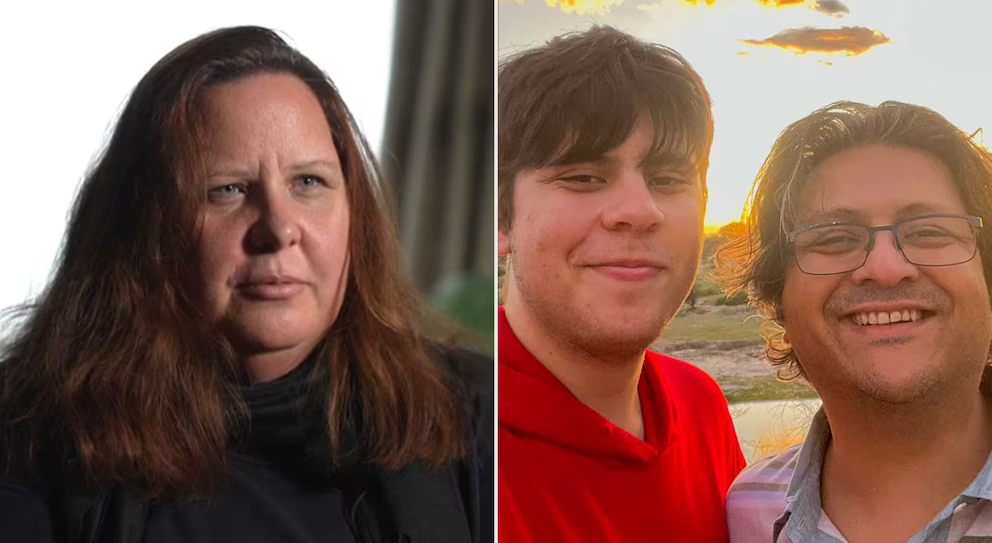

Inside, the remains of her husband Shahzada and her son Suleman, 19 years old: biological material separated with DNA tests by the Armed Forces Medical Examiner System - Armed Forces DNA Identification Laboratory (AFMES-AFDIL), based in Dover, Delaware.
"When I say bodies, I mean the liquid that remained," Dawood said in an interview with the British newspaper The Guardian."They came in two small boxes, like shoe boxes."
The image is disturbing, but it accurately reflects the nature of what happened on June 18, 2023, when the Titan, operated by the company OceanGate, suffered a catastrophic implosion during its descent towards the remains of the RMS Titanic.At 3,346 meters deep, the pressure of the ocean —about 380 times the atmospheric pressure at sea level, equivalent to the weight of about 50 elephants concentrated on an area the size of an A4 sheet— collapsed the hull of the submersible in a fraction of a second.
We recommend reading: El Salvador: Mother and stepfather sentenced for the homicide of a two-year-old
The five occupants died instantly: OceanGate CEO Stockton Rush, Pakistani-British businessman Shahzada Dawood, his son Suleman, British businessman Hamish Harding, and French explorer Paul-Henri Nargeolet, the world's leading authority on the Titanic, who had already visited the wreck 37 times.The forensic process that gave something back to the families
According to documents from the U.S. Coast Guard (USCG), the first human remains were recovered from the ocean floor on June 28, 2023, when the vessel Horizon Arctic arrived in St. John’s, Newfoundland, with the first fragments of the submersible. In October of that year, a second salvage operation recovered additional remains, this time from inside the debris of the Titan, and transported them to a US port for analysis. "The remains were carefully recovered and transported for analysis by medical professionals from the United States", the USCG said in a statement. Image of the seabed shows fragments of the Titan submersible after its implosion during a dive towards the Titanic (REUTERS/Archive) The identification work fell to the AFMES-AFDIL, the same laboratory that identifies the remains of military personnel fallen in combat. The DNA profiles of the five deceased were positively confirmed, according to the presentation of the Marine Investigation Board (MBI, for its acronym in English) of the USCG, published in September 2024. The process took months because the implosion left almost nothing recognizable. The physics of the event explains it: when the Titan's hull gave way, the compression of the air inside was so violent that, according to simulations developed in 2023, the temperature inside the submersible briefly reached values comparable to the surface of the sun, all in less than two milliseconds. What remained at the bottom of the ocean were fragments of the rear cone, the rear dome, titanium rings and remnants of carbon fiber, scattered within a radius of about 500 meters northeast of the bow of the Titanic. ADVERTISEMENTThe Titan submersible descends in the North Atlantic before the tragedy (REUTERS/Archive) Dawood received only what the lab could attribute with certainty to Shahzada and Suleman. There was also a pile of biological material with mixed DNA that could not be assigned to any particular victim. “They have a lot that they can't separate, all mixed DNA, and they asked me if I wanted part of that too. But I said no, only what they know is Suleman and Shahzada”, Dawood told the British newspaper.A helmet that should never have been submerged to that depth
The final report of the MBI, a 335-page document published in August 2025, concluded that the tragedy could have been avoided. The main cause was OceanGate's deficient engineering process for the Titan, which resulted in the construction of a composite carbon fiber hull with multiple anomalies that did not meet the strength and durability requirements needed to operate at that depth. The choice of material was, from the beginning, a high-risk bet. Conventional deep-sea submersibles use spherical hulls of titanium or high-strength steel, materials that distribute pressure evenly in all directions. Carbon fiber, on the other hand, is an extraordinarily strong material under tension, but weak under compression.Each dive subjected the Titan's cylindrical hull to what engineers call "cyclic loading": the pressure increased by 38,000% during descent and returned to zero upon ascent. This repeated cycle generated progressive microfractures and delaminations in the hull layers.
The investigation by the National Transportation Safety Board (NTSB) determined that the Titan's hull suffered irreparable damage in July 2022, during dive number 80, when the passengers heard a loud bang while ascending. The strain sensors registered a permanent change in the structural response of the hull. Rush dismissed the incident as a displacement of the frame and did not order any investigation. Each of the four subsequent dives was, according to the BBC, "a disaster waiting to happen." The Horizon Arctic vessel in the port of St. John's, Canada, after returning with recovered fragments of the Titan submersible. The hull spent the six months prior to the fatal voyage parked outdoors in a parking lot in St. John's, exposed to the Newfoundland winter, conditions that engineers consider unsuitable for a carbon fiber material. The last message from the Titan reached the surface on June 18, 2023 at 10:47:09 a.m., when the submersible was at a depth of 3,341 meters: "Dropped two wts" ("We dropped two weights"), a routine procedure to adjust buoyancy. Seven seconds later, the hull failed.The Mother Who Gave Up Her Seat
Christine Dawood was not on the Titan. She had given up her place to Suleman so that the teenager could accompany his father. Shahzada, a member of one of the wealthiest families in Pakistan, had insisted on going directly to the Titanic without prior training dives. “If I'm going to do a dive, I want to do it right”, he told his wife. The price of the two seats: 500,000 dollars. Shahzada Dawood and his son Suleman, two of the victims of the Titan; their family remembered the businessman's enthusiasm before the trip Dawood, a psychologist by training, was on board the Polar Prince, OceanGate's surface vessel, when at 11 a.m. on June 18, she heard that they had lost communication with the submersible.You can also read: Neighbor says mother of girl found dead in Los Girasoles is "hardworking and dedicated to her children"





