
 Spanish

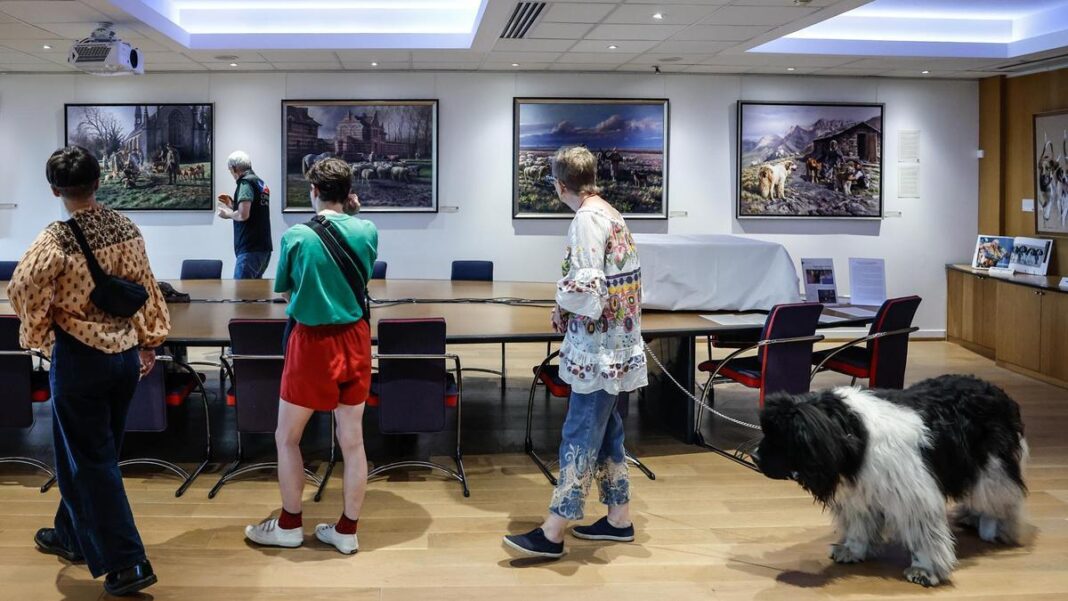

Aubervilliers (France).- The Dog Museum, a 'dog friendly' space where dogs like Spartacus can accompany their owners during the visit, is the first of its kind in France and the second largest in the world, after the one in New York.
Spartacus, a huge Newfoundland with black and white fur, is not intimidated by the attention of visitors and poses for photos. He has come with his owner to tour the museum in Aubervilliers (on the northern outskirts of Paris), where dogs are welcome and are an active part of the public, which makes the space unique.
"We have up to two small dog parks at the foot of the building so that the dogs that visit us can run before entering," explains Dorothée Fabre, head of the museum and media library, to EFE.
Opened last May 15th and located at the headquarters of the 'Centrale Canine', an institution that has coordinated the French canine community since 1881, it brings together more than 500 square meters of collections including sculptures, engravings and tapestries to objects as small as a button, reflecting the importance of the dog as a companion and cultural figure over time.
The first work that can be appreciated at the entrance is the registration form of the French Book of Origins, dating from 1885 and containing the first dog, Marco, officially registered in France.
Next to him is a panel that reproduces a curious collection from 1912: cards of different dog breeds that were included in tobacco packets in England, with an image on the front and a technical sheet on the back detailing the breed, character, and origin of the animal.
Modern Advertising and Pre-Columbian Statuettes
The collection reflects the place that the dog has occupied and continues to occupy in history: from modern advertising objects to pre-Columbian statuettes, including a small travel kennel from the time of Emperor Napoleon III. Among the featured pieces, you can see the drawings by the artist Julie Salmon, made with a ballpoint pen, which bring a unique beauty to the collection.The musicologist Marcelle Benoît, for her part, contributed numerous pieces focused on Chihuahuas and Chinese Cresteds, breeds she collected for years. "There we said: it's incredible. We can add what we had already acquired in markets and auctions to these two magnificent collections," said Dorothée Fabre. The idea of the museum came about more than fifteen years ago, while preparing the opening of a specialized media library that opened its doors in 2011. The definitive impulse came with a change in the direction of 'Centrale Canine' and a clear will to open up to the general public. "We wanted this former 'Centrale Canine' house to become a real dog house," says Fabre about the five-story building in which they are installed. Starting in September, thematic visits and school workshops will begin, following the success of an open day with children from Aubervilliers, which included reading workshops with dogs and art and awareness workshops. "Many children arrive afraid of dogs, but after a few hours they end up brushing and walking them," Fabre reported. He also highlights the therapeutic role of the dog: "We awarded a nurse in Brittany who accompanied her teenage patients with a Dalmatian. Sometimes it's easier to talk to a dog than to an adult." In the museum, works by numerous artists coexist, including several Spanish artists, such as Chiqui Díaz from Seville, awarded in 2021 with the Fine Arts Prize from the 'Centrale Canine' for his bronze sculpture of a greyhound in motion, or the paintings by the naturalist painter Miguel Ángel Moraleda that depict breeds associated with different regions of France.Many of the pieces come from the donations of military veterinarian Michel Contart, who bequeathed more than 2,000 books on the canine world, from the 18th century to 2008.






