
 Spanish

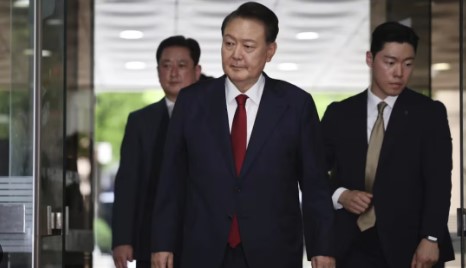

Signal,.- Former South Korean President Yoon Suk-yeol was taken into police custody for the second time on several charges related to the before and after of his failed attempt to impose martial law in the country last December.
Judge Nam Se-jin, of the Seoul Central District Court, issued an arrest warrant early this morning against the former president, requested by special prosecutor Cho Eun-suk, alleging concern that he might destroy evidence related to his criminal prosecution.
You may be interested in: North Korean leader supervises a test of new "killer drones"
The prosecution team led by Cho requested the arrest warrant on five charges: special obstruction of official duties, violation of the Presidential Security Service (SSP) law, abuse of authority to obstruct rights, falsification of official documents, and destruction or manipulation of public records. Yoon and his lawyers attended the hearing for the petition on the eve and rejected all accusations, before the former president was transferred to the Seoul Detention Center, in Uiwang, south of the capital, where he was waiting for the ruling and would later be taken into custody by the authorities. It's the second time Yoon has been arrested. His first imprisonment occurred last January, when he was already suspended from his duties as president after his 'impeachment' by Parliament, but before being officially removed. Yoon was dismissed in April after his state of exception decree was declared unconstitutional. According to the investigation led by Cho, Yoon tried to legitimize that action through a series of decisions and maneuvers that support the arrest. Among the most relevant accusations is the way in which Yoon convened and conducted the Cabinet meeting prior to the declaration of martial law. According to the prosecutors, on December 3, 2024, he summoned only 10 of the 19 Cabinet ministers, all considered loyal to his cause, deliberately excluding the rest to prevent them from opposing or questioning his decision. The meeting lasted less than five minutes and was presented as a formality to legitimize its proclamation of the state of exception, despite the Constitution requiring full deliberation by the Cabinet. Subsequently, a presidential official, also implicated in the investigation, allegedly falsified the minutes to make it appear that the meeting lasted 40 minutes and was held with greater participation and debate than actually occurred. Furthermore, Yoon is said to have instructed his spokesperson for foreign media to disseminate false statements that the martial law decree did not violate the constitutional order and that lawmakers had not been restricted from entering the National Assembly and voting on the suspension of the state of emergency. Other accusations detail that Yoon told his security staff in January to draw their weapons in the event of an attempt to arrest him in order to intimidate the agents. He is also accused of having ordered the then-deputy chief of the SSP to eliminate the records of encrypted channels used by implicated military personnel and, additionally, it is pointed out that backdated documents were drafted to give the appearance of legality to martial law, which were then destroyed.




