
 Spanish

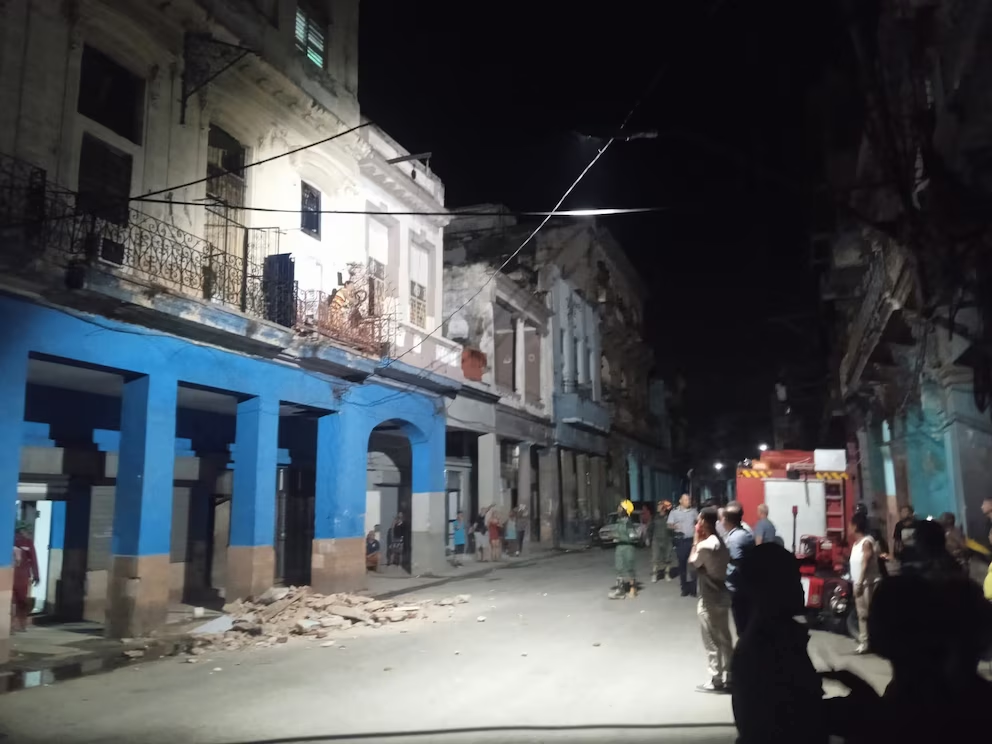

Four people died, including a seven-year-old girl, after the collapse of two buildings in the municipalities of Diez de Octubre and Old Havana, in the Cuban capital, authorities and local media reported this Saturday.
The first collapse took place in Diez de Octubre, where a 60-year-old man was trapped under the rubble after a building collapsed. The local newspaper Tribuna de La Habana reported that firefighters rescued his body after the incident, which occurred on Friday night.
Hours later, during the early hours of Saturday, a second collapse occurred in a multi-family building in the municipality of Old Havana, which left three people dead, including a seven-year-old girl, according to the Municipal Assembly of Old Havana. The institution, through its social networks, reported that the rescue teams worked at the scene to recover the bodies. The authorities attributed both incidents to the recent heavy rains and the structural deterioration of the buildings in the Cuban capital. Housing conditions in Cuba constitute one of the main socioeconomic problems in the country, especially in Havana, the most populated province, with 2.1 million inhabitants. Official data indicates that in the city there are 185,348 properties in poor condition; of these, 83,878 require partial repairs and 46,158 need major renovations. In addition, there are 43,854 homes needed for those who, after previous collapses, now reside in state shelters, along with another 11,458 homes required by the city's population growth. According to regime figures, Cuba has more than 3.9 million homes for a population of 9.7 million inhabitants, but 37% are in regular or poor technical condition. The housing deficit amounts to some 856,500 houses, which represents about 20% of the needs. In 2018, the Cuban regime announced a national policy to try to solve this problem in a decade. The country's real estate park is deteriorated, affected by the lack of maintenance derived from the scarcity of materials and substances aggravated by the economic crisis and the passage of natural disasters, mainly hurricanes. The prolonged crisis, the impact of the pandemic, and the tightening of US sanctions have intensified the structural problems. Independent economists and critics of the government have pointed out that, in recent years, public investment has focused on the construction of hotels, especially for the luxury sector, leaving the housing sector in the background. These recent collapses reflect the magnitude of the vulnerability faced by the population in sectors with old and degraded constructions.




