
 Spanish

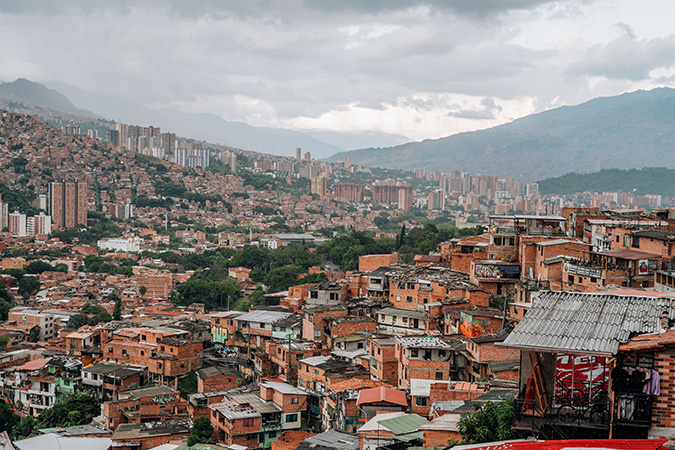

Medellín, Colombia. — Considered the most innovative city in Latin America, Medellín is an example of urban, social, and cultural transformation. Officially known as Medellín, Special District of Science, Technology, and Innovation, it is the capital of the department of Antioquia and the second most populated city in Colombia, with more than 2.5 million inhabitants in its urban area and more than 4 million in its metropolitan region.
History of Medellín
Medellín is located in the Aburrá Valley, an area inhabited since pre-Columbian times by indigenous communities such as the Aburráes. It was discovered by the conquistadors in 1541 and founded as a town in 1616 under the name of San Lorenzo de Aburrá. In 1675, by royal decree of Queen Mariana of Austria, it was elevated to Villa with the name of Nuestra Señora de la Candelaria de Medellín, in honor of Pedro Portocarrero, Count of Medellín, Extremadura.
Growth and consolidation as capital
In the 19th century, Medellín was designated the capital of Antioquia in 1826. Its economy was initially based on mining and gold trade. Later, industrialization boosted its growth, with the creation of banks, schools, and textile companies. In the 20th century, it consolidated as an industrial hub of Colombia, although it also went through a critical stage due to drug trafficking violence.
Urban and Social Renaissance
After the 90s, Medellín began an unprecedented transformation process. With investments in mobility (Metro, Metrocable, Tram), education (Library Parks) and public space, it went from being one of the most violent cities in the world to a global benchmark for social urbanism. It was recognized in 2013 as the most innovative city in the world by the Urban Land Institute.
Tourism, culture and modernity
The city has positioned itself as a tourist destination due to its cultural and natural attractions, and international events. Highlights include:
- Comuna 13: example of resilience and urban art.
- Plaza Botero and the Museo de Antioquia: epicenter of Fernando Botero's art.
- Pueblito Paisa: replica of a traditional Antioquian town.
- Parque Arví: ecological reserve connected by Metrocable.
- Catedral Metropolitana and Teatro Metropolitano: architectural emblems.

Every August, the iconic Feria de las Flores is celebrated, and the Christmas lighting is internationally recognized.
Geography, Climate, and Urbanism
The city is located 1,479 meters above sea level, with an average spring climate of 22 °C. It extends along the Medellín River, surrounded by mountains that give it a diversity of microclimates. The city is organized into 16 urban communes and 5 rural corregimientos.
Education, health and science
The city is home to renowned universities such as the University of Antioquia and the Universidad Nacional sede Medellín. It is a leader in scientific research and technology, with an innovation district and multiple registered research groups.
In healthcare, it has pioneering hospitals in transplants and medical tourism. It is one of the medical capitals of Latin America.
Economy and productive sectors
Medellín is home to important industries: textile, energy, telecommunications, health, construction, and food. It generates more than 8% of the Colombian GDP and leads exports of clothing and technology. It has a network of clusters that boost business competitiveness.
Transportation and Mobility
Its transportation system includes the Metro, Metrocable, Tram, Metroplús, and integrated bus networks. In addition, it has two airports: the José María Córdova International and the Olaya Herrera regional.
Heritage, Architecture, and Social Urbanism
Medellín's architecture combines history and modernity: from the neo-Romanesque style Cathedral to the Coltejer Tower, a modern icon. The city has prioritized social urbanism with plazas, interactive parks, and inclusive projects such as the electric escalators of Comuna 13.
Technical Sheet of Medellín
- Official name: Medellín, Special District of Science, Technology and Innovation
- Country: Colombia
- Department: Antioquia
- Gentilic: Medellinense
- Population (2020):
- City: 2,533,424 inhabitants
- Metropolitan area: 4,055,296 inhabitants
- Surface: 382 km² (328 km² in Medellín; 1,152 km² in the entire Aburrá Valley)
- Foundation:
- As San Lorenzo de Aburrá: 1616
- Erection as Villa de Medellín: November 2, 1675
- Official language: Spanish
- Current Mayor: [You can fill in with the current name]
- Transportation system: Metro, Metrocable, Tram, Metroplús, integrated buses, taxis





