
 Spanish

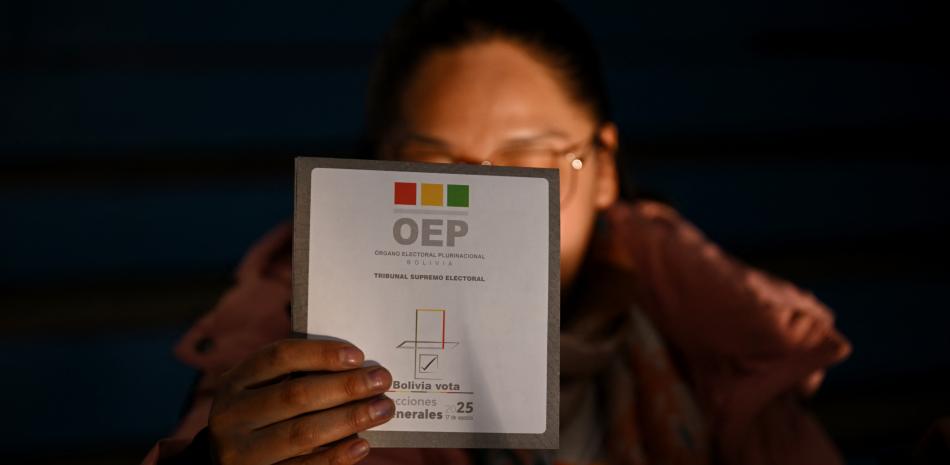

La Paz.- Bolivians will elect their next president in a second round for the first time in their history, in two months, something that had not happened before, as the runoff was recently introduced in the Constitution in force since 2009.
According to preliminary data provided by the electoral body at the end of the voting day on Sunday, centrist senator Rodrigo Paz Pereira achieved 32.14% of the vote and right-wing former president Jorge Tuto Quiroga (2001-2002) 26.81%.
You may be interested in: Evo Morales is out of the Bolivian elections
The 2009 Constitution states that there will be a runoff election if no candidate obtains more than 50% of the valid votes or a minimum of 40% with at least ten points ahead of the next one. Before that year, the election of the president was defined in the Constitution that governed the country between 1967 and 2009, which stated that "the President of the Republic will be elected by direct suffrage" and "at the same time and in the same way the Vice President will be elected". "If none of the candidates for the Presidency or Vice Presidency of the Republic obtained an absolute majority of votes, the Congress will take three of those who had obtained the highest number for one or the other office, and from among them will make the election", indicates the old constitutional text. It also established that if in a first scrutiny in Parliament none of the candidates obtained an absolute majority of the votes of the concurrent representatives, a new vote should be held between the two who had obtained the highest number of votes, until one of them achieves "the absolute majority". From the return to democracy in 1980 after the military dictatorships of the previous decade until 2002, no candidate obtained an absolute majority, so the presidencies in that period were always defined by the vote in the then Congress. In the 1989 elections, Gonzalo Sánchez de Lozada came first with 25.64% of the votes, the military man Hugo Banzer was second with 25.23%, and Jaime Paz Zamora came in third with 21.82%. Despite having finished third, Paz Zamora (1989–1993) was president after receiving the support of the Nationalist Democratic Action (ADN) of Banzer and the Conscience of the Fatherland party (Condepa), for which the popular television presenter Carlos 'El Compadre' Palenque ran. In 1994, the election system was modified so that if none of the candidates reached a majority in the elections, the subsequent congressional vote would be decided only between the two most voted. Evo Morales (2006-2015) was the first politician to reach the Presidency since the return to democracy with a majority and without the need for a vote in Congress.Morales won the 2005 general elections with 53.72% of the votes, while former President Quiroga came second with 28.62%.
The new election system was applied starting with the 2009 elections, but there was also no need to go to a second round, as Morales won those elections and the 2014 elections with more than 60% of the votes. In 2019, Morales ran again and his opponent was former president Carlos Mesa (2003-2005) In the 2019 general elections, the main candidates were Morales, who ran again despite the Constitution and the results of a referendum preventing him, and former President Carlos Mesa (2003-2005). Initially, the then-president was proclaimed the winner, but those elections were annulled due to allegations of electoral fraud in his favor and to the detriment of Mesa, which arose from the paralysis of the transmission of preliminary results for almost 24 hours and the subsequent change in the voting trend that ruled out a runoff. This triggered the crisis that led to the resignation of Morales, who has claimed to be the victim of a "coup d'état." Now, Paz Pereira and Quiroga will face each other at the polls on October 19.




