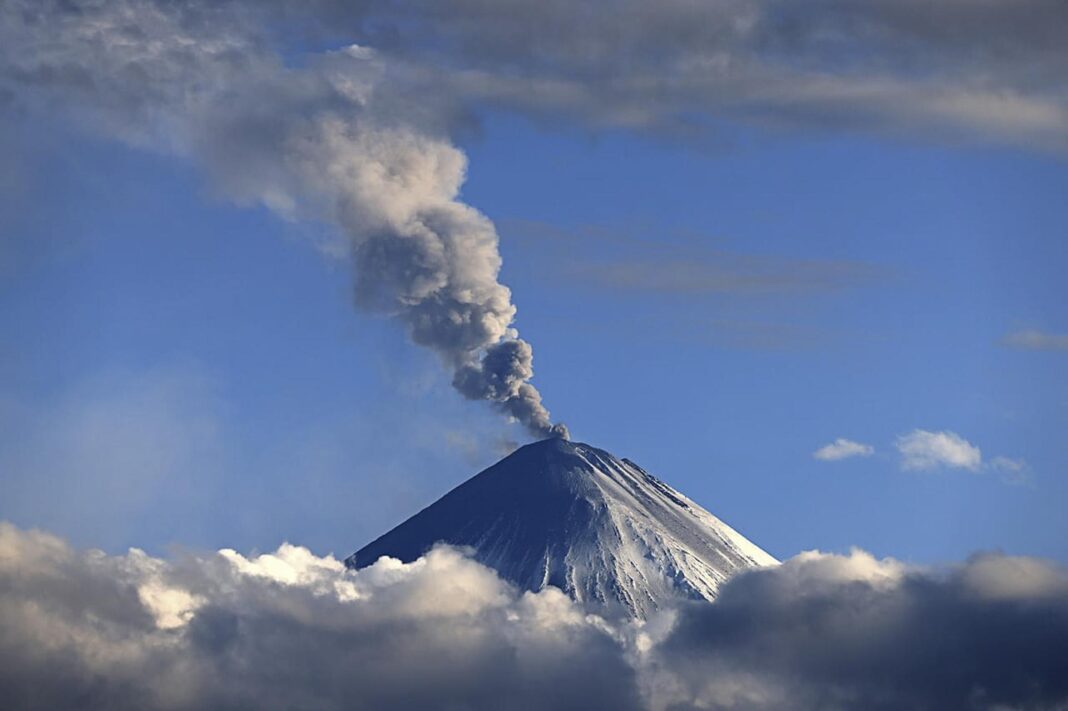
Moscow.- For the first time in almost 300 years, seven volcanoes are simultaneously active in Kamchatka, in the Russian Far East, which awakened after the 8.8 magnitude earthquake that occurred last week and which, according to scientists Russian caused a 2-meter displacement of the south of the peninsula.
The volcanoes Bezimianni, Kambalni, Karimsnki, Kliuchevski, Krashenínikov, Mutnovski and Avachinski, which were not active at the same time since 1737, when an earthquake also occurred in the region, reported local media.
The case of the Krashennikov volcano is particularly noteworthy, as it began emitting lava for the first time since 1463, and in recent days has ejected ash columns up to 6 kilometers high.
Another case that worries scientists is that of Kambalni, inactive for several decades.
Meanwhile, the lava flow from Kliuchevski reaches 3 kilometers in length, approaching the Bogdánovich glacier, which has already begun to melt.
Volcanic activity is affecting regional tourism, where excursions to the Mutnovsky and Avachinsky volcanoes are popular, where tremors and landslides are now especially dangerous.
Last Wednesday, the peninsula suffered the strongest earthquake in the last 70 years, which also caused a tsunami that affected the Pacific coast of this area.
Russian authorities warned that aftershocks could occur for at least a month.
The local branch of the Unified Geophysical Service of the Russian Academy of Sciences reported on Telegram that the south of Kamchatka moved almost two meters to the southeast after the earthquake.
Part of the Pacific Ring of Fire, Kamchatka has about 30 active volcanoes out of the nearly 130 it has in total, inscribed on the UNESCO World Heritage List since 1996.
In addition to high volcanic activity, the region suffers constant earthquakes due to being on the edge of the North American tectonic plate, bordering the Eurasian, Pacific, and very close to the Philippine plate, making it one of the areas with the highest seismic activity on the planet.

 Spanish