
 Spanish

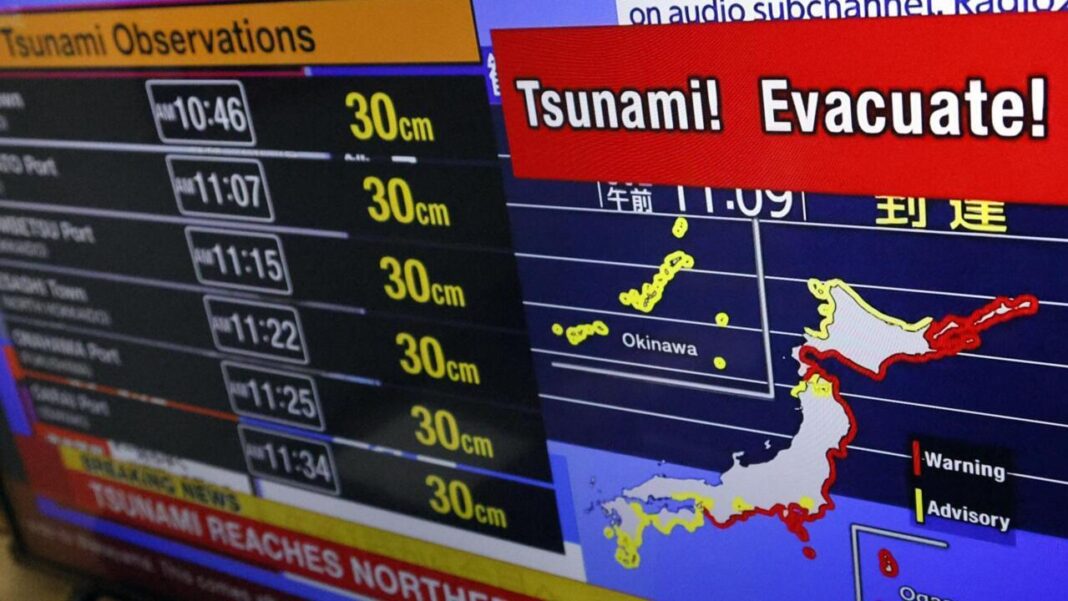

International Writing.- An earthquake of magnitude 8.8 off the coasts of the south of the Russian Kamchatka peninsula triggered tsunami alerts this Wednesday in several countries bathed by the Pacific Ocean, including Japan, the US territories of Hawaii and Alaska, Canada and in several Latin American countries.
The earthquake was recorded at 8:25 Japanese local time (23:25 GMT on Tuesday), reported the Japan Meteorological Agency (JMA), which estimated a preliminary magnitude of 8 that it later revised to 8.7 and subsequently to 8.8.
Read more: A 5.8-magnitude earthquake hits eastern Taiwan
The United States Geological Survey (USGS) also detected the tremor, whose epicenter was estimated at about 18.2 kilometers deep above the seabed. Despite its great magnitude, the earthquake was barely felt in Japan, where it reached level two on the Japanese seismic scale of seven levels (focused on measuring the shaking on the surface and the destructive potential) in the cities of Kushiro, Akkeshi, Shibetsu and Betsukai, in the southeast of Hokkaido Island, in the north of the Japanese archipelago and southwest of the epicenter. Japanese authorities confirmed the arrival this Wednesday of a tsunami of up to 40 centimeters on the island of Hokkaido, in northern Japan, after an alert was issued. The first waves reached the city of Hanasaki, in Nemuro, at 10:30 local time (01:30 GMT), while tsunamis of similar height were observed in the towns of Hamanaka, the port of Kushiro and Ako, according to the Japanese chain NHK. The height of the tsunami could rise, given that several hours can pass from the arrival of the first waves until the maximum height of this phenomenon is recorded. Japanese authorities ordered the evacuation of coastal areas from eastern and southern Hokkaido, and the prefectures of Aomori, Iwate, Miyagi, Fukushima, Ibaraki, Chiba, Kanagawa, Shizuoka, Mie and Wakayama, on the Pacific coasts that encompass the entire eastern half and part of the center of the archipelago, in anticipation that tsunamis could reach three meters. In addition, Tokyo Bay is subject to a tsunami warning of up to one meter, as well as Osaka, where the Universal Exposition is being held, and the islands of Shikoku (west), Kyushu (southwest) and Okinawa (southwest). Tsunamis of up to 20 centimeters are also expected on the coasts of the Sea of Japan. The National Oceanic and Atmospheric Administration (NOAA) raised the tsunami risk alert to the maximum in the entire state of Hawaii, located in the middle of the Pacific Ocean, as well as in the westernmost part of Alaska. In addition, it issued a precaution for the entire west coast of the United States and Canada. Hawaii Governor Josh Green declared a state of emergency in the archipelago and called on the population to evacuate coastal areas. Canadian authorities asked residents of much of its Pacific coast to avoid beaches and coastal areas. In the Philippines, the arrival of waves "less than one meter" was warned in several coastal points of the archipelago. "The first tsunami waves are expected to arrive between 13:20 and 14:40 local time (5:20 and 6:40 GMT)," stated the Seismology Department. According to the analysis results from the Indonesian Meteorology, Climatology, and Geophysics Agency (BMKG), the earthquake has the potential to cause a tsunami with a height of less than 0.5 meters.Widespread alert in Latin American Pacific
The Tsunami Alert Center (CAT) of the Secretariat of the Navy (Semar) of Mexico issued an alert for the coasts of the Mexican Pacific, where the arrival of heights less than 20 centimeters is expected starting at 02:00 local time (08:00 GMT on Wednesday) and up to five hours later in Ensenada, Punta Abreojos (Baja California), Cabo San Lucas (Baja California Sur), Mazatlán (Sinaloa), Puerto Vallarta (Jalisco), Manzanillo (Colima), San Blas (Nayarit), Lázaro Cárdenas (Michoacán), Acapulco (Guerrero), Salina Cruz (Oaxaca) and Puerto Madero (Chiapas). Meanwhile, the Meteorology Agency of the state of Chiapas (AMC) also pointed to the coasts of Guatemala (Champerico), El Salvador (Acajutla), Nicaragua (Corinto) Costa Rica (Quepos) and Panama (Punta Mala). Chilean President Gabriel Boric reported that there is a "tsunami alert for the entire coast of Chile for tomorrow (Wednesday)" and that according to protocol, evacuation will take place "three hours before the estimated arrival of the wave." The alert applies to the regions of Atacama, Coquimbo and Valparaíso, and a state of precaution in Arica y Parinacota, Tarapacá, Antofagasta, O'Higgins, Maule, Ñuble, Biobío, La Araucanía, Los Ríos, Los Lagos, Aysén and Magallanes. The National Tsunami Alert Center of Ecuador issued a warning due to the "high probability" of a tsunami affecting the Galapagos Islands, and observation is maintained for the coasts of the continental territory.In the event of a tsunami reaching the Ecuadorian coasts, it would arrive at the first points at 10:00 local time in Galapagos and at 11:00 local continental time (16:00 GMT), and at the most distant points it would arrive around 13:00 hours (18:00 GMT).
The Hydrography and Navigation Directorate of the Peruvian Navy issued a tsunami alert for the entire coastline of the country. However, the General Maritime Directorate (Dimar) of Colombia reported that "there is no tsunami threat" for the Colombian Pacific coast. Shortly after the earthquake, images began circulating on social media of structural damage in locations on the Kamchatka Peninsula, including the partial collapse of a kindergarten in the Kamchatka Krai, while the governor of the Sakhalin region published photos of damage on Paramushir Island.




