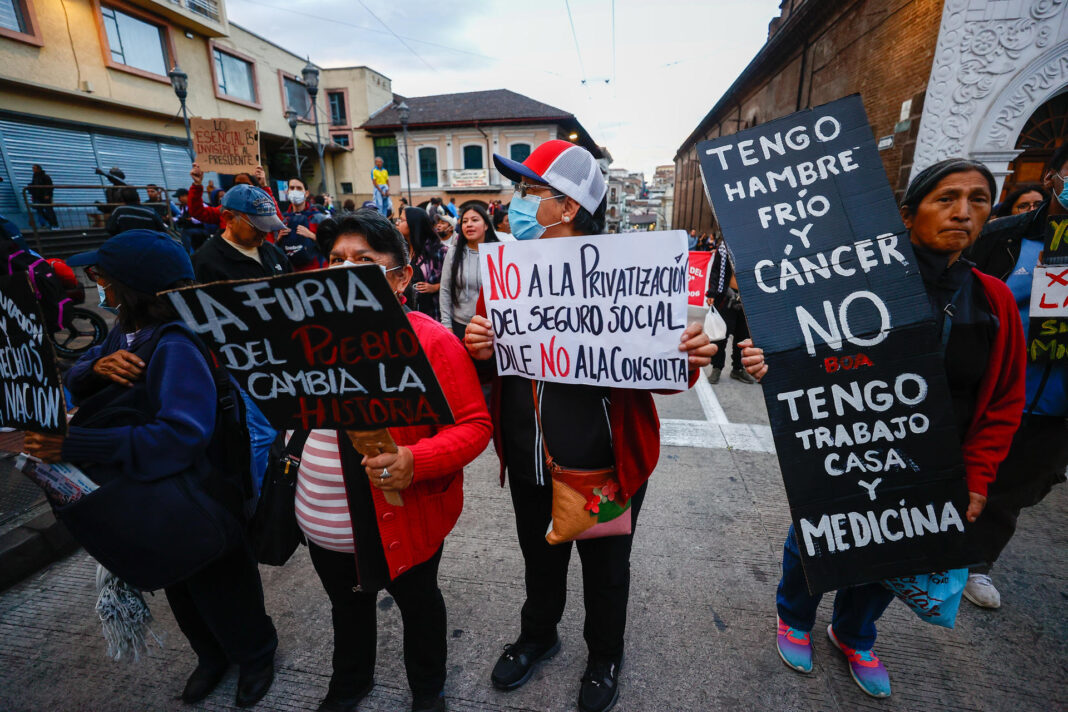
Quito,.- Hundreds of people participated this Sunday in marches against the Government of President
Daniel Noboa, which were dispersed by the Police, while the military maintained control at access points to the Ecuadorian capital, Quito, to prevent demonstrators from other areas of the country from taking the capital, according to the Minister of the
Interior, John Reimberg.
On the 21st day of the protests called by the
Confederation of Indigenous Nationalities (Conaie) against the elimination of the diesel subsidy and other demands, this Sunday was characterized by the concentration of protesters in about five points of Quito, while the Andean province of Imbabura, epicenter of the mobilizations and blockades, remained blocked.
You may be interested in: Ecuadorian government claims Noboa's convoy suffered "criminal attacks"
One of the demonstrations in Quito began in the south of the city seeking to reach the area of El Arbolito park, but there were also protests at the Ciclista roundabout (center-north), El Ejido park (in front of El Arbolito), on Los Shyris avenue (financial and commercial zone) and at the Oyacoto toll, on one of the main entry or exit routes from Quito to the north.
With tear gas, the Police dispersed the protesters who were advancing shouting slogans against the Government and with signs that read "We are not terrorists", in reference to the accusation made by the Government against the participants in these protests charged with acts of violence.
The president of Conaie, Marlon Vargas, asserted that the Government "prevented the concentration and did not allow the peaceful march of social sectors and citizens in Quito to advance."
"The military and police deployment acted with violence from the beginning," he asserted, indicating that "this action reflects a warmongering policy that denies dialogue and criminalizes protest," he said.
Control in access
After a flyover of the city, the Minister of the Interior highlighted that most of the city remained "at peace" during this Sunday and denounced that the protesters "threw firecrackers" (pyrotechnics) at the helicopter, so the Police had to act.
"We are going to maintain order, peace, that's what we are working on as a security block," he said, reaffirming that they have controls at some access points to the city, especially in the north where they found several trucks with people in the beds who wanted to enter the city.
"The controls we have set will prevent that from happening because we are not going to allow the peace in the capital to be altered," he stressed, recalling that they will not allow Quito to be taken either, as Vargas threatened last week.
The minister insisted that they will maintain the blockades, so he apologized to those returning from the four-day holiday that ends this Sunday because "it is the measure" they must take to be able to have "absolute control over who wants to enter Quito and with what intentions", he commented.
Diesel, VAT and referendum
The trigger for the protests was the elimination of the diesel subsidy decreed by Noboa on September 12, which raised its price from $1.80 to $2.80 per gallon (3.78 liters).
However, the Conaie is now also demanding a three-point reduction in the value-added tax to 12%, improvements in health and education, and has included in the protest its rejection of the popular consultation on November 16, in which - at Noboa's initiative - it will be asked about the possibility of installing a Constituent Assembly to draft a new Constitution.
So far, there is one indigenous person dead in the protests, more than a hundred injured between protesters and public forces, and more than a hundred detainees.
The Conaie already led in 2019 and 2022 demonstrations that reached Quito, which led presidents Lenín Moreno (2017-2021) and Guillermo Lasso (2021-2023) to back down when they also wanted to eliminate state subsidies on fuels to meet the fiscal adjustment goals of the credit programs signed with the International Monetary Fund (IMF).

 Spanish