
 Spanish

You may be interested in: Russia condemns US attacks against Iran and demands "an end to aggression"
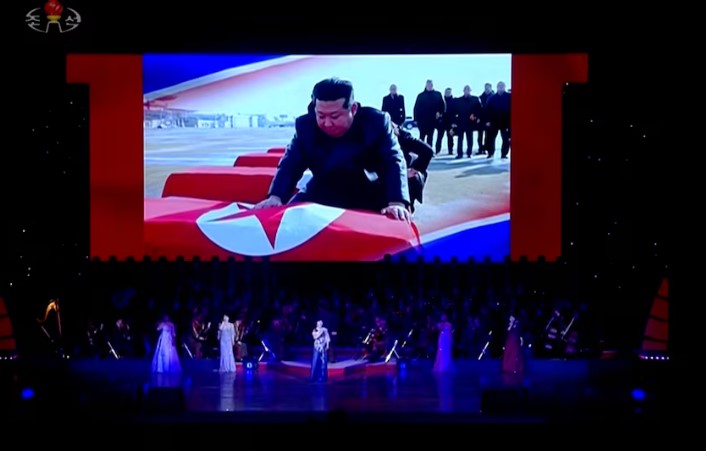
In the stalls, several women were crying. Kim's face, along with her daughter's, remained serious and moved as they watched the tributes. Minister Lyubimova, sitting next to her, applauded. There were no speeches or proclamations. Only images and music, in a visual language more eloquent than any declaration.
The details of the act were not accompanied by official explanations about the identities of the soldiers or the place where they died. But the projected sequences — where fighting, Russian and North Korean symbols, and funerals presided over by Kim were mixed — seem to be part of the context of an increasingly close military cooperation between North Korea and Russia. The staging took place just weeks after Russia publicly thanked the active participation of North Korean soldiers in the Kursk region, where —according to Moscow— they contributed to repelling a Ukrainian offensive. It was President Vladimir Putin himself who, in a statement released at the end of April, celebrated the “complete defeat” of Ukrainian troops in the area and highlighted the role of the “units of the Korean People's Army” in that operation. The Russian state television had shown days before, for the first time, images of North Korean soldiers training on Russian soil, carrying weapons and uniforms of the Moscow Army. According to Western intelligence services, about 11,000 North Korean troops had been deployed since August 2024, with about 3,000 reinforcements after the first casualties. North Korea, for its part, confirmed its participation through its agency KCNA, which described the intervention as part of the fulfillment of the treaty signed with the Kremlin in December of last year. The treaty, personally signed by Putin and Kim Jong-un in Pyongyang in June 2024, establishes a strategic partnership that includes a mutual defense commitment. Since then, both capitals have multiplied the public gestures of closeness, in a context of increasing international isolation and multilateral sanctions.At Sunday's event, Kim did not take the microphone. Nor were there any official statements detailing the reasons for the funeral or the identity of the deceased. But the images —carefully selected by North Korean propaganda— outline the contour of a narrative: soldiers marching, falling and being bid farewell with honors, while the military alliance with Moscow is celebrated with flowers, violins and official photographs.
After the concert, Kim, his daughter, and the Russian representatives toured a photographic exhibition at the theater. Later, they held private conversations, according to state media reports. Among the topics discussed, neither Ukraine nor the ongoing conflict were mentioned. The war, however, was in every image. Although the regime of Pyongyang avoids directly mentioning the conflict, the public tribute to fallen soldiers, the use of Russian symbols in the images and the presence of high-ranking Russian officials at the event suggest a deeper involvement of North Korea in the war being fought west of its border.




