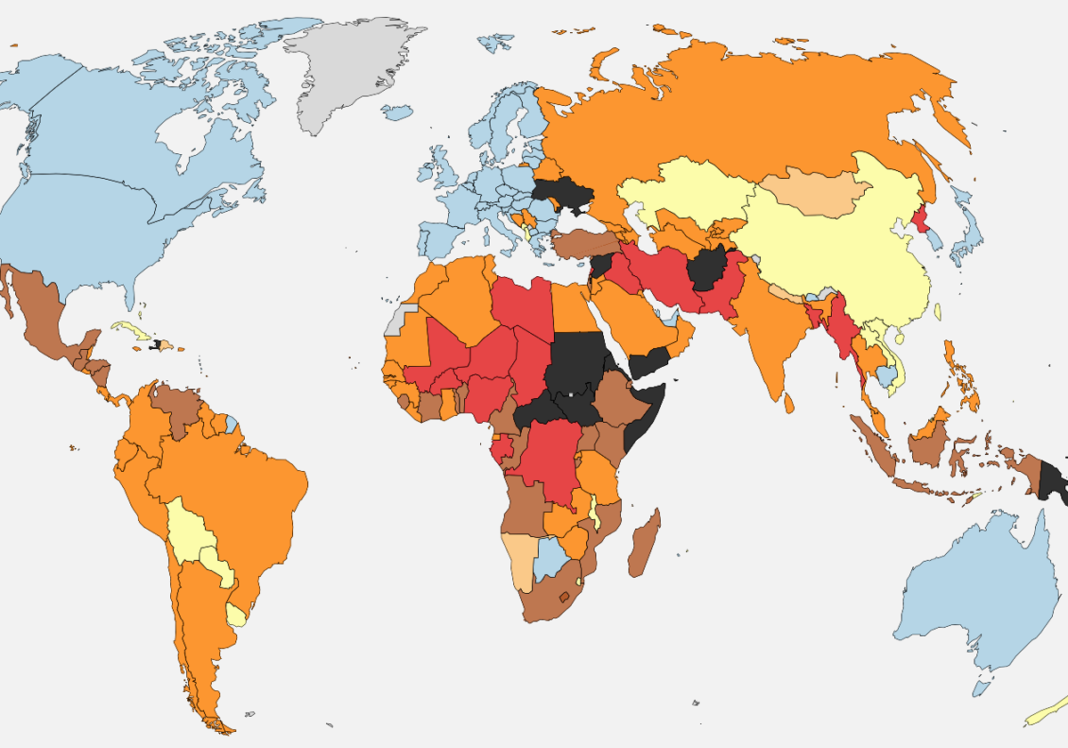
Writing.- The Institute for Economics & Peace (IEP) has published the 19th edition of the Global Peace Index (GPI) 2025, which ranks 163 independent countries and territories according to their levels of peacefulness, covering 99.7% of the global population, according to the report itself.
For the first time, Russia occupies the last position of the Global Peace Index 2025, with a score of 3.441, according to the IEP report. It is followed by Ukraine (3.434), Sudan (3.323), Democratic Republic of the Congo (3.292) and Yemen (3.262). The group of the ten least peaceful also includes South Sudan (3.117), Syria (3.184), Afghanistan (3.229), Central African Republic (2.912) and North Korea (2.911).
According to the report, these countries record the highest levels of
warfare, displacement of people, and
militarization. The number of deaths from internal and external conflicts in these nations exceeds the thresholds of
1,000 victims annually, and the peaceful resolution of disputes remains very limited. The IEP highlights that the internationalization of conflicts aggravates the obstacles to achieving
sustainable peace.
The
Middle East and
North Africa region remains the least peaceful globally, concentrating several of the worst-rated countries. The report notes that the reduction of peace troops and the fall in funding for international missions coincide with the increase in
active wars and forced internal displacement.
The GPI is based on 23 quantitative and qualitative indicators to analyze peace in three main areas:
Safety and Social Protection, Ongoing Internal and International Conflicts, and Degree of Militarization. According to the report, the downward trend in global peacefulness is accentuated, with more countries increasing their military spending in a context of geopolitical tensions and disintegration of traditional alliances.
The IEP report indicates that in 2024 there were 59 active armed conflicts, the highest number since World War II. In addition, the number of successful conflict resolutions fell to its lowest level in 50 years, as decisive victories decreased from 49% in the seventies to 9% in the last decade, and peace agreements fell from 23% to 4% in the same period. On the other hand, 78 countries are involved in conflicts outside their borders, a figure driven by geopolitical fragmentation and the growing prominence of intermediate powers.
The global trend towards reducing militarization has reversed, reports the IEP, with 106 countries showing higher levels of militarization in the last two years. The average level of global peace decreased by 0.36% compared to the previous year, with 74 countries improving their indicators and 87 deteriorating. The economic cost of violence for the world economy reached $19.97 trillion in purchasing power parity (PPP), equivalent to 11.6% of global economic activity, the report indicated.
In what positions are the United States and Latin America located?
The United States ranks 128th in the 2025 Global Peace Index, maintaining its position from last year. The country has high military spending and internal challenges in social security, although it shows improvements in crime perception and homicide rates.
Mexico is in 135th position after a two-place rise, but continues to face high levels of violence associated with organized crime. The report underlines that Central and North America, despite reductions in homicides in several countries, still has the highest average homicide rate on the planet.
Argentina ranks 46th, with a significant improvement of five places in the last year attributed to the change of government in 2023 and a decrease in violent demonstrations. Meanwhile, Venezuela is in 139th place, with a worsening in the score and critical indicators of internal conflict and persistent political tensions.
Colombia ranks 140th, impacted by the resurgence of internal armed conflicts and high displacement rates. Peru advances 14 positions to 96th, reporting improvements in security after a change of government in 2022, while Cuba drops two places to 102nd, affected by restrictions on civil liberties and internal tensions.

 Spanish