Havana, June 28 (EFE) - The "balserito" Elián González returned to Cuba a day like today 25 years ago, after surviving a shipwreck bound for the United States and becoming the center of a tense family, legal, diplomatic and ideological dispute that marked relations between the two countries.
At 31 years old, González lives in Cárdenas, his hometown, away from the spotlight. He is an industrial engineer, is married and has a daughter, works in a state organization and, since 2023, is a national deputy.
After its media explosion a quarter of a century ago, it now barely appears in headlines and news about the anniversary. EFE requested an interview through the Cuban government, but has not yet received a response.
González, in a recent conversation, thanked for being able to return to the island and get away from public exposure. He also recalled his father's "firm conviction" that he should achieve his return and the great popular support.
"The fact that an entire nation mobilized and stood by my father's pain, and wished for my return, has been something that has marked and changed our entire lives, no matter how much we have tried to make it as normal as possible," he said about this matter five years ago to an official media outlet.
"There are always places and commitments to attend, people who want to greet us, for whom I see no other way to fulfill my part than by greeting them, by being faithful and respectful to them, because, without hardly knowing that child, they added their voices for my return," he commented.
An Unforgettable Episode
On November 22, 1999, Elián González, barely five years old, left Cuba with his mother Elizabeth Brotons - who was separated from his father - and a dozen Cubans who intended to irregularly reach Florida.
However, the precarious boat capsized near the US coast. "I remember when we fell into the water, that I was put on a tire and my mother was covering me and then, at some point, I raised my head and I didn't see her anymore," the young man recounted a few years ago in an interview.
Only Elián and a couple of rafters survived, who swam to the shore.
The little one floated on the tire -as a life preserver- for two days, until some fishermen rescued him and handed him over to the Immigration and Naturalization Service (INS), which entrusted him to his paternal great-uncle, Lázaro González, in Miami.
The apple of discord
The relatives of the child in Miami demanded custody of Elián, arguing that his mother had given her life so that he could "grow up in freedom".
But his father, from Cuba, upon learning of what had happened, requested his repatriation, alleging that the mother had taken the minor without his consent. The Cuban government became involved in the case.
The then-Cuban president, Fidel Castro, personally led a genuine crusade he called the "battle of ideas" to bring the child back, despite the deep economic crisis the island was suffering after the collapse of the socialist bloc.
The case escalated rapidly, became politicized, and turned into the latest excuse to renew the standoff between Havana and the Cuban exile in Miami.
The Cuban government promoted massive demonstrations - many of them in front of the US diplomatic mission in Havana - created the so-called "open forums", with rallies demanding Elián's return, and launched a television program to follow the details of the case.
In Miami, the most radical anti-Castro groups engaged in an offensive in US courts to retain the young Cuban refugee.
The extensive media coverage of the case also helped to garner support from activists and religious groups in the U.S., such as the National Council of Churches, the largest ecumenical association in the country.
The End of the Dispute
U.S. immigration authorities recognized on January 5, 2000, the parental rights of Juan Miguel González, a decision supported by the then Attorney General, Janet Reno, and Democratic President Bill Clinton.
The repatriation of the minor was processed, while relatives and anti-Castro groups like the Cuban American National Foundation persisted in the courts with demands for political asylum to retain the young migrant.
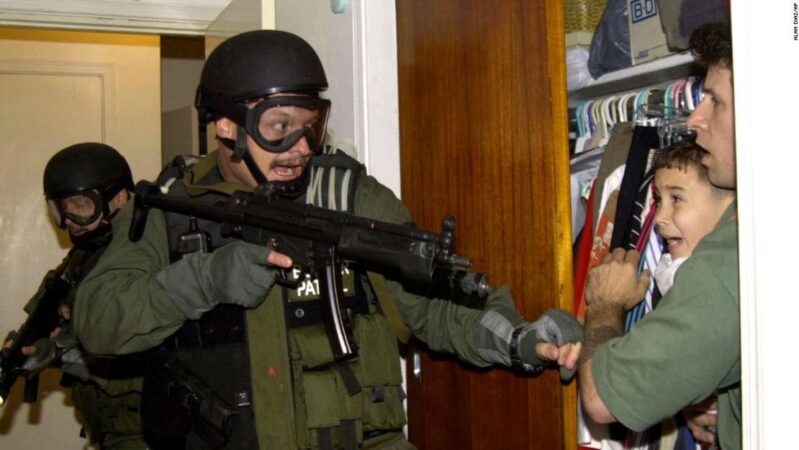
The father traveled to the U.S. in April and was able to reunite with Elián, after a federal operation, ordered by the Department of Justice, forcibly removed him from his relatives' house.
On June 28, 2000, Juan Miguel González arrived in Havana with his son.
From that moment on, a stage of reintegration into his family environment and the beginning of the first school year opened up for the child, under the accompaniment of psychologists who supervised the process of normalizing his life.
Years later, in public statements, Elián thanked the people of Cuba and the United States for supporting his father. Regarding his relatives in Miami, he assured that he held no "grudges" against them.

 Spanish