
 Spanish

You may be interested in: marriage between people of the same sex
In December 1959, for example, when the Fréjus dam collapsed and caused a catastrophe that left 421 victims. Among the deceased was a young man who was going to get married a few weeks later. His fiancée, pregnant at the time of the tragedy, faced the possibility of her child being born out of wedlock, a situation that then implied significant legal and social consequences. Public pressure motivated the authorities to modify the legislation and recognize marriage even after the death of the contracting party.
While it is an exceptional situation, according to the media Ouest France, several dozen marriages of this type are celebrated each year in France. The process requires a series of legal and family approvals, and can only be carried out if it is proven that the deceased clearly expressed their will to marry. Nowadays, only the President can authorize it. Article 171 of the French Civil Code states: “The President of the Republic may, for serious reasons, authorize the celebration of the marriage if one of the future spouses has died after the official formalities that unequivocally indicate their consent have been fulfilled. In this case, the effects of the marriage go back to the date prior to the death of the spouse”.How to apply for marriage
According to TF1 Info, "to make this decision, the State relies on founded reasons and on a set of evidence that proves a mutual marital will." Even if the union materializes, the posthumous marriage does not grant the right to intestate inheritance, nor is a marital regime recognized between the parties.The request must be addressed to the President of the Republic, through the Ministry of Justice and the Directorate of Civil Affairs and the Seal. Before its approval, the file goes through the analysis of the Attorney General of the Court of Appeal and the Court of Justice. Only then does the President issue a decree authorizing or rejecting the marriage.
According to Actu Juridique, "it is necessary to gather the elements that allow to unequivocally establish the consent of the deceased for the marriage. The documents presented must clearly indicate the desire to carry out the celebration, and it can be supported by the testimony of credible people. Among the members of the deceased's family, sometimes not everyone is in favor of the marriage and it is advisable to weigh the arguments of each one," specifies the media. Lack of solid evidence can hinder approval. Letters, witnesses, photographs, and other documents can support the file, although they do not guarantee the outcome. The presumption of paternity, the consent of direct relatives, or the prior planning of the marriage help to strengthen the request, but the final word belongs to the president.Ceremony and Effects
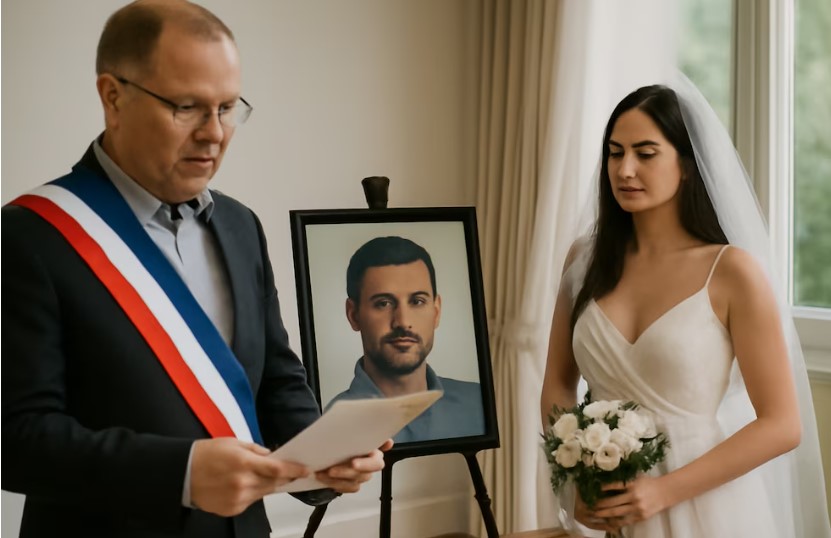
The ceremony has a symbolic character. Given the obligatory absence of the deceased spouse, a picture with his photograph usually occupies a place next to his partner. The local mayor officiates the act, reads the presidential decree and, instead of the traditional vows, validates the consent already expressed in life by the deceased.
After the celebration, the surviving spouse legally becomes a widower or widow, although the union does not imply automatic property rights. According to TF1 Info, the Ministry of Justice receives about a hundred requests each year, of which almost half are rejected. “In a 2007 ruling, the Court of Cassation reiterated that the absence of official formalities that unequivocally demonstrate the deceased's marital intentions justifies the President of the Republic's refusal to authorize a posthumous marriage,” they detailed.This type of wedding does not respond to romanticism or a deep-rooted cultural tradition. In most cases, it reflects a legal and emotional need on the part of those who lost their partners before fulfilling the dream of getting married. Although the law may seem unusual, it offers a way to close a bond that death abruptly interrupted.






