
 Spanish

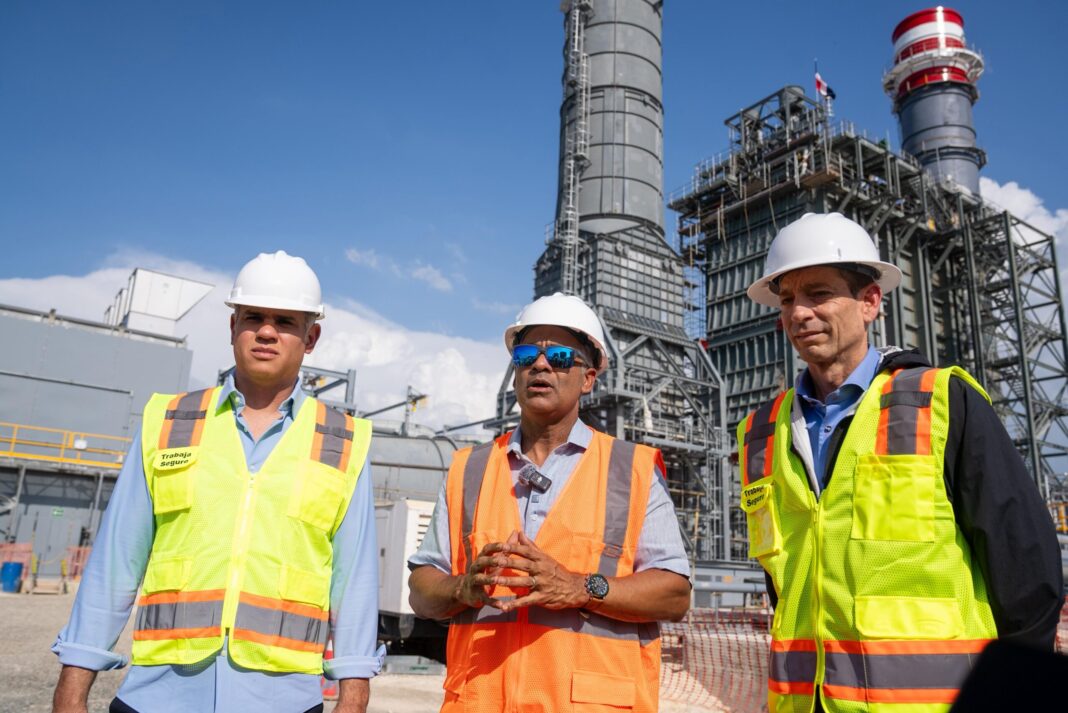

During the tour, Santos and the delegation that accompanied him, headed by the governor of Montecristi, Leissa Cruz, received explanations from the executives and technical staff of the plant, about the functions and operation of the different components of the complex, as well as the execution levels of each one.
The head of Energy and Mines weighed the levels of modernity that characterize the project, the significant advances in its development, and the important contribution it will make to the diversification of the energy matrix, the stability of the system, and the economic development of the Northwest Line and the country in a broad sense.
“We have been able to verify that a large part of its engineering is quite advanced. The turbines are installed and we will soon be able to see the start of testing and energization. It should be noted that this project starts with a 345 KV transmission line, which goes from here, passing through Guayubín and the vicinity of Santiago, to El Naranjo,” said Santos.
On his side, Jaime Santana, president of the company Energía 2000, developer of the plant, explained that Manzanillo Power Land was conceived to streamline and modernize the country's energy market. He pointed out that it has a state-of-the-art turbine that meets the highest operating standards.
“The project is in the final stages and is expected to be online by the end of 2025 or the beginning of 2026,” said Santana, who highlighted that the use of natural gas, considered a transition fuel, makes this plant a sustainable and environmentally friendly solution.During the tour, Joel Santos was accompanied by the Vice Minister of Energy, Alfonso Rodríguez; the ministerial advisor, Joel Ramírez; the directors of Social Management and Rural and Suburban Electrification, Vladimir Ozorio and Príamo Feliz, respectively; former Major League Baseball player Nelson Cruz; and the Vice Minister of Climate Change and Sustainability of the Ministry of Environment, Ana Emilia Pimentel.






