 Spanish


Havana.- The President of Cuba, Miguel Díaz-Canel, warned this Friday to the U.S. that there will be no possible understanding or negotiation with "coercion" and indicated that his country is willing to "dialogue", but on "equal terms" and with "respect".
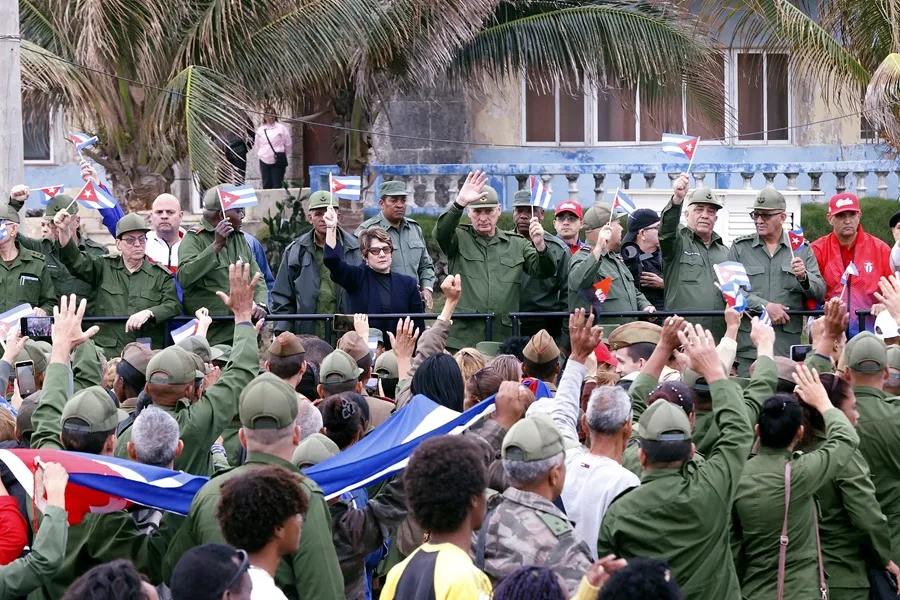
This day, the second and last of tribute after the arrival in the country of the remains of the 32 island soldiers who died during the American operation, was crowned with a massive act of reaffirmation at the Anti-Imperialist Tribune, between the US embassy and the Havana seawall. Díaz-Canel once again attacked the administration of the U.S. president, Donald Trump, in a speech with markedly nationalistic, belligerent tones.The act, in which several thousand people participated, was headed by Díaz-Canel and other high-ranking officials of the Government, the Army and the Communist Party of Cuba (PCC, the only legal one). Unlike yesterday, former President Raúl Castro was not present on this occasion."Imperialist gentlemen, we have absolutely no fear of you... We don't like, as Fidel [Castro, former president of the island] said, being threatened. They are not going to intimidate us," he said in front of thousands of military personnel, state workers, and supporters of the Executive. The president pointed his finger several times, from the podium, at the American embassy.
"There is no surrender or capitulation possible"
After the speech, a March of the Fighting People began, an initiative loaded with symbolism that rescued the pro-government mobilizations devised in the midst of the Cold War by former President Fidel Castro for moments of greatest tension with Washington. The last one organized was, precisely, in December 2024, in response to Trump's victory and the escalation of rhetoric in the Florida Straits. It was the first time in decades that a march of this type had been held. But the symbolism went further. Díaz-Canel wore the olive green uniform of the head of the National Defense Council (CDN), as he did the day before when receiving the coffins, something that, according to the law, can only be done in states of war and emergency, or in case of general mobilization. In the Government's activities to honor the military personnel who died in Venezuela, the discourse of confrontation with the «enemy» and the «imperialists» has relegated to the background the mourning and sadness for the death of the Cuban military personnel in Caracas. "There is no surrender or capitulation possible, nor any kind of understanding on the basis of coercion or intimidation. Cuba does not have to make any political concessions, nor will that ever be on a negotiating table for an understanding between Cuba and the United States," said the Cuban president. Díaz-Canel spoke in historical terms in the face of Trump's threat. He did not rule out a possible attack but assured that, if it were to happen, Cubans would fight "fiercely", as in "the wars for independence in the 19th century, the Sierra Maestra, the clandestine struggle, Africa and even Caracas in this 21st century".Cubans in Venezuela
The ruling party has markedly hardened its tone towards Washington after confirming the death of the 32 "combatants" during the attacks in Venezuela on January 3rd. Many analysts had pointed out that Maduro's first personal security circle was mainly made up of Cubans, something that Caracas and Havana had never confirmed. A 2022 report by the UN Independent International Fact-Finding Mission on Venezuela (FFMV) concluded, after analyzing "confidential written agreements" between Caracas and Havana, that this collaboration dates back to 2006.Trump warned Cuba on Sunday that it would no longer receive money or oil from Venezuela, noting that the island has been «living for years» thanks to money and crude oil from the South American country in exchange for «security services» for the «last two dictators», referring to Maduro and his predecessor, Hugo Chávez.