
 Spanish


On a remote island in northern Norway, archaeologists made a discovery that challenges everything that was known about the history of the Vikings. Under the burial mound of Herlaugshaugen, in Leka, a team of researchers found 29 iron rivets and wooden remains that, according to radiocarbon analyses, date back to the year 700 AD. The discovery forces a rethinking of the origin of the monumental ship burials in Scandinavia: it advances by at least a century the presence of these rituals in Norway and calls into question traditional ideas about the transition between the Iron Age and the Viking era.
The importance of the discovery, disseminated by Nature News and the journal Antiquity, lies in the fact that it demonstrates that the tradition of burying monumental ships in Scandinavia began much earlier than previously believed. The Herlaugshaugen mound not only reveals the existence of these practices in pre-Viking times, but also suggests the presence of elites with sufficient power and resources to organize funeral rituals on an enormous scale. This evidence points to a Norwegian society with a hierarchical organization and centralized power networks several centuries before the official arrival of the Vikings. Aerial view of the impressive coastal landscape of Herlaugshaugen, where recent archaeological findings have revealed parts of a buried ship
The Herlaugshaugen mound, an important archaeological site located in the Namdalen area, stands out as one of the largest burial mounds in Norway: it exceeds 62 meters in diameter and reaches a height of 12.5 meters. Linked in local legends to the mythical King Herlaug Haraldsson, the site attracted the attention of archaeologists and explorers from the 18th century.We recommend reading:The Norwegian Prosecution requests 7 years in prison for Princess Mette-Marit's son for rape
During the excavation carried out in 2023 by specialists from the Museum of the Norwegian University of Science and Technology and heritage authorities of Trøndelag county, it was decided to open specific trenches to avoid structural damage. The use of metal detectors was key to locating the 29 iron pieces —mostly large clapboard nails—, some still with remains of elm or oak wood attached. Detail and size of a clinker nail from the ship (NTNU)
According to experts, the arrangement and size of these rivets suggest that the buried ship was over 20 meters long. The mound, composed mainly of sand and seashells, also presents layers of charcoal on top, evidence of rituals or successive construction stages. Other findings, such as fragments of swords, human and animal remains, and bronze pieces, complete the picture that emerges from previous excavations at the site.Chronology of the Ship Burial at Herlaugshaugen
To determine the age of the find, experts analyzed with radiocarbon both the wood attached to the rivets and the layers of charcoal from the mound. The results place the burial between the years 656 and 774 AD, with a higher probability towards 700 AD, a date that precedes the famous ship burials in Norway, such as those of Karmøy, which correspond to the end of the 8th century. The iron rivets are consistently large and well preserved, some with remains of wood attached (NTNU) “The Herlaugshaugen tumulus represents a ship burial dating from the end of the 7th or early 8th century,” the research team pointed out in dialogue with Nature News. This data advances the practice of monumental ship burials in Norway, placing Leka in an era that until now was only associated with rituals such as that of Sutton Hoo, in England. The match between the dates obtained and the stratigraphic relationship of the samples reinforces the hypothesis that Herlaugshaugen constitutes the oldest example of funerary monumentalism with ships in mainland Norway.Historical Relevance and Power Networks in Pre-Viking Scandinavia
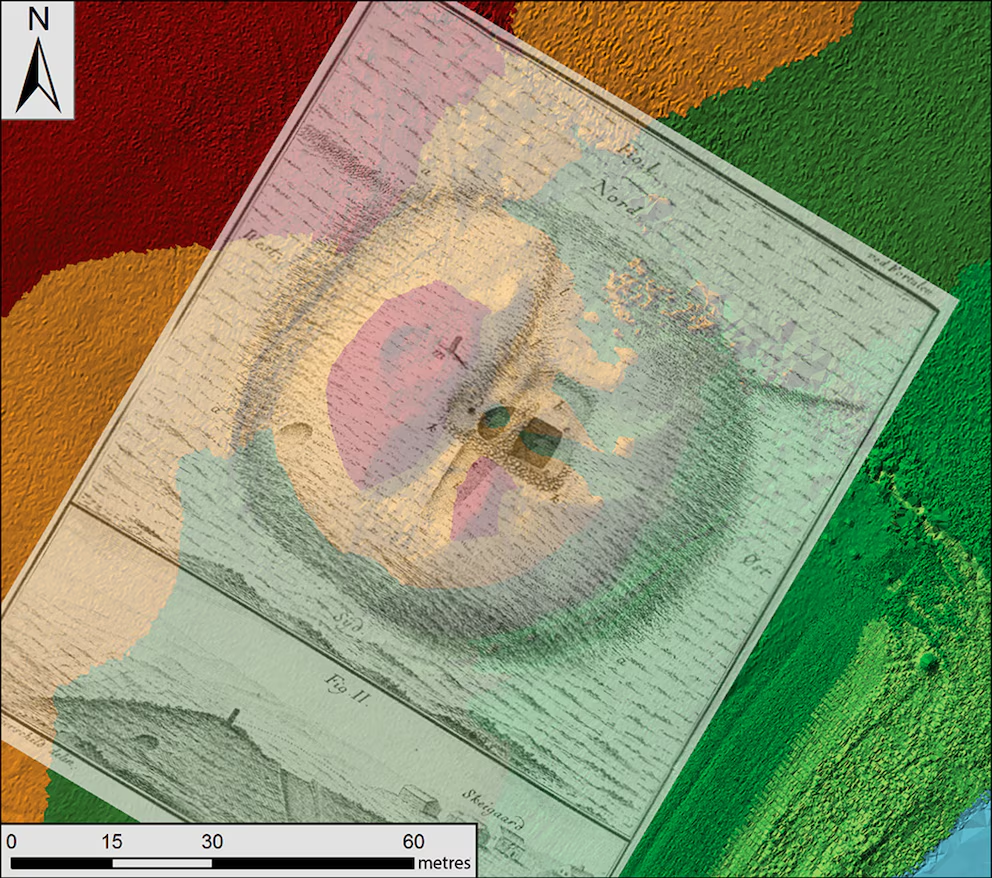
The discovery invites us to rethink how **power** and **prestige** were organized and manifested in Northern Europe. According to the research, **building and burying a ship of such size required a mobilization of resources and collective work on a large scale**, a clear sign that centralized elites and consolidated power structures already existed before the Viking Age. The Herlaugshaugen mound is located on the island of Leka, specifically in the town of Skei, within the municipality of Leka, in the province of Trøndelag, Norway. The study also points out that, around the year 700, ship burials were already reserved for the most privileged sectors of society. As the Norwegian team summarizes, the finding provides "a new piece to understand the development of society in northern Europe in the 7th to 10th centuries". The size of the tumulus reinforces its symbolic and territorial value compared to other maritime communities. The strategic location of Leka, in the heart of the Norwegian coast and within reach of the main maritime routes of the North Atlantic, made the island a key point for trade and interaction between different peoples. For centuries, it functioned as an exchange node connecting the Norwegian coast with the European continent and the British Isles, facilitating both the traffic of goods and the circulation of ideas and funerary practices. In addition, the tradition of assemblies and markets reveals that the island was a meeting center for leaders and merchants, which increased its political and social weight in the region. Illustration of the Herlaugshaugen tumulus made by P.H. Sommerschild in 1780 (published in Suhm, 1784) The study highlights that monuments such as the Herlaugshaugen tumulus not only legitimized the power of local elites, but also reflected the visible competition between dynasties and clans in the final stage of the Iron Age, positioning Leka as a central stage in the disputes over territorial control and resources.Comparison with other funeral traditions
By analyzing the role of the Leka mound within the funerary traditions of the North Atlantic, Herlaugshaugen appears in parallel with emblematic monuments such as Sutton Hoo, in England, and Bertnem, in Trøndelag, highlighting the similarities in rituals and the central place of the sea as a symbol of status and power. This map illustrates the location of Viking ship burial sites in Northern Europe, including the recent discovery in Gjellestad, Norway, which rewrites Nordic history.
Specialists maintain that the existence of monumental burials in Scandinavia and eastern England reveals an early and sustained circulation of ideas and funerary customs. Recent research suggests that maritime routes not only boosted the trade of objects, but also allowed the exchange of rituals and symbols, which contradicts the traditional view of a late English influence.You can also read:Princess Mette-Marit of Norway apologizes for being associated with Epstein
The study concludes that each society adapted funerary monumentality and the meaning of its rituals to its political and geographical context, but the Herlaugshaugen mound becomes a key reference for understanding how the emblems of power were transmitted and re-signified in the North Sea environment. The monumental ship burial in Leka broadens the panorama on the social changes in northern Europe between the 7th and 10th centuries, and shows how ritual architecture and funerary marks were integrated into the formation of new hierarchies and political structures. Herlaugshaugen not only adds a piece to the archaeological puzzle of the region, but also opens the possibility of rethinking the role of Scandinavian Norway in the development of large networks of power and maritime mobility before the Viking Age.