
 Spanish

From the Colonization to the Independence of the United States
The history of the United States begins with the arrival of Europeans in the New World. In 1513, the Spanish conquistador Juan Ponce de León landed in Florida, being the first documented European presence in the current U.S. territory. In the 17th century, French, Dutch, and English founded settlements, with the latter being the most successful. In 1607, the Jamestown colony was founded, and in 1620, the pilgrims established Plymouth. In 1674, the Netherlands ceded the territory of New Amsterdam to England, which was renamed New York. By the end of the 17th century, forced labor gave way to the massive use of African slaves. By 1732, the Thirteen British Colonies had already been established, which, with elected governments and the slave trade, were expanding rapidly. Tensions with the United Kingdom led to the Revolutionary War (1775–1781). The Continental Congress created the Continental Army in 1775, and on July 4, 1776, it proclaimed the Declaration of Independence. With the support of France and Spain, the colonies defeated the British Empire. In 1787 the Constitution was drafted, and in 1789 George Washington assumed the presidency. In 1791 the Bill of Rights was approved.Territorial Expansion and Internal Conflict in the United States
With the Louisiana Purchase from France in 1803, the U.S. doubled its size. In 1819, Spain ceded Florida, and in 1845 Texas was annexed. The victory over Mexico in 1848 granted the U.S. a large part of the Southwest. The expansion was driven by "Manifest Destiny", the Gold Rush (1848), and railway development, but it also brought with it the dispossession of indigenous peoples.Civil War and Reconstruction of the United States of America
The expansion of slavery into new territories unleashed tensions between the North and the South. In 1861, the secession of the slave states initiated the Civil War. The Union's triumph in 1865 abolished slavery and guaranteed rights to African Americans, although the Reconstruction era was followed by the imposition of segregationist laws in the South.Industrial Boom and International Prominence of the USA
The 19th century brought industrialization, migratory waves, and urban development. In 1898, the U.S. defeated Spain and annexed Puerto Rico, the Philippines, and Guam. In World War I, it supported the Allies, and in World War II it was decisive after the attack on Pearl Harbor in 1941. In 1945 it dropped the atomic bombs on Hiroshima and Nagasaki, marking the end of the conflict.| Estado | Capital | Estado | Capital |
|---|---|---|---|
| Alabama | Montgomery | Montana | Helena |
| Alaska | Juneau | Nebraska | Lincoln |
| Arizona | Phoenix | Nevada | Carson City |
| Arkansas | Little Rock | New Hampshire | Concord |
| California | Sacramento | New Jersey | Trenton |
| Colorado | Denver | Nuevo México | Santa Fe |
| Connecticut | Hartford | Nueva York | Albany |
| Delaware | Dover | Carolina del Norte | Raleigh |
| Florida | Tallahassee | Dakota del Norte | Bismarck |
| Georgia | Atlanta | Ohio | Columbus |
| Hawái | Honolulu | Oklahoma | Oklahoma City |
| Idaho | Boise | Oregón | Salem |
| Illinois | Springfield | Pensilvania | Harrisburg |
| Indiana | Indianápolis | Rhode Island | Providence |
| Iowa | Des Moines | Carolina del Sur | Columbia |
| Kansas | Topeka | Dakota del Sur | Pierre |
| Kentucky | Frankfort | Tennessee | Nashville |
| Luisiana | Baton Rouge | Texas | Austin |
| Maine | Augusta | Utah | Salt Lake City |
| Maryland | Annapolis | Vermont | Montpelier |
| Massachusetts | Boston | Virginia | Richmond |
| Míchigan | Lansing | Washington | Olympia |
| Minnesota | Saint Paul | Virginia Occidental | Charleston |
| Misisipi | Jackson | Wisconsin | Madison |
| Misuri | Jefferson City | Wyoming | Cheyenne |
Culture, Tourism, and Diversity
The U.S. is today a vibrant mix of cultures and traditions. Cities like New York, Los Angeles, Miami, and Chicago are tourist icons, while its national parks —like Yellowstone and the Grand Canyon— attract millions of visitors. The country combines modernity and history, art and nature, technology and spirituality. Its music, cinema, literature, gastronomy, and innovation make it the largest cultural exporter in the world.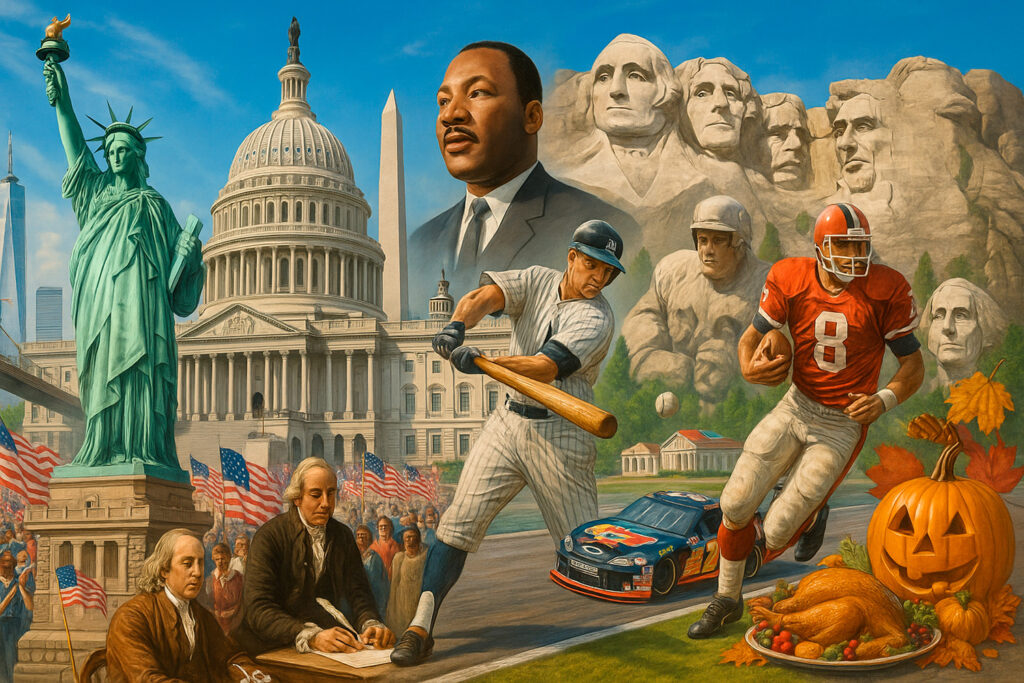
National holidays: symbols of identity
The American calendar reflects its diversity and historical memory. Among the main holidays are:- January 1 – New Year’s Day
- Third Monday of January – Martin Luther King Jr. Day
- Third Monday of February – Presidents Day
- Second Sunday of May – Mother’s Day
- Last Monday of May – Memorial Day
- June 19 – Juneteenth, commemorating the end of slavery in Texas.
- Third Sunday of June – Father’s Day
- July 4 – Independence Day
- First Monday of September – Labor Day
- Second Monday of October – Columbus Day
- October 31 – Halloween
- November 11 – Veterans Day
- Fourth Thursday of November – Thanksgiving
- December 25 – Christmas
Sports: A National Passion
Baseball has historically been the national sport, but today American football holds the top spot in popularity. It is followed by basketball, ice hockey, and motorsports. Leagues like the NFL, NBA, and MLB attract millions of fans. NASCAR and IndyCar dominate racing, while events like the Indianapolis 500 and the 24 Hours of Daytona have global prestige. Tennis also stands out with the U.S. Open, one of the four Grand Slams. In addition, sports such as surfing, lacrosse, and snowboarding have local roots or developments. The United States has been an Olympic host on several occasions (Los Angeles, Atlanta, Salt Lake City) and is the country with the most Olympic medals in history: more than 2,700 in Summer Games and 330 in Winter Games.Technical Sheet of the United States of America
Most popular sports:American football, baseball, basketball, hockey, motorsport
Official Name:
United States of America (United States of America)
Abbreviations:
EUA (in Spanish), USA (in English)
Nationality:
American
Capital:
Washington D. C.
Most populous city:
New York
Form of government:
Federal constitutional republic, with a presidential system
Current President (2025):
Donald J. Trump
Main Language:
English (no official language at the federal level)
Currency:
United States Dollar (USD)
Total area:
Approx. 9,833,517 km²
More than 340 million inhabitants Population density:
Approx. 36 inhabitants/km² Political division:
50 states + 1 federal district + 5 main territories Borders:
It borders Canada to the north and Mexico to the south; to the east with the Atlantic Ocean and to the west with the Pacific Ocean
Major religion:
Christianity (Protestants and Catholics)
Independence:
July 4, 1776 (Declaration of Independence)
Constitution:
Ratified in 1788; in force since 1789
Approximately 22.6 trillion USD (the highest in the world)
GDP per capita:
Approx. 70,000 USD
Economy:
Capitalist, diversified, technologically advanced
International organizations:
UN, NATO, G7, G20, OAS, OECD, among others
Very varied (tropical, arid, temperate, continental, polar) Main cities:
New York, Los Angeles, Chicago, Houston, Phoenix, Philadelphia, San Antonio, San Diego, Dallas, San José
Highlighted national holidays:
July 4th (Independence Day) Thanksgiving Day Day of the Fallen (Memorial Day) Martin Luther King Jr. Day Christmas and New Year




