
 Spanish

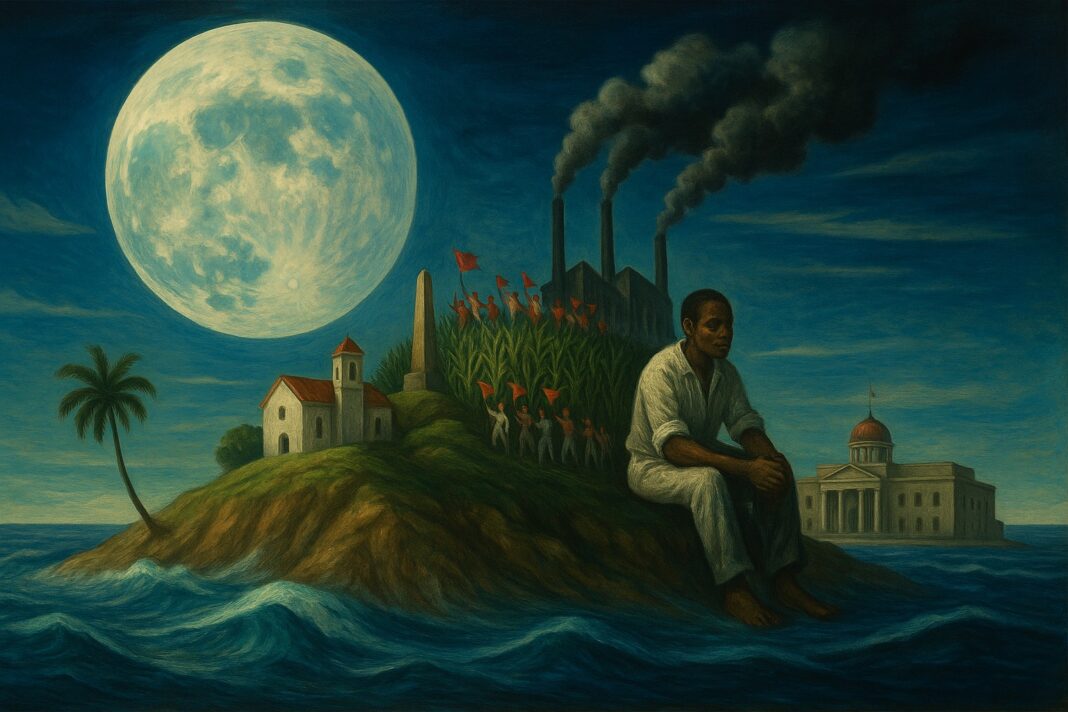
Originally published in 1949, “There is a country in the world” by the national poet Pedro Mir is not only one of the most emblematic texts of Dominican literature, but also a powerful declaration of identity, memory, and social denunciation. With this poem, Mir cemented his role as the lyrical voice of the people and left a legacy that remains current in the collective consciousness of the Dominican Republic.
The poem begins with a resounding statement: “There is a country in the world”, this phrase transforms into a mantra throughout the text, an anaphora that serves as an emotional and ideological anchor. The country that Pedro Mir describes is not simply a geography, but a history marked by suffering, beauty, injustice, and hope.
From his first verses, the poet confronts poverty, the exhausting work of the sugarcane workers, inequality, and oppression, all within the context of the regime of Rafael Leónidas Trujillo, whom Mir openly criticized from exile. Through sensory images and shocking metaphors, the poem denounces the exploitation of field workers and the indifference of national and international powers.
“There is a country in the world”
It is not a poem of evasion or ornamental beauty. It is poetry committed, visceral, pierced by pain and love for the land. Pedro Mir achieves a masterful balance between the lyrical and the political, without falling into the pamphlet. His language is direct, but full of musicality and rhythm, which allows the message not to be diluted, but to resonate in each repetition of that "country in the world".
Mir does not just point out injustices; it also sings the dignity of the Dominican people, their strength in the face of adversity, and their unwavering connection to the land, the sea, and sugar, elements that function as symbols of both identity and exploitation.Today, more than 70 years after its publication, the poem continues to be studied in schools, recited in official events, and cited in social protests. Its relevance lies in its ability to name, with clarity and poetry, the structural evils that still affect the nation: inequality, the neglect of the countryside, the concentration of power, and the fight for justice.
Pedro Mir, who was declared National Poet in 1984, not only gave us a literary work, he gave us an ethical compass. “Hay un país en el mundo” is that mirror in which Dominicans continue to look at their history, their wounds, and their hope.
Fragment of the poem:
“There is a country in the world
placed in the same path of the sun,
native of night,
placed in an unlikely archipelago
of sugar and alcohol.”
Thus begins the song of a man who, upon naming his homeland, defended it, questioned it, and dignified it. That country is, and continues to be, the Dominican Republic.

About the poet:
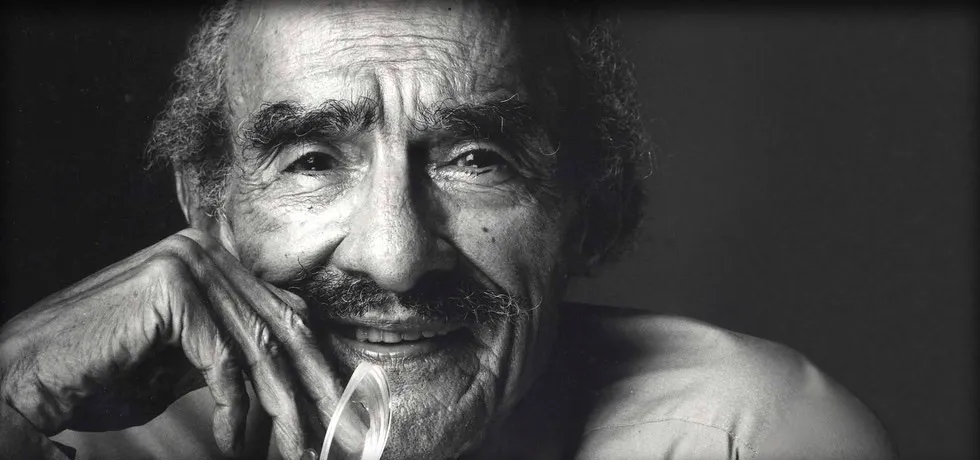
Pedro Julio Mir Valentín was born in San Pedro de Macorís in 1913. The son of a Cuban father and a Dominican mother, he was orphaned at a very young age, which profoundly marked his childhood.
He was a Dominican poet, essayist, historian, lawyer, and professor.
His work is characterized by a deep social sensibility and a firm commitment to justice and national identity. Due to his activism and his ideas against the dictatorial regime that existed in the country, he was forced into exile in Cuba.
He studied Law at the University of Santo Domingo, today Autonomous University of Santo Domingo, but his literary vocation led him to develop a prolific career as a writer.
Pedro Mir was also a university professor and a member of the Dominican Academy of Language. His legacy remains as a symbol of struggle, hope, and love for the Dominican Republic
Throughout his life, he received numerous recognitions both nationally and internationally. In 1984, he was declared National Poet of the Dominican Republic, the highest literary honor in the country. He also received the National Literature Prize and other awards that reflect his importance within Dominican and Caribbean culture.
Pedro Mir passed away on July 11, 2000 at the age of 87. His legacy endures in poetry, critical thought, and in the memory of a people who recognize him as one of their most steadfast and profound voices. His work continues to be read and studied as a testament to love of country, human sensitivity, and commitment to truth.





