
 Spanish

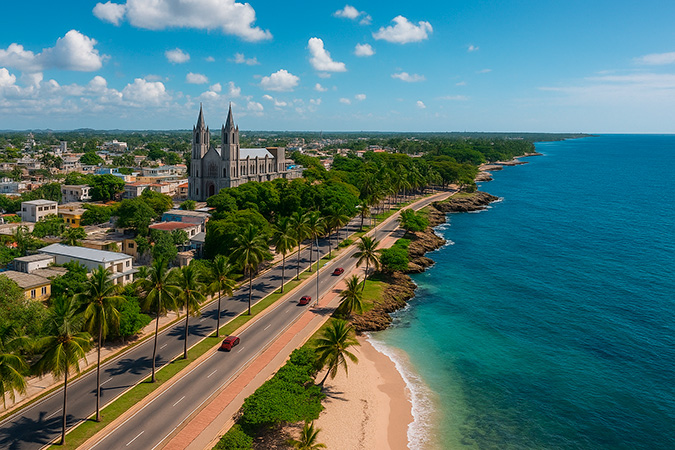
San Pedro de Macorís is not just a province: it is a melting pot of cultures, history, and development that has profoundly influenced the Dominican identity. Located in the eastern region of the country and forming part of the Higuamo Development Region, this province has been the epicenter of the sugar industry, professional baseball, energy production, coastal tourism, and cultural diversity.
A source marked by the Higuamo River
The origins of San Pedro de Macorís date back to the 19th century, when it was just a fishing village on the banks of the Higuamo River, initially known as Mosquitisol. In 1882, during the presidency of Monsignor Fernando Arturo de Meriño, it was erected as a Maritime District and, with the constitutional reform of 1907, it formally became a Dominican province.
During the American military occupation (1916-1924), San Pedro was a focus of resistance thanks to the guerrilla movement Los Gavilleros, which fought alongside El Seibo against foreign domination.
Municipalities and administrative division of San Pedro de Macorís
The province of San Pedro de Macorís has a total area of 1,254.3 km² and is divided into 6 municipalities and 2 municipal districts:
Municipios:
- San Pedro de Macorís (municipality seat)
- Guayacanes
- San José de los Llanos
- Ramón Santana
- Consuelo
- Quisqueya
Municipal districts:
- El Puerto (belongs to San José de los Llanos)
- Gautier (belongs to Consuelo)
Industry, Sugar, and Migration
San Pedro was the heart of the Dominican sugar industry from the late 19th century. Sugar mills like Porvenir, Angelina, Consuelo and Quisqueya marked the economic boom of the area, attracting immigrants from Cuba, Puerto Rico, the English Caribbean islands and Europe. The arrival of the so-called cocolos left an indelible mark on the culture, religion, music and customs of the province.
Today, the province maintains a diversified economy: free trade zones, alcohol distilleries, two cement factories, electric power production, agroindustry, tourism, and even the only Corn Flakes factory in the Caribbean.
Tourism and nature
The largest tourist hub in the province is Juan Dolio, in the municipality of Guayacanes, known for its proximity to Santo Domingo and its wide range of hotels, residences, and gastronomy. Here are golf courses such as Guavaberry and Metro Country Club, as well as beaches such as Guayacanes, Caribe, Boca del Soco and Playa Mortero.
Other attractions include:
- The Cave of Wonders: with more than 500 Taino pictographs.
- Barceló Rum Museum and the historic city center.
- Mallén Lagoon, Río Cumayasa Natural Reserve, Río Soco Wildlife Refuge and Río Higuamo, the longest navigable river in the East.
- Pinewood Dominican Republic Studios, with its water tank for underwater filming.
Sport and Baseball: A Passion for Export
San Pedro de Macorís is recognized as the cradle of Dominican baseball. It has produced more Major League baseball players than many entire nations. Names like Sammy Sosa, Alfonso Soriano, Rico Carty, and Robinson Canó are icons of the national and international sport.
The team Estrellas Orientales represents the province in the Dominican Winter Baseball League, based in the historic Tetelo Vargas Stadium, founded in 1910.
Cultural diversity and human richness
The ethnic and cultural diversity of San Pedro is one of the most marked in the country. In addition to its Cocolo and Antillean heritage, the province has been the cradle of great intellectuals and artists:
- Pedro Mir, national poet.
- Carmen Natalia, poetess.
- René del Risco, narrator.
- Evangelina Rodríguez, first Dominican doctor.
- Mario de Jesús Báez, composer.
Infrastructure and services
San Pedro de Macorís has important hospitals such as the Doctor Antonio Musa Regional Hospital, private health centers, specialized clinics, libraries and universities such as the Universidad Central del Este (UCE). It also has the 911 emergency system and multiple sports and cultural complexes.





