
 Spanish

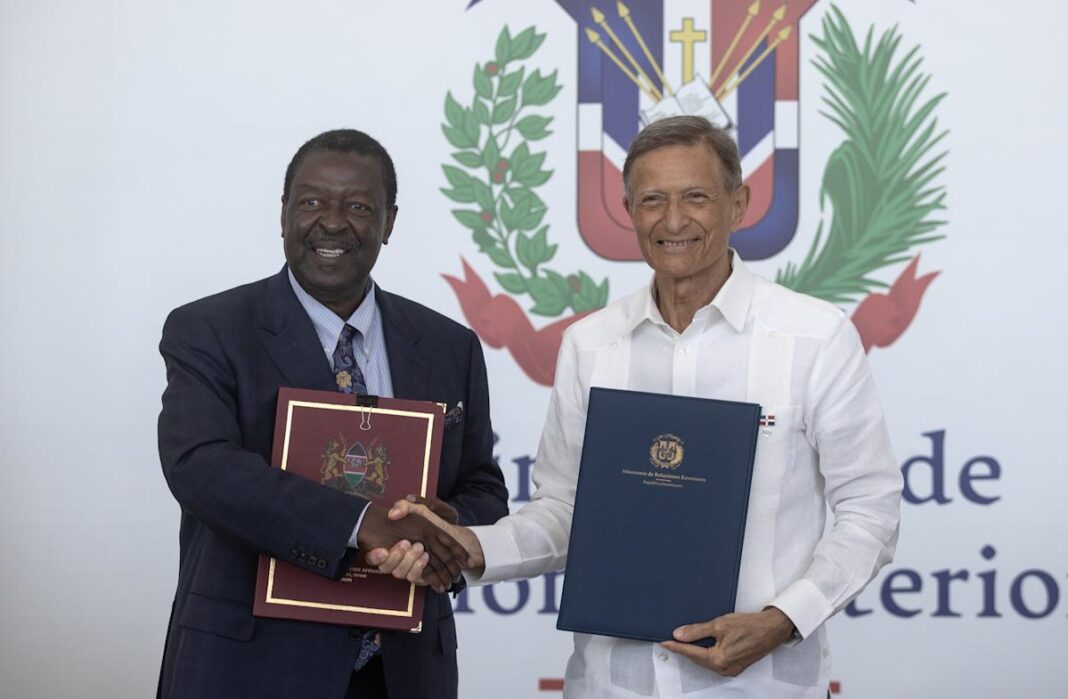

Santo Domingo,- Kenya and the Dominican Republic signed this Monday an agreement in support of the Kenyan police officers who are part of the Multinational Security Support Mission (MSS) in Haiti, led by the African nation, amid the serious crisis affecting all levels of that impoverished Caribbean country.
This is the memorandum of understanding on medical evacuation, repatriation of the wounded and deceased, as announced in a press conference in Santo Domingo by the Kenyan Minister of Foreign Affairs, Musalia Mudavadi, and his Dominican counterpart, Roberto Álvarez.
You may be interested in: Haitian arrested for killing cattle farmer in Estero Hondo
The two chancellors specified in their respective statements that 20 members of the mission have been attended to in the Dominican Republic, which represents "a genuine commitment to those who risk their lives", as Álvarez highlighted, who emphasized the decisive "role" of the MSS in the face of the critical situation in Haiti.
Mudavadi, who is on a two-day visit to the Dominican Republic, underscored the Caribbean nation's support for the force deployed in Haiti.
The MSS "requires a lot of cooperation in terms of sharing intelligence" and the Dominican Republic "has provided invaluable support" in that regard, he affirmed.
"Our request is that we continue to support each other and cooperate for the success of this mission," added the Kenyan minister at the event in the Dominican Ministry of Foreign Affairs, in which a memorandum of understanding was also signed between the Institute of Higher Education in Diplomatic and Consular Training (Inesdyc) and the Foreign Service Academy of Kenya for the training of diplomatic personnel from both countries.
Likewise, Mudavadi maintained that the role of the Dominican Republic "will continue to be valuable" so that more countries of the Caribbean Community (Caricom) join the MSS.
In October 2023, the UN Security Council authorized the deployment of a support mission to the Haitian National Police, in response to the request made a year earlier by the authorities of that country to eradicate the violence of armed gangs.
The MSS in Haiti currently has almost a thousand military personnel and police deployed, mostly Kenyans, but also Salvadorans, Guatemalans, Salvadorans, Bahamians, Jamaicans, and Belizeans.
Initially, the mission was planned to have 2,500 members, but it has faced difficulties with contributions from other countries.
Furthermore, force has not achieved tangible results against insecurity in a Haiti increasingly suffocated by the violence of armed gangs, which control almost 85% of the capital Port-au-Prince.
In the first three months of the year alone, 1,617 people died and another 580 were injured due to violence involving armed gangs, self-defense groups, and unorganized members of the population, as well as operations by security forces, according to data from the United Nations Integrated Office in Haiti (Binuh).
In 2024, violence in Haiti caused at least 5,626 deaths (a thousand more than the previous year), 2,213 injuries, and 1,494 kidnappings, according to data verified by the UN, in a country with more than a million displaced people after having to abandon their homes due to insecurity.





