
 Spanish

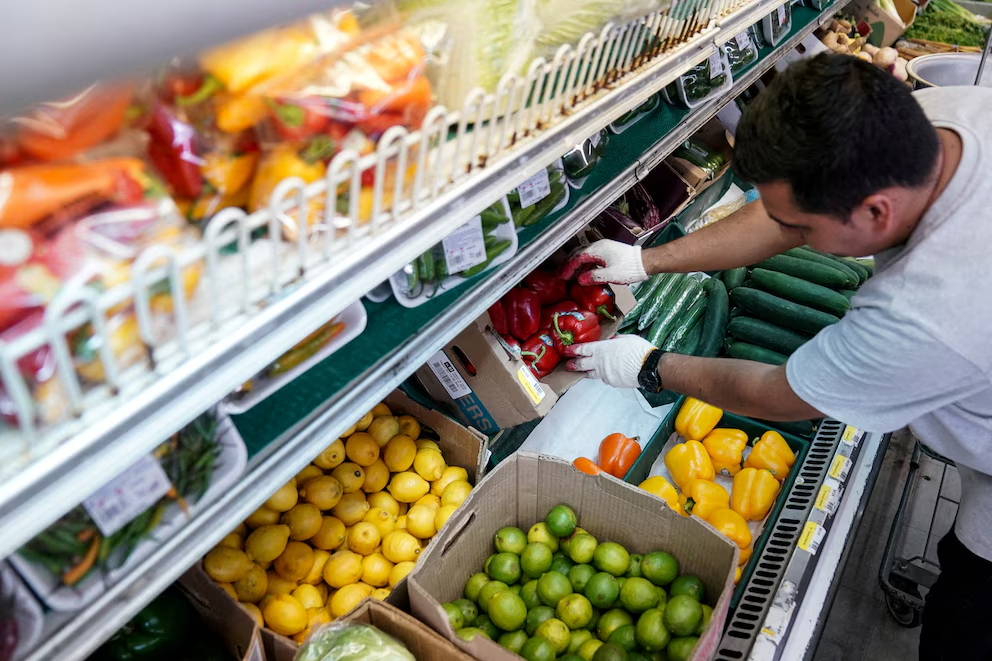

Washington.- U.S. President Donald Trump signed an executive order on Thursday that exempts a wide range of imported agricultural products from tariffs, in an attempt to curb the rising cost of food that worries millions of consumers.
The measure, announced by the White House, is retroactive from midnight and represents a significant change in the trade strategy advocated by the president since the beginning of his term.
The decision temporarily eliminates the tariffs established this year on essential products such as beef, tomatoes, coffee, bananas, avocados, oranges, pineapples, as well as black and green tea, cinnamon, and nutmeg. According to the official statement, the exemption will also extend to other foods that have experienced sharp price increases in recent months, partially driven by the tariff policies of the Administration itself.
The decree instructs the Department of the Treasury and the Office of the United States Trade Representative (USTR) to suspend the increased tariffs and review their economic impact. Kevin Hassett, director of the National Economic Council, acknowledged that the loss of purchasing power of families has become an urgent priority for the White House.
The easing of tariff policy comes after a series of electoral defeats for Republicans in key states such as Virginia, New Jersey, and New York, where the cost of living dominated the political debate. Democratic victories intensified the pressure on the Trump Administration to adopt measures that mitigate the rise in prices in supermarkets.
You can also read: Trump says he will request an investigation into Bill Clinton and others' links to Epstein
Although Trump has repeatedly defended tariffs as an instrument to protect American industry, the new executive order represents a shift from his traditional stance, by acknowledging the impact of these tariffs on consumers' wallets.
Agreements with exporting countries The exemptions will be part of the trade agreements under negotiation with Argentina, Ecuador, Guatemala, and El Salvador, which contemplate the elimination of reciprocal tariffs of 10% and 15% on certain agricultural exports. Once the regulatory frameworks are finalized, products originating from these nations will temporarily be exempt from tariffs upon entering the US market. Economic Effects Since the beginning of the year, the Government had established a base tariff of 10% on most imports and selective increases for certain goods. Although overall inflation has remained stable, economists consulted by Reuters warned that the prices of products such as meat have risen due to supply restrictions and the gradual transfer of tariff costs to consumers, a trend that could deepen next year. With this measure, the Administration seeks to curb that escalation and offer immediate relief to American households, in a context where the cost of living has become one of the central issues of the national political debate.





