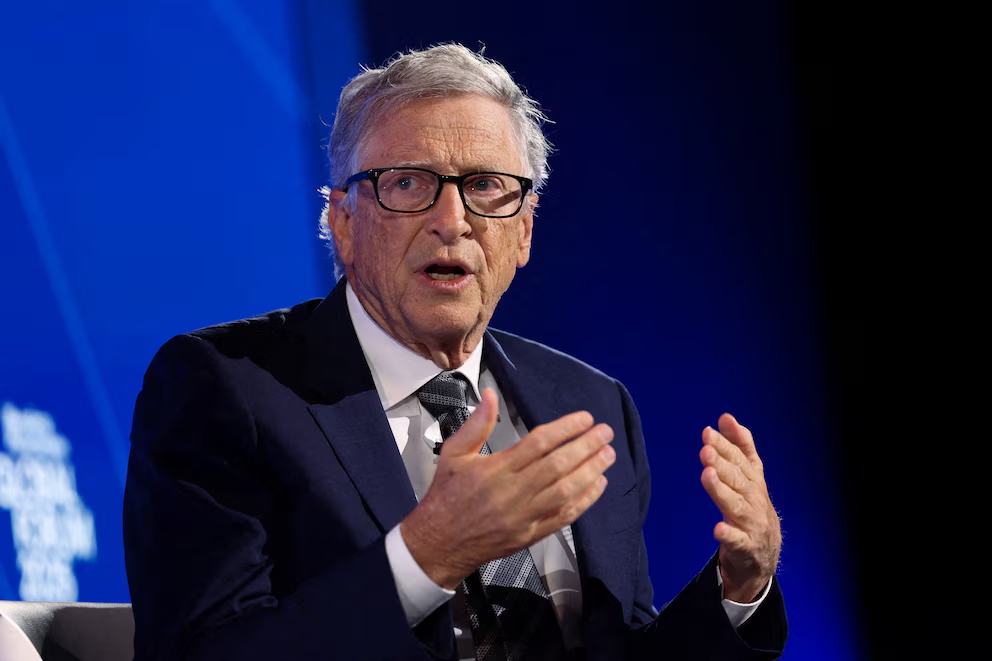
Microsoft co-founder and philanthropist Bill Gates declared this Thursday to the AFP agency that it is "tragic" that child deaths are increasing worldwide for the first time this century, because the richest Western countries have drastically reduced international aid.
The United States has implemented the deepest cuts, and Gates stated that the so-called Department of Governmental Efficiency (DOGE), created by his fellow billionaire Elon Musk, is "responsible for many deaths".
The United Kingdom, France, and Germany have also reduced aid "disproportionately," Gates — the main funder of numerous global health programs — noted during a video interview from Seattle.
Cuts imply that the number of children who will die before the age of five will rise to 4.8 million this year, which is 200,000 more than in 2024, according to the annual Goalkeepers report by the Gates Foundation, published on Thursday.
Gates called the rise in infant mortality a "tragedy," which had been steadily declining from approximately 10 million annual deaths recorded at the beginning of the millennium.
The aid destined for developing countries has fallen by 27% this year, putting at risk the advances against various diseases, such as malaria, HIV and polio, according to the report.
If global cuts of around 30% are consolidated, an additional 16 million children could die between now and 2045, according to estimates from the Institute for Health Metrics and Evaluation (IHME), funded by the Gates Foundation.
"That means 16 million mothers who will face an experience that no one wants or should have to live," Gates pointed out.
"Chaotic" DOGE Snippets
Gates criticized the "chaotic situation" that occurred at the beginning of this year, when Musk's DOGE abruptly interrupted the subsidies managed by the United States Agency for International Development (USAID), which has been dismantled since Donald Trump's return to the White House in January.
"I am speaking with President Trump to try to convince him to restore the aid, so that the cut is, in the worst case, moderate. I don't know if I will succeed," said the 70-year-old businessman.
Gates, one of the main donors to the Gavi alliance —responsible for the distribution of vaccines worldwide—, said he was disappointed that the United States did not renew its funding for the organization in June.
U.S. Secretary of Health Robert F. Kennedy Jr. also sent a video to Gavi's fundraising event "in which he reiterated his extremely refuted and erroneous views that these childhood vaccines should not be used," Gates noted.
“Although the Gates Foundation collaborates with all administrations —and we find certain points of agreement with Secretary Kennedy regarding vaccines—, we have essentially opposing views on the role that vaccines have played in the world.”
Restrictive Budgets
While he acknowledged that "budgets in the developed world are very tight," Gates lamented that international aid is being "disproportionately" targeted for cuts in European countries.
He also indicated that he had discussed these cuts with political leaders in France, where the budget has not yet been finalized.
"I spoke with the prime minister and the president, among others, and I told them: please remember the importance of this… but the budgetary situation is very difficult."
Gates also expressed his confidence that new tools — such as innovative vaccines — will allow to reduce infant mortality rates again in the next five years.
In particular, he highlighted the new vaccines against respiratory syncytial virus (RSV) and pneumonia, as well as a preventive injection against HIV administered every six months called lenacapavir, which began to be distributed this week in South Africa.
The Bill and Melinda Gates Foundation was created in 2000; Melinda French Gates retired last year after the couple's divorce.
In May, Gates announced that he would donate his fortune — exceeding $200 billion — over the next two decades, culminating this process in 2045.
Jessica Sklair, a researcher in elite philanthropy at Queen Mary University of London, told AFP that Gates already exerts "an enormous influence in the field of global health."
The cuts to aid will likely increase that influence, he added, noting that private philanthropy does not seem likely to "step in to fill the void."
Another investigation by the Barcelona Institute for Global Health, published exclusively by AFP last month, concluded that more than 22 million people could die from preventable causes between now and 2030 due to cuts in aid in the United States and Europe. 
 Spanish