
 Spanish


The Government of Honduras officially announced this Tuesday its immediate withdrawal from the so-called “The Hague Group”. The decision, communicated through a statement from the Secretariat of Foreign Affairs and International Cooperation, marks a strategic distancing from the international legal pressure blocs in which the Central American country had actively participated in recent years.
Through the official note, the Honduran Foreign Ministry justified the measure under the principle of national sovereignty, arguing that the State's foreign policy must be executed in an "autonomous and balanced" manner. According to the document, remaining in this group generated dynamics that could "compromise the independence of criteria" necessary for Honduran foreign action. Error en el proceso de traducción With Tegucigalpa as the epicenter of this new directive, the world observes how Honduras tries to navigate the turbulent waters of the geopolitics of 2026, betting on its own voice that, according to the Government, will not be silenced or directed by external blocs.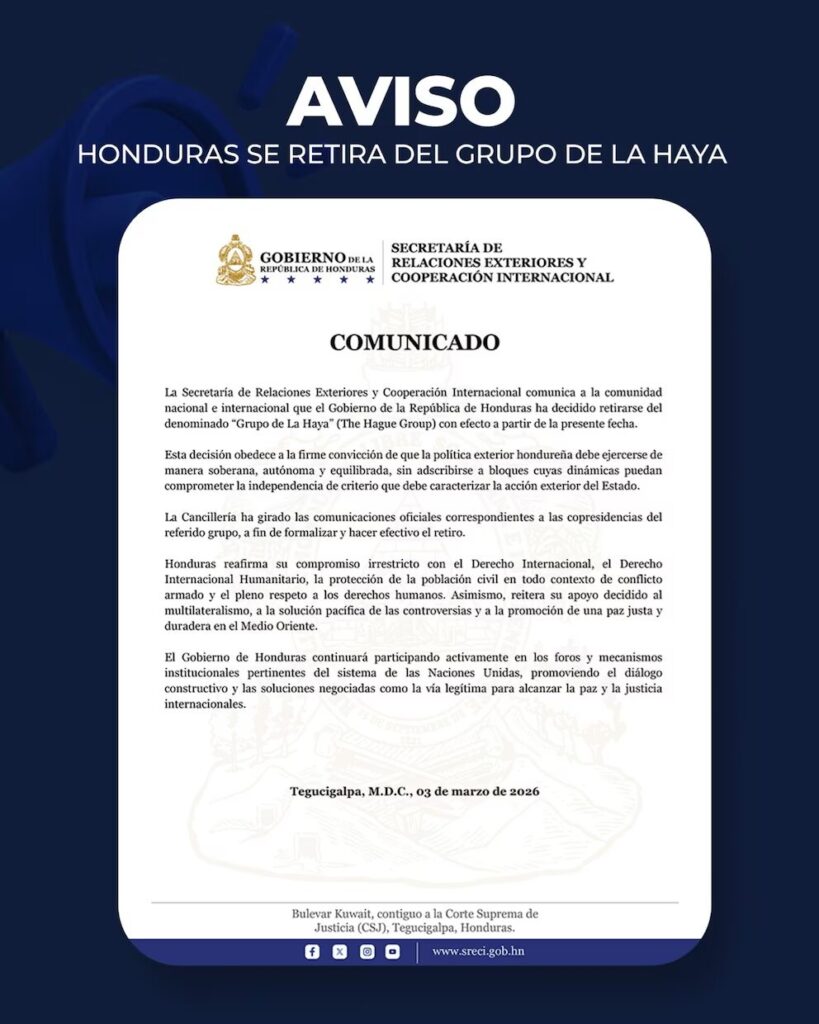
We recommend reading:Young man dies in Honduras after failing to raise money for emergency air transport
Sovereignty versus bloc multilateralism
Despite the break with the bloc, the Honduran Government was emphatic that this does not represent an abandonment of International Law. On the contrary, the statement mentions: “Honduras reaffirms its unrestricted commitment to International Law, International Humanitarian Law and the protection of the civilian population in any context of armed conflict”.
Likewise, the Honduran State emphasized that it will continue channeling its peace efforts through formal institutions, specifically the United Nations (UN) system, promoting negotiated dialogue as the only legitimate way to achieve justice. However, the decision could also draw criticism from sectors advocating for a more aggressive stance in denouncing international abuses, questioning whether the pursuit of "balance" is not, in reality, a form of pragmatism that weakens the voice of small nations in world courts. The withdrawal of the Hague Group marks the beginning of a phase of "Balance Diplomacy" for Honduras in this 2026. By moving away from the dynamics of collective legal confrontation, the country attempts to navigate a multipolar world where sovereignty is, once again, the most valuable currency at the negotiating table.



