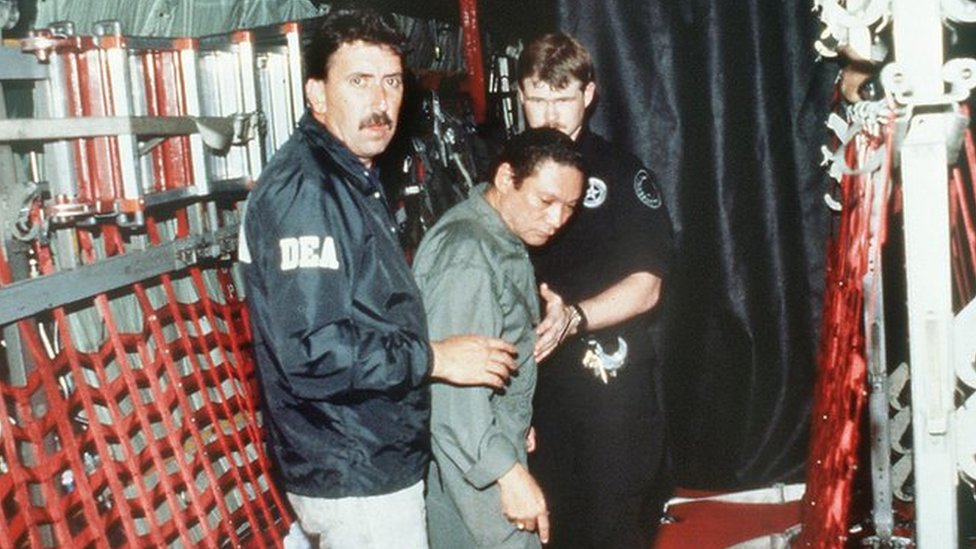
In a day that will be inscribed in the books of contemporary history, this January 3rd saw the capture of the president of Venezuela, Nicolás Maduro, by US forces in a surprise military operation in Caracas, exactly 36 years after Manuel Antonio Noriega, the former dictator of Panama, was arrested and handed over to US authorities on the same date.
The operation against Maduro included selective bombings in the Venezuelan capital and culminated in his arrest along with his wife, Cilia Flores, who were taken out of the country to face charges of drug trafficking and conspiracy in the courts of the Southern District of New York, according to official US sources.
United States authorities, led by former President Donald Trump, described the action as a historic victory in the fight against drug trafficking and organized crime, and announced that they will temporarily assume the administration of the South American country until the installation of a transition government.
The memory of a January 3rd
On January 3, 1990, 36 years ago, Panamanian General Manuel Antonio Noriega surrendered to US forces after weeks of siege at the Apostolic Nunciature of the Vatican in Panama City, an event that ended his regime and led him to trial in the United States on charges of drug trafficking and money laundering.
Manuel Antonio Noriega Moreno was the strongman of Panama during the 1980s. Although he never formally held the Presidency, he exerted absolute control over the country as head of the Defense Forces, influencing civilian governments, elections, and the main decisions of the State between 1983 and 1989.
His fall occurred in the context of the United States invasion of Panama, known as “Operation Just Cause”, which began on December 20, 1989. Washington justified the intervention by alleging the need to protect its citizens, restore Panamanian democracy, and bring Noriega to justice, whom it accused of serious crimes.
After several days on the run, Noriega took refuge in the Apostolic Nunciature of the Vatican in Panama City. The place was surrounded by US troops, who even resorted to psychological pressure tactics, such as playing music at high volume, until the military man finally surrendered on January 3, 1990.
That same day, Noriega was arrested and transferred to the United States to face charges of drug trafficking, money laundering, conspiracy, and extortion. U.S. authorities pointed to him as a key collaborator of the Medellín Cartel and for having allowed Panama to become a strategic route for drug trafficking to North American territory.
Paradoxically, for years Noriega had maintained links with United States intelligence agencies, particularly the CIA, a relationship that was broken when he stopped aligning with Washington's interests in the region.
In 1992, a federal court in Miami sentenced him to 40 years in prison, a sentence that was later reduced. After serving sentences in the United States and France, he was extradited to Panama, where he remained incarcerated until his death in 2017, at the age of 83.
Noriega's arrest set a historic precedent in Latin America, becoming one of the few cases in which a leader in office was captured by foreign forces and tried outside his country. Decades later, the coincidence that another Latin American ruler is arrested on January 3 inevitably revives that episode that changed the political course of Panama and left a deep mark on the region.
Found Reactions
The international community has reacted in a polarized way to the operation. While some governments condemn the action as a violation of Venezuelan sovereignty, other political and social sectors celebrate Maduro's detention as the end of a regime accused of corruption, repression, and collusion with criminal groups.
Analysts point out that this historical coincidence — two captures of Latin American leaders by the United States on the same calendar day with decades of difference — underscores the persistence of US foreign policy in the region and raises questions about the political and social future of Venezuela. 
 Spanish