
 Spanish

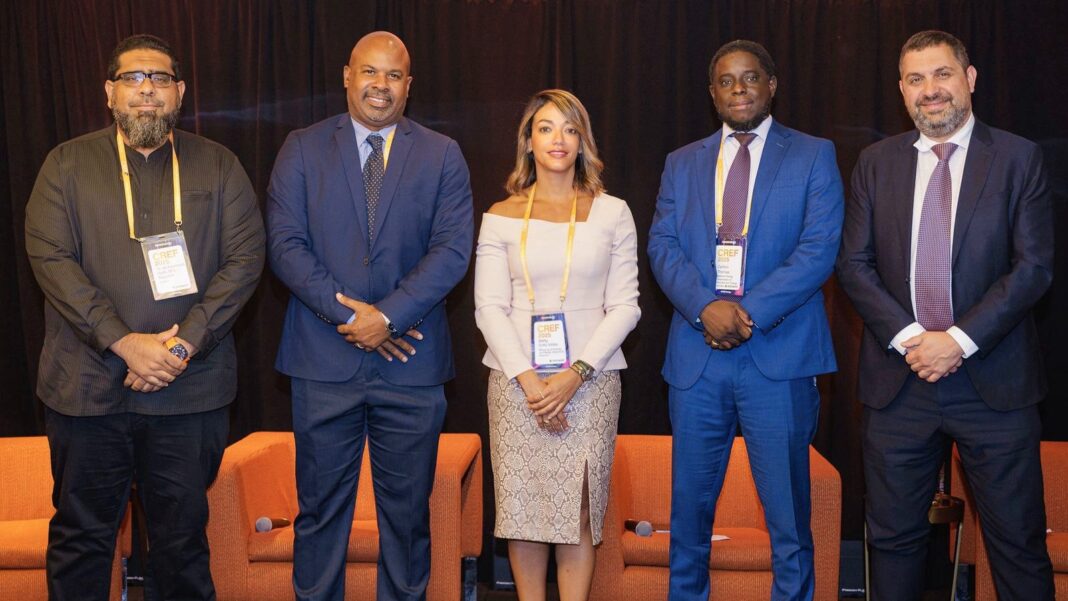

Miami.- Dominican Republic participated in the 17th edition of the Caribbean Renewable Energy Forum (CREF) 2025, by New Energy Events, which took place in Miami, United States, the largest annual event in the region, and which brought together leaders of the electricity sector and representatives from 25 countries.
The Vice Minister of Innovation and Energy Transition, Betty Soto, attended representing the country and addressed as a central theme the steps that the Dominican Republic is taking to promote the energy transition.
Other topics discussed by Soto were the country's challenges in energy matters in the face of economic growth; the modernization of the grid; advances in the regulatory framework; evaluation of the project portfolio, the investment opportunities available to the country, and how female participation in the electricity sector drives progress in energy security and resilience.
Soto said that for the Dominican Republic, the security and reliability of the electrical system is a key priority to guarantee a stable and affordable supply for all productive sectors and citizens.
In that context, he highlighted how the actions of the current government management have gone hand in hand with the actors of the private sector, who have led the generation of energy, and the public sector, which has played its central role in transmission and distribution.
In terms of renewable energy, Soto highlighted that the Dominican Republic has 33 projects in operation, 21 solar energy projects, which will contribute 1,033 megawatts (MW); 10 wind energy projects, which will represent 433 MW, and 2 biomass energy projects, that is, 37.00 MW.
Another of the country's actions presented at CREF by the vice minister were the 111 concessions granted for renewable energy projects since 2020; the investment in executed projects, which amounts to approximately US$1,131,033, and the projects under execution US$822 million.
“In 2024, the energy sector represented 22.18% of foreign direct investment flows,” the vice minister highlighted.
Green Hydrogen in the Caribbean
As part of his agenda at the event, Soto also participated in the panel Advances in Green Hydrogen in the Caribbean, where he highlighted that the Dominican Republic has carried out some initiatives early on in key areas.
He cited that among those actions is the implementation of hydrogen technology in the cement plant of the company Cemex, in San Pedro de Macorís; the realization of the study Prospective Analysis of Green Hydrogen in the Dominican Republic, supported by GIZ, and the presentation of the roadmap Towards a Renewable Hydrogen Strategy for the Dominican Republic.
“In line with this, in January of this year the Dominican Republic became the first country in the Caribbean region to give its approval and recognition to the final design of the Clean and/or Low Emission Hydrogen Certification System for Latin America and the Caribbean (CertHiLAC),” Soto pointed out.
Carolina Silié Ruiz, a partner at Headrick, also participated in the event. 500 representatives from public service companies, promoters, financiers, and investors from the energy, climate, finance, technology, and other industries attended the CREF 2025.





