 Spanish


The regime of Cuba opted for an unusually self-critical tone amid a crisis that severely affects the population. The official commemoration of July 26, National Rebellion Day, became a space where the political leadership tried to combine the call for internal unity with the acceptance of structural problems. Prime Minister Manuel Marrero maintained that the complex economic situation will require addressing internal "errors" and "deficiencies".
Marrero's participation, who led the main event, represented a notable difference from previous years. Neither the dictator Miguel Díaz-Canel nor Raúl Castro assumed leadership of the speech to the citizenry during this event, a decision that repeated the scheme applied in the 2023 edition. This shift in the representation of the head of state in the main political event of the year shows a tendency to delegate spokespersons to figures other than the first historical positions of the country.
During his intervention, Marrero described the current context as one of the most difficult the country has faced. He stated that "like never before" there are "enormous challenges, both internal and external." The statement underscored the exceptional nature of the crossroads and the existence of causes stemming from the state's own management. This approach maintained a balance between the traditional explanation of the crisis – with external factors pointed out – and the admission that there are also deficient decisions and management in the internal sphere.
One of the priority axes identified by the regime was the need to "reduce the annoying blackouts that so affect the population and the economy", a problem whose explicit mention by Marrero ended up making visible the magnitude that the energy crisis has taken on in Cuban daily life. This problem, historically treated with caution in official channels, now occupied a prominent place on the government agenda, and was presented as an essential challenge to overcome in order to achieve economic recovery.
The words used during the central act were revealing of the discursive shift, admitting that the crisis cannot be explained solely as a result of external pressures and that internal errors persist that hinder progress. Marrero, however, avoided detailing the immediate measures to overcome the crisis.
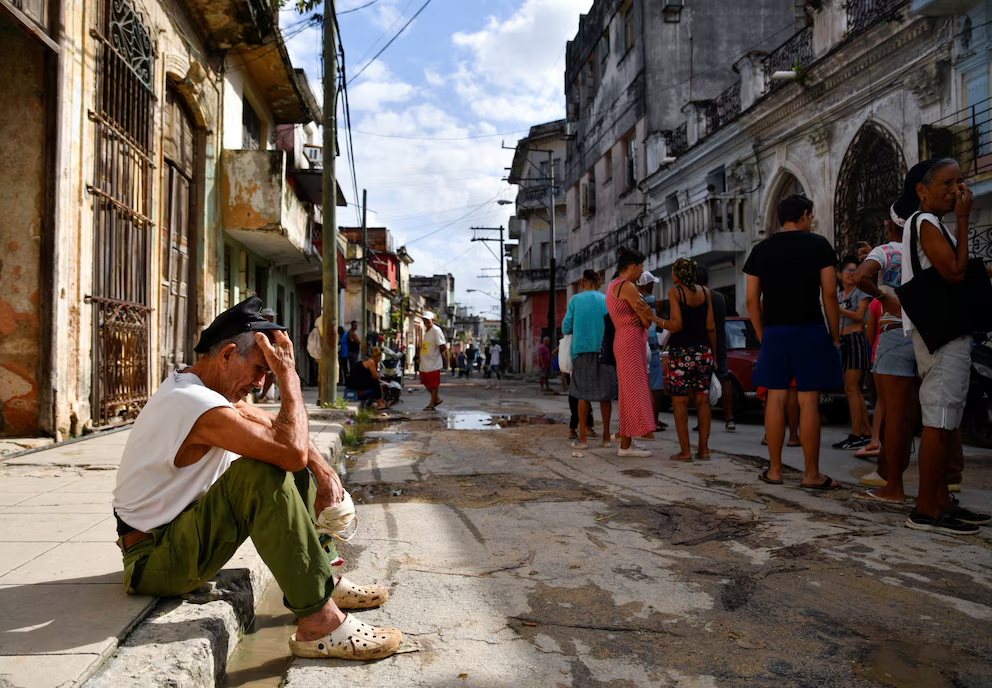
Despite its recognition, this Saturday the population will once again suffer blackouts. According to figures released by the Electric Union (UNE), about 45% of the country will not have electricity during peak consumption hours, which coincide with the afternoon-evening hours. The power cuts, which exceed 20 hours a day in eastern cities like Santiago de Cuba and Holguín, and reach 16 hours in the capital, Havana, set the pace of a prolonged crisis.
The immediate causes behind these massive blackouts stem primarily from the lack of fuel and foreign currency. The electricity generation park is in an obsolete state, as a result of decades of exploitation without sufficient investment to renew or maintain vital infrastructure. Most thermoelectric plants operate with old technologies and show advanced deterioration, which considerably reduces the system's capacity to supply national demand.
The UNE announced that during the peak hour of this Saturday there will be a maximum electrical generation capacity of 2,090 megawatts (MW), insufficient to cover the expected demand of 3,650 MW. This gap represents a deficit of 1,560 MW and a direct impact of 1,630 MW, although in practice the real values usually exceed the official forecasts. In addition, it was reported that 86 distributed generation plants remain out of service, due to the impossibility of acquiring fuels such as diesel and fuel oil in international markets.
Independent instances assessed the situation as the result of chronic underfunding of the electricity sector, under the absolute control of the State since 1959. Various calculations estimate that between 8,000 and 10,000 million dollars would be needed to reactivate and modernize the national electricity grid, an investment that is currently considered unattainable due to the lack of resources and international restrictions.
This scenario of aggravated crisis implies extensive blackout cycles, with a direct impact on the economy – due to the paralysis of industrial and commercial processes – and on domestic life, where the interruption of the electricity supply affects the refrigeration of food, access to water, and the functioning of transportation and hospitals. The energy crisis has become an inseparable component of Cuban reality, marking the political and social priorities of the moment.
Cuba's regime acknowledged internal "errors" and "deficiencies" amid the severe crisis suffered by the population