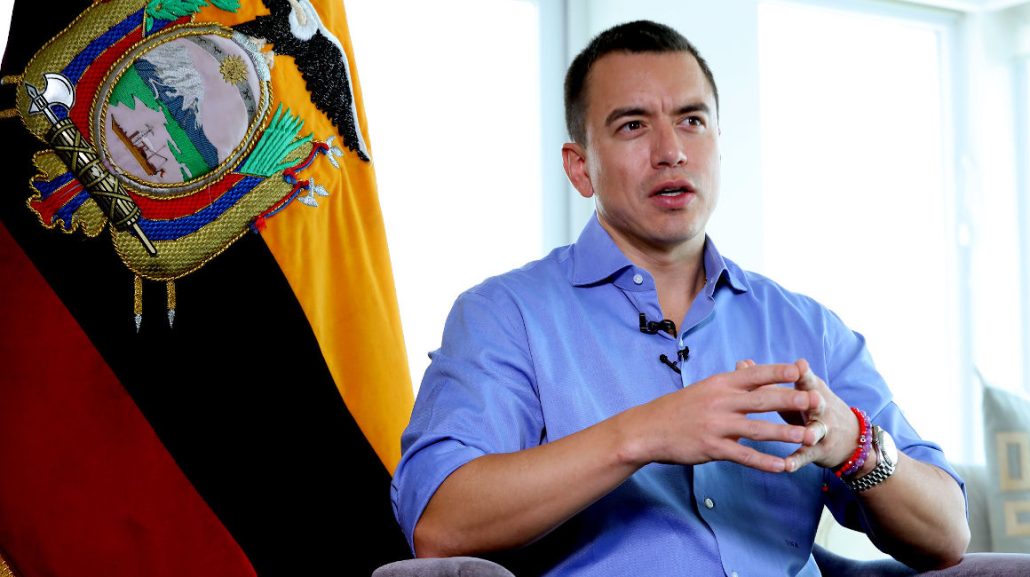
Guayaquil, Ecuador.- The President of Ecuador, Daniel Noboa, once again convened (by decree this Saturday) a referendum for Ecuadorians to decide on the establishment of a Constituent Assembly to draft a new constitution, after the Constitutional Court provisionally suspended a similar one that he issued the day before.
The president repealed executive decree 148, which he issued without first obtaining prior validation of the question from the Constitutional Court, as established by the law, and for which it was suspended; and published another with the same call and in which he calls on the National Electoral Council (CNE) to continue with the process provided for in the Constitution and in the electoral law to take Ecuadorians to the polls.
The CNE plenary had met on the morning of this Saturday to begin the electoral process for the 2025 referendum, scheduled for November and in which there are currently two questions, but did not address the call for the establishment of the Constituent Assembly, due to the Court's suspension.
Instead, the electoral body asked the judges to rule "swiftly" on the precautionary measures filed and the validity of the decree related to the Constituent Assembly.
You can read: Ecuador's Constitutional Court suspends Noboa's decree to convene a Constituent Assembly
However, hours after the CNE session, the decree was repealed by the president and the electoral body has not reported whether it plans to meet again to address the new presidential call.
Provisional Court Suspension
The Constitutional Court provisionally suspended at the last minute on Friday the effects of executive decree 148 in which President Noboa called for a referendum related to the establishment of the Constituent Assembly, after admitting for processing five lawsuits of unconstitutionality filed by human rights organizations and lawyers.
The judges assured that the decisions had been made "in strict respect of the Constitution and the law, with the sole purpose of preventing irreversible effects that could jeopardize democracy, the rule of law, and the participation rights of all Ecuadorians."
However, President Noboa pointed out this Saturday in one of his new decrees that "no body is above the will of the Ecuadorian people" and that "in use of the conferred attributions and in strict compliance with the democratic mandate received from the citizenry", it is his duty "to guarantee that the popular will is respected and channeled through the mechanisms provided in the Constitution, without interference".
The controversial call to launch the process of a Constituent Assembly coincides with the open struggle that Noboa maintains with the Constitutional Court, which he accused of "political activism" by limiting a series of laws and states of exception promoted in recent months by the ruler, which accumulate numerous claims of unconstitutionality by warning of possible violations of fundamental rights.
The constitutional judges have also denied four questions of the referendum proposed by Noboa, decisions that the president strongly criticized and that led him to lead two massive marches against the magistrates in Quito and Guayaquil.
The Constituent Assembly, with which Noboa seeks to change the magna carta approved during the term of former President Rafael Correa (2007-2017), was one of his biggest campaign promises in the electoral campaign in which he managed to be re-elected as ruler of Ecuador for a full term (2025-2029), after having come to power in 2023.

 Spanish