
 Spanish

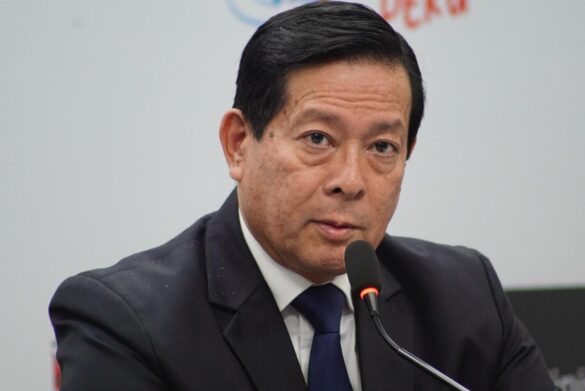

Lima.- Peruvian Prime Minister Eduardo Arana affirmed this Thursday that his country is called to lead economic growth in the region in 2026, because it has become a "geopolitical axis" in the Pacific, due to its "fiscal stability, with confidence in the markets, seriousness and with commitment" to decentralization.
Arana pointed this out when presenting to the plenary of Congress the public sector budget bill for 2026, which amounts to 257.562 million soles ($73.171 million), in addition to the debt and fiscal balance for next year.
After the substantiation of the budget project was known, it was questioned by congressmen from various benches, who pointed out that, in reality, it will represent a decrease in public investment and an increase in current expenses. The President of Congress, the conservative José Jericó, considered that "in real terms the country will not have more resources than the previous year" and is "facing a budget that is still maintained, almost unchanged, and that therefore demands greater efficiency in allocation and execution." In turn, right-wing parliamentarian Lady Camones also said that the 5,000 million soles more imply "a fairly low increase compared to previous budgets, which is not a minor fact, and is a clear sign that the Executive is proposing a low-impulse, adjustment, containment fiscal strategy, it will not reactivate the economy, it will not generate employment, and boost domestic demand." For his part, leftist Edgard Reymundo commented that the budget "does not respond to the great gaps" facing his country and that it will affect young people and children "who will continue to study in schools that are falling apart, and those who are treated in public hospitals who die for lack of doctors and medicines". Fujimorist Ernesto Bustamante also warned that the budget allocated to science and technology comprises a "tiny amount", compared to what neighboring countries invest, and considered it "unacceptable to cut 14% of the budget to Concytec (National Council of Science, Technology and Innovation)".
Read more: Paniagua Feliz highlights electronic notary signature at conclave in Peru
The prime minister assured that the budget has a "decentralized approach" and addresses "the needs of the most vulnerable sectors", so it will be distributed "efficiently" so that institutions and different government bodies meet their goals. "Development and growth with responsibility; development and growth with seriousness," he assured before indicating that the budget comprises 5,761 million soles more than that of this year, an increase of 2.3%, which he considered "consistent with the economic expansion" of his country and to guarantee fiscal sustainability. "By 2026, 61.4% of the decentralized budget will be executed by regional and local governments, an amount higher than in 2023. Therefore, this budget primarily addresses the government's major challenges," he said. He detailed that this has to do "with the needs and expectations" of citizens on issues of citizen security, education, health, social protection, water and sanitation, national connectivity, and agriculture and irrigation. The proposal, which was supported by the Minister of Economy and Finance (MEF), Raúl Pérez Reyes, indicates that regional governments will have a budget of 59.164 million soles, of which 14.325 will be allocated to project investments, while local governments will have 34.175 million soles, 12.985 million of which will be for investments. In that sense, 77% of the budget will be allocated to investment expenditure in order to continue and ensure that the works are not stopped, 13% will be for new investments and projects "where they are most needed" and 10% to the elaboration of new studies and technical files that allow the launch of future projects. Criticism for decrease in public investmentAfter the substantiation of the budget project was known, it was questioned by congressmen from various benches, who pointed out that, in reality, it will represent a decrease in public investment and an increase in current expenses. The President of Congress, the conservative José Jericó, considered that "in real terms the country will not have more resources than the previous year" and is "facing a budget that is still maintained, almost unchanged, and that therefore demands greater efficiency in allocation and execution." In turn, right-wing parliamentarian Lady Camones also said that the 5,000 million soles more imply "a fairly low increase compared to previous budgets, which is not a minor fact, and is a clear sign that the Executive is proposing a low-impulse, adjustment, containment fiscal strategy, it will not reactivate the economy, it will not generate employment, and boost domestic demand." For his part, leftist Edgard Reymundo commented that the budget "does not respond to the great gaps" facing his country and that it will affect young people and children "who will continue to study in schools that are falling apart, and those who are treated in public hospitals who die for lack of doctors and medicines". Fujimorist Ernesto Bustamante also warned that the budget allocated to science and technology comprises a "tiny amount", compared to what neighboring countries invest, and considered it "unacceptable to cut 14% of the budget to Concytec (National Council of Science, Technology and Innovation)".





