
 Spanish

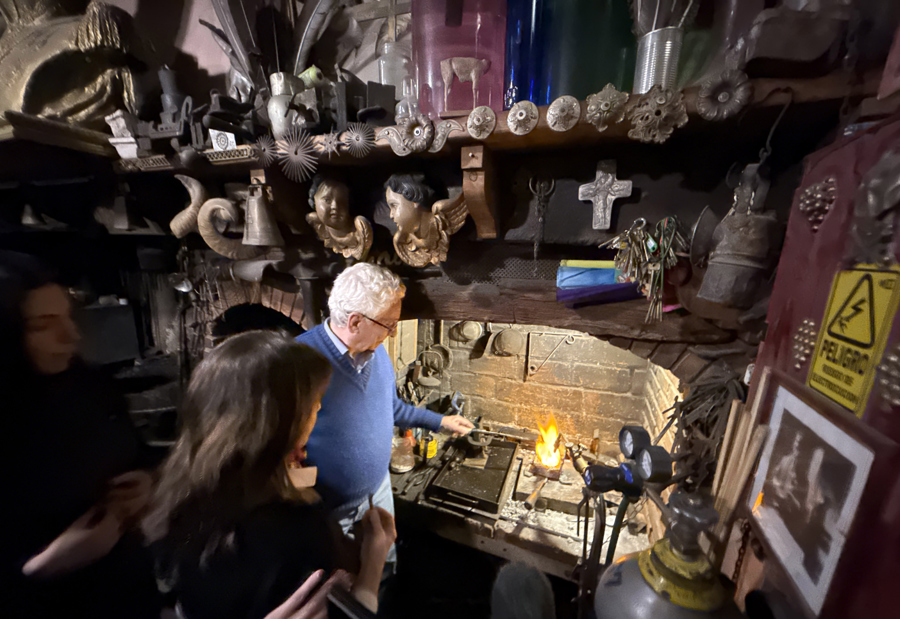

In his home-workshop in San Telmo, one of the mythical neighborhoods of Buenos Aires, Pallarols gathers his relatives and family to make them witnesses to the beginning of a new work of art.
Amidst glasses of wine, greetings, hugs, relics, sarcophagi, paintings by renowned artists, and a grand piano, Pallarols, 82, lights the fire, places a small crucible in the oven, and distributes to his guests pieces of metal, which correspond to rose petals made with melted bullets.
The gathered, one by one, pass before the furnace, throw in the metal, and turn the workshop into a place of pilgrimage.
Previously, they had hand-chiseled the base of the chalice, as the objective is for the ciborium to reach the Vatican imbued with the work and spirit of many people. "Unite humanity," says the artist.
In his workshop, crammed with tools, old hardwood tables and a furnace that melts gold, silver and bronze, the goldsmith makes another announcement during an interview with EFE: the chalice of Leo XIV, in addition to bullets, will carry remains of reliquaries that he himself made with his hands for the first Argentinian saint, Hector Valdivieso.
"I made the reliquaries for the parishes of the 24 provinces (of Argentina) and some for Spain, because they killed him in Asturias, and I had several pieces of bronze left over from all that material," he states.It is also said that before taking the chalice to Rome, Pallarols will take it around the Argentine provinces and travel with it to Chiclayo, the city in northern Peru where León XIV was bishop.
Milei returned the baton of command
There are two types of artwork that have given Juan Carlos Pallarols worldwide fame: the roses of peace, made with melted bullets from current and past conflicts, such as the Falklands, the Spanish Civil War, or World War II, and the ceremonial staffs he has made for the presidents of Argentina.
He made his first cane for Juan Domingo Perón, in 1973, and then he made it for all the presidents after the dictatorship: from Raúl Alfonsín (1983-1989) to Javier Milei, who rejected it in 2023 because he had not sculpted the heads of his three dogs in silver.
Regarding this eccentricity, Pallarols recalls: "He returned it to me because I didn't want to make him some little dogs on the handle. In a national emblem you can't put little dogs or my mother's portrait, or anyone's. Each emblem has a form of construction and design. And he returned it to me with a letter. They later made another command staff with the little dogs".
"I have it there, in my collection of canes. I have the canes that I have recovered because I have bought them, some have been given to me by the relatives of the presidents who used them," he adds without rancor, but with pride, while showing EFE those works of art in precious metal and wood. Regarding Milei's cane, he adds: "I don't know what I'm going to do because it's not mine, I was paid when I handed it over, that is, it's property of the Presidency. I think what the president did in returning it is very imprudent, it's not correct."Neither Dalí nor Johnny Deep, with unknown people
Hollywood celebrities, Arab princes and European queens, billionaires from all over the world and ordinary people have paraded through the Pallarols workshop. The doors of this house-museum are always open to artists who play the piano or accordion, or sing tango, milonga or malagueña.
"Yes, to many famous people, but when I try to remember, it fades from my memory," he replies when EFE asks him which well-known people have commissioned works and visited him in San Telmo. Think a little and, after boasting of friendship with Joan Manuel Serrat, states: "Johnny Deep was here and commissioned me to make the bust of an Austrian actress, who was also a scientist and invented a communications system in World War II."Hedy Lamarr was the architect of long-range wireless communication and Deep commissioned her bust from Pallarols to then ask the Austrian authorities to display it in a public square. The American actor believes that Lamarr has not been honored as she deserves.
The artist continues: "Dalí had asked me for a mate, with his mustache made of gold, large, but he died while I was making it."Despite having met many important people throughout his life, Pallarols confesses that "the most beautiful works are not for famous people, they are for those who feel the silversmithing, the celebration, who understand what it is to capture something for a lifetime. They do it with more honesty, without exhibitionism and, therefore, it is more beautiful and more authentic".
With that authenticity, the famous goldsmith from San Telmo will travel to Rome to deliver his chalice of peace to Pope Leo XIV.Esther Rebollo





