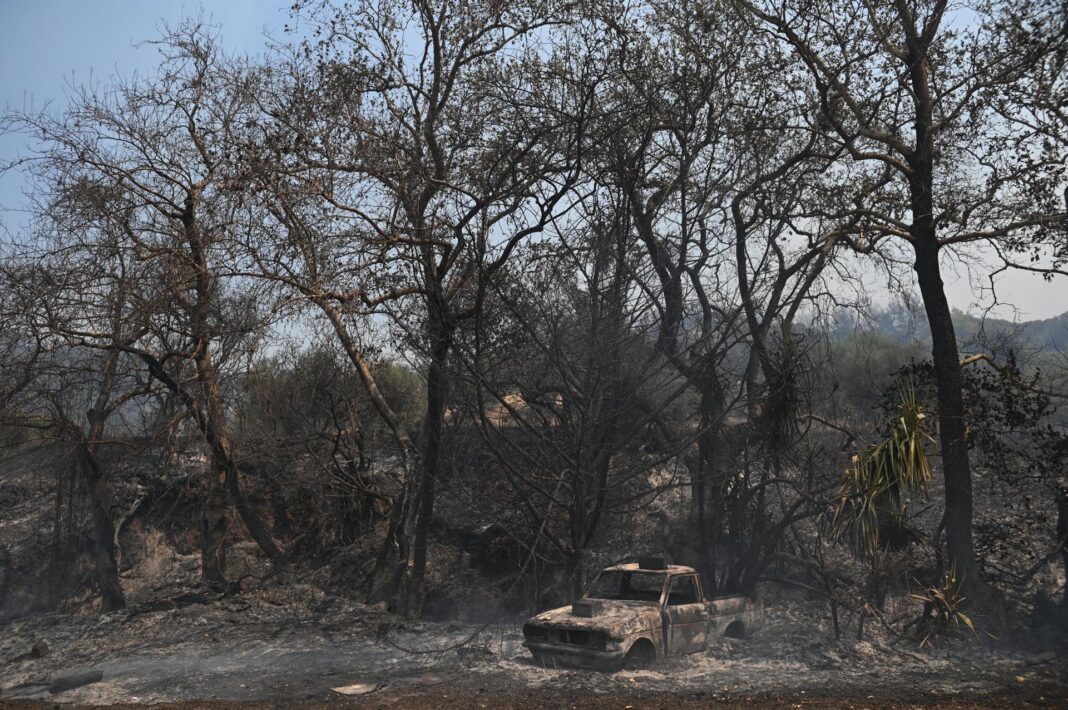
Environment Writing.- Extreme temperatures persist in Europe, with suffocating days and tropical nights that have led authorities in different countries to activate multiple alerts; in addition, the wave of
fires continues to affect Spain, Greece, Turkey, Portugal and the Balkan peninsula.
Two new fires in Turkey
Firefighting teams are trying to control two new fronts declared yesterday in southern Turkey this Thursday, amid strong winds and temperatures of up to 38 degrees, one of which affects Silifke, a district in the province of Merion, on the Mediterranean coast of southern Turkey, where the wind complicates the tasks.
According to the Anadolu news agency, the extinguishing teams worked all night and aerial means began to operate early in the morning.
Also, teams are also struggling to contain the fire that started yesterday in Hatay, on the border with Syria, a rugged terrain that is difficult to access.
The operation has ten helicopters, 122 vehicles and 344 people and, as a preventive measure, the residents of five villages were evacuated and a highway has been closed to traffic.
Since July, hundreds of fires have caused the death of 15 people in Turkey who were fighting the flames.
Three dead and over 100,000 hectares destroyed
The wildfires that continue to be active in Spain have already left three fatalities and, according to the European Forest Fire Information System (EFFIS), 105,000 hectares burned so far in 2025, more than double in the same period in 2024.
The latest victim is a 37-year-old man who died this Thursday after suffering burns to 85% of his body while fighting the fire that spread to the province of León (north of the country).
Also died, with 98% burns on his body, a 50-year-old hospital worker in Tres Cantos (Madrid), while trying to rescue horses, and a 35-year-old man trapped in the fire in Castilla y León while carrying out clearing work on his own.
Castile and León, Galicia (both in the north of the country) or Andalusia (south), to which Asturias (north) and the Valencian Community (east) have recently been added, maintain active hotspots, aggravated by a heat wave that has already lasted ten days, in addition, the number of fires has risen to 201 so far this year.
Portugal battles 32 rural fires
More than 2,800 personnel, 900 vehicles and 20 aerial resources are fighting this Thursday against 32 rural fires in Portugal, on a day with a high temperature warning in more than half of the country.
The National Emergency and Civil Protection Authority reported seven "significant incidents" in the districts of Viseo (center), Coimbra (center), Vila Real (north) and Guarda (center), which are being fought by about 2,500 firefighters, 800 vehicles and 19 aerial resources.
The most worrying fire is the one in Arganil, in Coimbra, active since Wednesday, where 919 personnel, almost 300 land resources and seven aerial resources are working.
Following high temperatures, the Portuguese Institute of the Sea and Atmosphere (IPMA) has placed ten of the country's 18 districts on orange alert, many of which border Spain. Furthermore, Portugal maintains the state of alert until this Friday to facilitate prevention and combat against the flames.
100,000 hectares in Albania and North Macedonia
North Macedonia has lost about 50,000 hectares of forest this summer due to fires, while another 49,000 have burned in Albania, according to data published by the authorities of both countries.
In the last 24 hours, the North Macedonian National Crisis Management Center has declared 18 new outbreaks, four of which are still active, the most dangerous being that of the Jasen hunting reserve, about 20 kilometers south of Skopje.
In Albania, the situation has improved due to milder temperatures and gentle winds, after three days of intense fighting against the fire that left two dead in the central county of Elbasan, the most affected area with ten damaged localities, in addition, residents have begun to return to their homes and roads have reopened.
Greece manages to contain the main fires
The situation has improved this Thursday on the six major fire fronts in Greece, which have burned more than 10,000 hectares in two days, as reported by the Fire Department, while it is being investigated whether several of these were caused.
The advances are especially notable in Zakynthos, in the Ionian Sea, and in Filippiada, in the northwest, with 1,800 and 1,700 hectares burned, respectively.
In Zakynthos, there are no active fronts, but control and surveillance efforts continue, while in Filippiada, scattered outbreaks persist. Meanwhile, in Achaea, in the northern Peloponnese, eleven aerial vehicles are working to contain the flames, and on the island of Chios, in the Aegean Sea, the fire is advancing in hard-to-reach areas, supported by two planes and six helicopters.

 Spanish