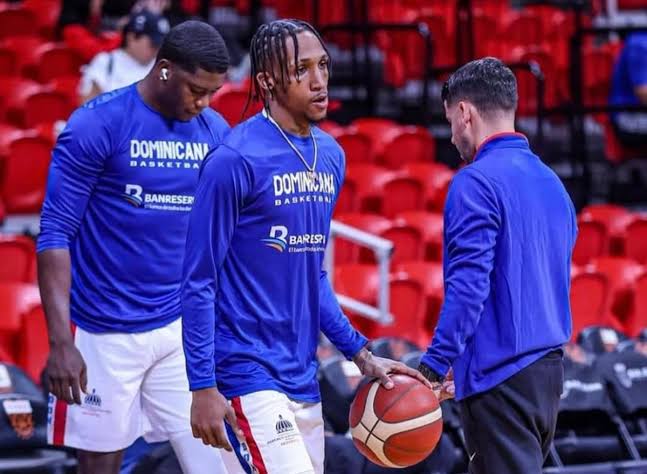
Santo Domingo. The recent decision by the Dominican Basketball Federation (FEDOMBAL) to indefinitely suspend player Jassel Pérez from the national team program has generated mixed opinions. But, beyond the noise, it has revealed a worrying reality that goes beyond sports: that of a young talent who urgently needs help to redirect his personal and professional life.
You may be interested in:Jassel Pérez speaks out and apologizes after being left out of the national team
At just 24 years old, Jassel Pérez is one of the biggest prospects in Dominican basketball. Possessing natural talent, with uncommon physique, speed, and explosiveness, he has shown in multiple scenarios that he has the potential to go far. However, his behavior on and off the court has eroded the trust of coaches, leaders, and fans, leading to this drastic measure: removing him from the national team.
This sanction should not be seen as a simple punishment or an act of authority, but as a serious and necessary wake-up call. Moreover: it should be interpreted as an opportunity. Not to exclude, but to rescue. Not to destroy a career, but to save a life.
Uncontrolled talent: a time bomb
The history of sports is full of promises that, due to a lack of emotional structure, guidance, or adequate support, ended up squandering their potential. Jassel, unfortunately, is on that dangerous path today. Impulsive attitudes, gestures of rebellion, disciplinary conflicts, and erratic decisions have begun to tarnish what should have been an upward trajectory.
Now is not the time to point fingers or crucify him on social media. It's time to show empathy and human understanding. We're talking about a young man who, like many, has probably grown up in a complex environment, without the emotional preparation to handle the pressure, sudden fame, and expectations that fall on a rising sports figure.
The Responsibility of the Environment
Beyond individual failures, there is also a collective responsibility. Young players are often thrown into the elite without being prepared for the demands of stardom. Teams, leagues, federations, and agents must assume their role as comprehensive trainers, not just performance enhancers.
Jassel Pérez doesn't need more sanctions. He needs psychological and therapeutic support, mentors, guidance, and a real support system to help him regain his emotional balance and sporting purpose.
There's still time
The positive thing is that time is still on his side. At 24 years old, most athletes are just entering their competitive prime. If Jassel manages to turn this moment into a turning point, he can rebuild his path, strengthen his character, and return with more maturity to the stages where he is needed: the court and the national team.
But that process cannot fall on him alone. FEDOMBAL, the clubs, the Ministry of Sports, and even the private sector should join forces to design a comprehensive plan for rehabilitation and personal development. It would be an important institutional signal that the sanction is not a final point, but the beginning of a recovery process.
A lesson for everyone
The case of Jassel Pérez should serve as a warning to other young athletes: talent is not enough. Discipline, attitude, humility, and self-control are as essential as scoring points or making spectacular plays.
It should also inspire federations and coaches to prioritize mental health, create psychological and emotional development programs, and offer safe spaces for athletes to express their inner struggles before they overwhelm them.
Conclusion: the ball is still in their hands
Jassel Pérez can still write a great story: one of redemption, learning, and maturity. But to achieve it, he must recognize that he has a problem, accept help, and commit to his personal transformation.
And as a society, we must change the approach. Instead of mockery or condemnation, let's offer support, understanding, and constructive demand. May this sanction not be a closure, but the beginning of a different and better stage.
Jassel's talent is not in question. What is at stake now is his future as a professional, as a citizen, and as an example for the coming generations. The time to act is now. And, as in basketball, time is running out... but there's still a game to play.

 Spanish