
 Spanish

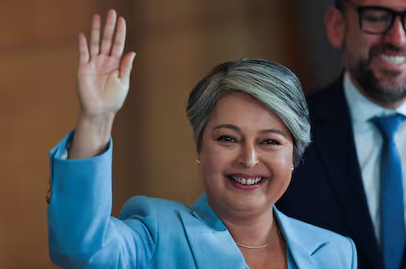

Santiago de Chile.- At the head of the broadest progressive coalition in the country's history, former minister Jeannette Jara made history this Sunday by becoming the first communist to win the first round of a presidential election in Chile, but did not get enough votes and will seek to stop the far-right José Antonio Kast in the second round in December.
"Hate, criticism of others, and exacerbating fear are not enough to govern a country," he said this Sunday after casting his vote in Conchalí, one of the humblest neighborhoods in Santiago, where he was born and lived part of his childhood.
A communist militant since adolescence, former student leader, lawyer and public administrator of 51 years old, Jara was almost unknown until in March 2022 she joined Gabriel Boric's government as Minister of Labor.
The approval of some of the most emblematic laws of this Administration, such as the reduction of the working day and the pension reform, earned him great popularity and made him win the open primaries to the citizenry that progressivism celebrated in June, prevailing over the candidate of social democracy, also former minister Carolina Tohá.
You can read: Who is Rodrigo Paz Pereira, the new president of Bolivia?
"The agreement reached for the pension reform catapulted it because it achieved cross-party consensus with the support of the ruling party, the business sector, and the right," Octavio Avendaño, a political scientist from the University of Chile, told EFE.This Sunday, on the way to her polling station, a crowd of neighborhood residents accompanied and encouraged her with applause: "I am fortunate to be able to walk peacefully down the street among the people who know me and those who don't," she said.
Less dogmatic than the communist direction
Daughter of a mechanic and a homemaker, Jara is the eldest of five siblings and has spoken on multiple occasions about the economic difficulties her family went through when she was a child. "Her social background, the knowledge that things are difficult, that everything gets complicated, is what has marked her the most, even more than the party," historian Cristian Pérez, from the University of Playa Ancha, told EFE. Considered a less dogmatic figure than other communist leaders, she was not the first choice of the party leadership, with whom she has publicly maintained differences, such as when she admitted that there are political prisoners in Cuba and the president of the formation, Lautaro Carmona, publicly contradicted her. During his campaign, he announced that, if he were to become President, he would "suspend or resign" from the party as a sign that he represents "a much broader coalition" and try to convince the centrist sectors who see his membership as an impediment to winning. Her career in the public sector began in the second Administration of former President Michelle Bachelet (2014-2018), when she was appointed Undersecretary of Social Welfare. Since then, they have maintained a relationship of political and personal affinity and are often compared for their empathetic and close style. More than a decade later, she was proposed to take over the Ministry of Labor, a portfolio that had not been in the hands of the PC since 1973."Vital Income"
Jara, who leads a coalition ranging from Christian Democrats to communists, has focused his campaign on the "cost of living" and the importance of "being able to make ends meet." However, like the other candidates, it has prioritized security, economic growth, and control of irregular migration, the main concerns of citizens. One of his star proposals is a "vital income" of 750,000 pesos (about 800 dollars), but he has also promised to seek to lift banking secrecy to combat organized crime and reform the public health system.Although in the campaign she has tried to distance herself from Boric and has said that she has a "style" of her own, for the second round she has the challenge of not being just the candidate of the Government and multiplying the support of the ruling party, which has not managed to exceed 30% approval.
It also has the challenge of overcoming the anti-communist sentiment that exists in part of Chilean society and that both the far-right and the traditional right have sought to foster during this campaign. "We'll see if anti-communism prevails more in Chile than anti-Pinochetism," Avendaño concluded.




