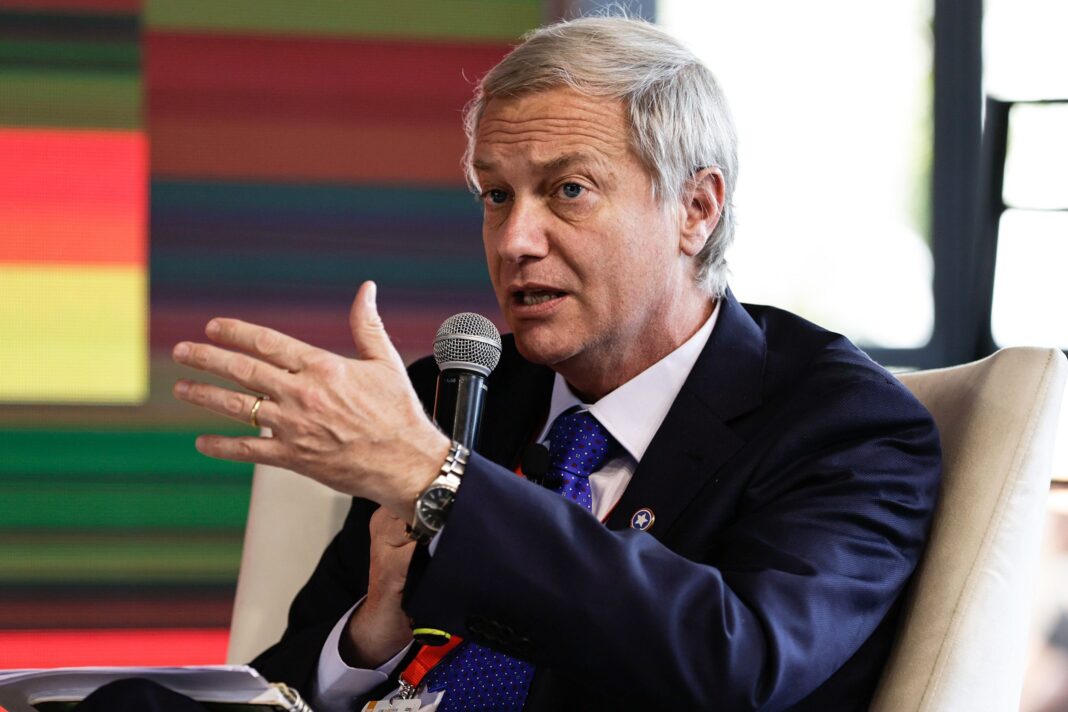
Santiago de Chile.- With an almost monothematic campaign, focused on combating crime and irregular migration, the far-right former deputy José Antonio Kast came second in the presidential elections this Sunday, with the xxx of the votes, and managed to pass to the second round of December against the leftist Jeannette Jara.
"We are not just talking about winning an election, we are talking about reclaiming our country," said Kast this week in his campaign closing, a 59-year-old ultra-Catholic lawyer and father of nine children.
Unlike his other two attempts to reach the Presidency (2017 and 2021), in this campaign Kast has avoided at all costs speaking publicly about his ultraconservative convictions regarding individual freedoms, such as abortion, same-sex marriage, or the morning-after pill, as well as his defense of the military dictatorship (1973-1990).
When asked, in the few interviews granted, he has limited himself to saying that he has "the same convictions", but that "Chileans today have other urgencies".
You can read: Chile will hold a second round between leftist Jara and far-right Kast
Kast, who four years ago stated that if Pinochet were alive he would vote for him, "learned from his previous campaign and this time has a very clear strategy, with a very reduced program, focused on citizen security", Cristóbal Rovira, academic at the Pontificia Universidad Católica, told EFE.
His big promise is to form an "emergency government" with which to apply a firm hand against crime and irregular migration and solve the "worst crisis of the last decades" in which Chile is mired.
"The Alternative to Chaos"
Mass deportations, shielding of the northern border with fences and ditches, maximum security prisons with total isolation for drug trafficking leaders, and tougher penalties for any crime are some of the measures he promises if he wins next December 14th.
It also proposes to criminalize irregular migration and limit public benefits in health, education, and housing for undocumented migrants.
Although crime has increased in recent years, Chile remains one of the safest countries in the region, with a homicide rate in 2024 of six per 100,000 inhabitants, but it is one of those with the highest perception of insecurity.
"Kast adapts to Chile the discourses of the global far-right, a current that takes advantage of or foments the feeling of crisis to sell itself as the only alternative capable of stopping the chaos," explained to EFE journalist Felipe González Mac-Conell, co-author of the book 'Kast. The Chilean far-right'.
More deliberate than other leaders
Son of a prosperous couple of German migrants - his father was affiliated with the Nazi party - and a law graduate from the Pontifical Catholic University, Kast is not an outsider in politics. He was a deputy for 16 years for the conservative Independent Democratic Union (UDI), which he left before his first attempt to reach La Moneda as an independent.
In 2019, he founded the Republican Party, which led him two years later to win the first round of the presidential elections, although he ultimately lost against Boric by a wide margin in the second round.
The Republican Party's first major triumph was the "sorpasso" it made over the traditional right four years ago. Two years later, they managed to win the constituent assembly and led the failed drafting of a second Constitution proposal.
Despite having very similar programmatic agendas, he differs from other ultra leaders in the region in his ways, much less disruptive and aggressive, and in his calm tone.
"They have baptized him as the 'ultra boring' of the region and he tries to take advantage of it and present himself as someone who is supposedly moderate and not radical, but in the Academy we continue to consider him far-right," Cristóbal Rovira, academic at the Pontificia Universidad Católica, told EFE.
In these elections, however, he has a more radical competitor: the libertarian Johannes Kaiser, who boasts of representing a new "unabashed" and Pinochet-supporting far-right and who finished fourth, above the candidate of the traditional right, Evelyn Matthei.
Kast already has the support of Kaiser and, most likely, Matthei. It remains to be seen who right-wing populist Franco Parisi, the big surprise of the night, will ask for the vote, but the numbers are favorable for the far-rightist and for him to fulfill what he promised in his closing: "At the third time, it's the charm!"

 Spanish